Telescopic Ceiling Fan Duster: Factory-Direct B2B Guide (2026)
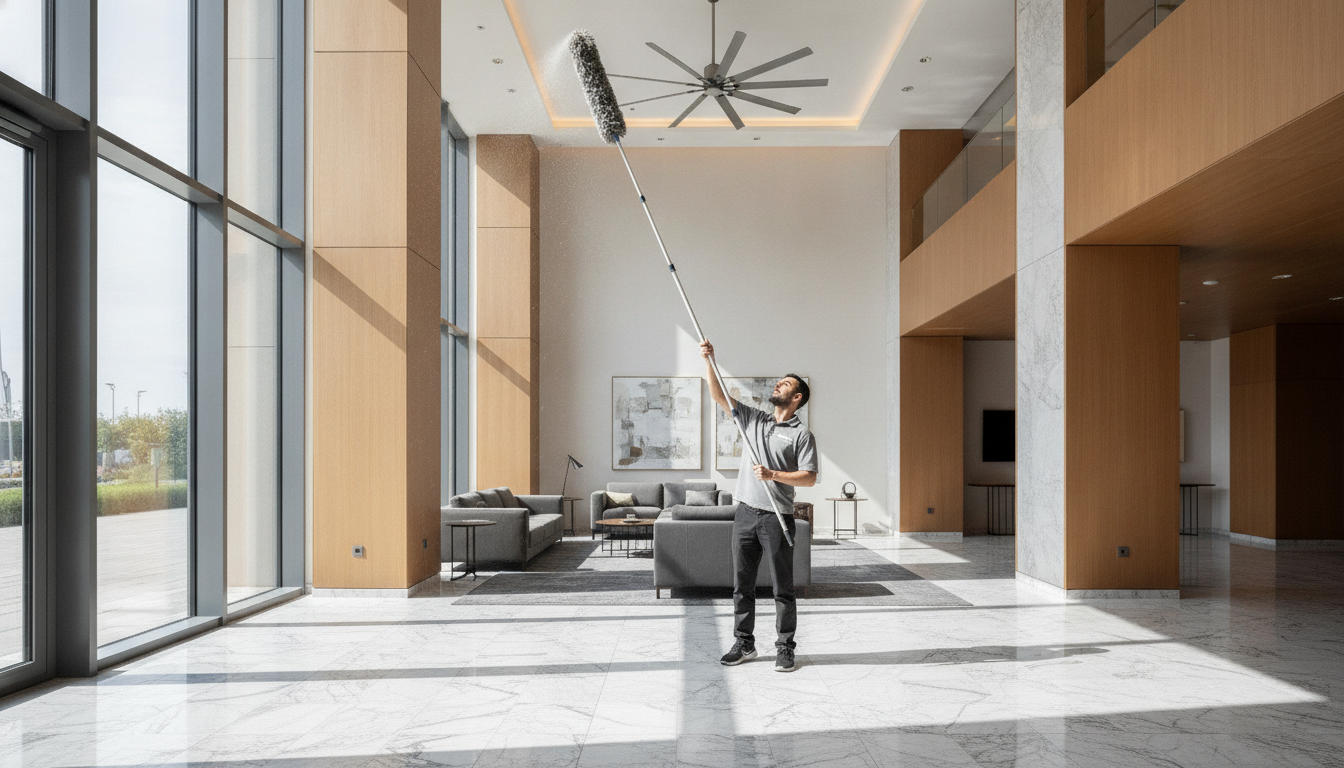
A telescopic ceiling fan duster is an extendable cleaning tool designed to reach high ceiling fans, cobwebs, and overhead surfaces without a ladder. For B2B buyers, distributors, wholesalers, and facility-management firms, the critical specs are pole rigidity when fully extended (typically 100-120 inches), head flexibility to conform to blade angles, washable microfiber or electrostatic heads for repeat use, and compatibility with accessory ecosystems. Factory-direct sourcing from Taizhou offers MOQ from 2 units for stock models and 500 units for private-label runs, with CE compliance for EU, UK, US, and Australian markets.
Key Takeaways
- Pole stability at full extension determines control on ceiling fans; commercial-grade telescopic dusters use stainless-steel or reinforced aluminum tubes to minimize wobble.
- Washable microfiber heads reduce replacement costs for facility buyers, but require proper drying time between uses to maintain shape and electrostatic properties.
- Factory-direct orders from Taizhou manufacturers start at 2 units for stock models and 500 units for private-label production, with CE certification included.
- Multi-use positioning, bendable heads that lock at angles, extends utility beyond ceiling fans to HVAC vents, blinds, and high corners in commercial properties.
- Export-ready packaging and compatibility with standard threaded poles (ACME or European thread) matter for distributors integrating dusters into existing cleaning-tool catalogs.
Why Pole Rigidity Matters for Ceiling Fan Cleaning
Wobble at full extension is the most common complaint about budget telescopic ceiling fan duster models. When a pole flexes or twists, the user loses precision on narrow fan blades, and dust falls instead of being captured. Commercial buyers need units that remain stable at 100+ inches.
Material and Wall Thickness
Stainless-steel tubing with 0.5mm wall thickness provides the best rigidity-to-weight ratio for poles extending beyond 8 feet. Aluminum alloy is lighter but requires thicker walls (0.7mm minimum) to prevent flex. Hollow fiberglass poles, common in retail kits, bend noticeably under side load and are unsuitable for professional use.
Locking Mechanism Design
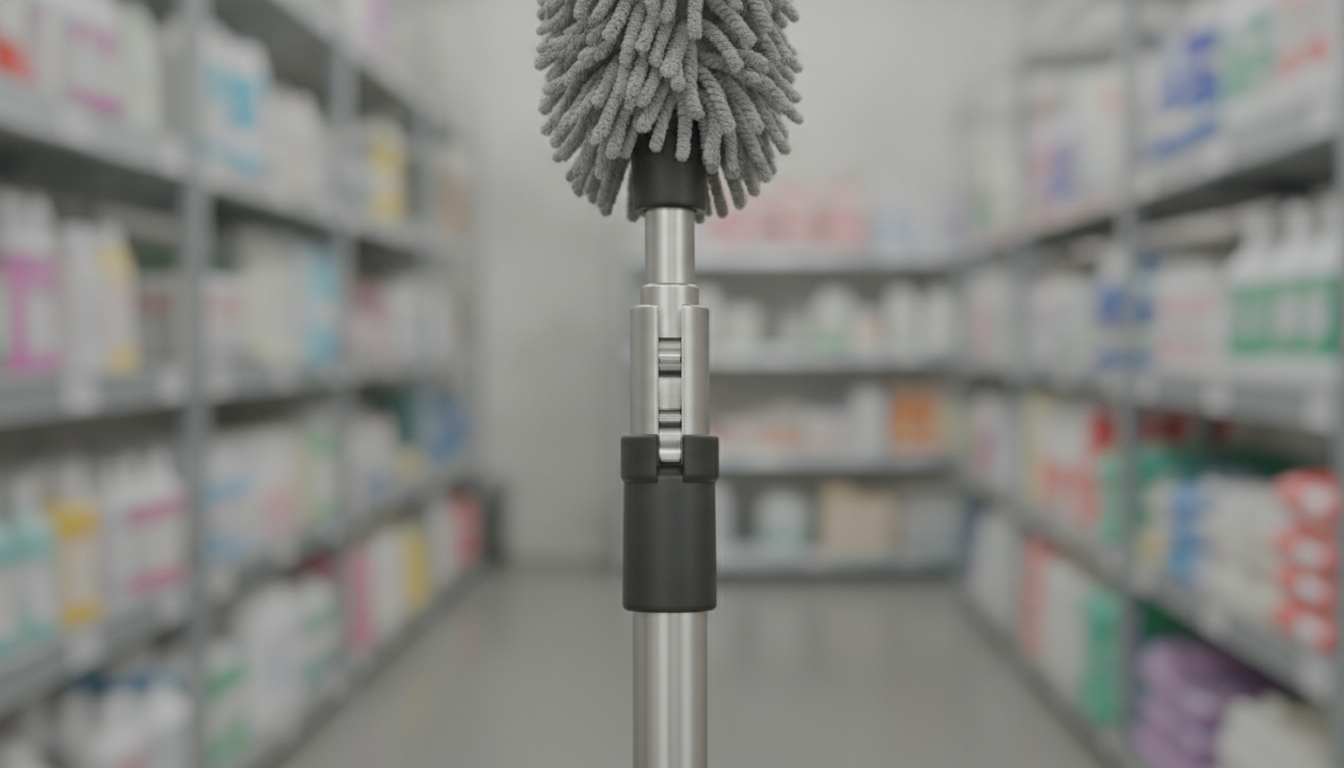
Twist-lock collars outperform push-button locks in maintaining rigidity because they compress the inner tube against the outer tube along the full circumference. Push-button designs create a single-point lock that allows rotational play. For facility buyers ordering in volume, twist-lock adds approximately 15-20% to unit cost but eliminates mid-task slippage.
Tested Extension Count
A three-section pole (collapsed 36 inches, extended 108 inches) balances reach and stability better than four- or five-section designs. Each additional joint introduces a flex point. Buyers targeting 12-foot ceilings should specify three-section poles rather than longer, more segmented alternatives.
Head Design for Blade Coverage and Dust Capture
The duster head must conform to the blade surface and trap dust rather than push it into the air. Facility managers report that rigid heads miss the leading and trailing edges of blades, requiring multiple passes.
Bendable vs. Fixed Heads
Bendable heads with a flexible wire core inside the microfiber sleeve allow the user to shape the duster to match blade curvature and ceiling corners. Fixed heads work only on flat surfaces. For commercial properties with mixed ceiling heights and fan styles, bendable heads reduce the need to stock multiple duster types.
Microfiber Density and Pile Length
High-density microfiber (300 grams per square meter or higher) with 10-12mm pile length captures fine dust and holds it electrostatically. Lower-density heads (below 250 g/m²) require a second pass or a damp wipe. Buyers should request microfiber weight specs during quotation, as many suppliers list only pile length.
Electrostatic vs. Feather-Style Heads
Electrostatic microfiber heads generate static charge through friction and hold dust without sprays. Feather-style heads (synthetic ostrich plumes) work well for cobwebs but lack the surface area to clean wide fan blades efficiently. Distributors serving both residential and commercial markets often stock both types, but facility buyers prioritize microfiber for repeatability.
Washable Head Economics and Replacement Cycles
Washable heads lower total cost of ownership for facility-management firms running daily or weekly ceiling-fan maintenance schedules. However, wash durability varies widely across suppliers.
Wash-Cycle Ratings
Commercial-grade microfiber heads rated for 50+ machine washes maintain electrostatic properties and shape. Budget heads lose pile integrity after 10-15 cycles. Buyers should specify wash-cycle ratings in RFQs and request third-party test reports that measure dimensional stability after repeated laundering cycles.
Drying Time and Backup Inventory
Microfiber heads require 4-6 hours of air drying to restore full fluffiness; tumble drying on high heat degrades fibers. Facility buyers operating multi-shift schedules need backup heads to maintain productivity. A three-head rotation (one in use, one drying, one clean and ready) supports continuous operations without downtime.
Replacement Head Availability
Proprietary head attachments lock buyers into single-source replacement purchases. Distributors should prioritize models with standard threaded mounts (ACME 3/4-inch or European M12 thread) that accept third-party heads. This flexibility protects against supplier discontinuation and allows buyers to mix head types on a single pole.
Multi-Use Positioning Beyond Ceiling Fans
A telescopic ceiling fan duster that serves only one task has limited appeal to facility buyers managing diverse cleaning needs. Bendable heads and accessory compatibility extend utility across HVAC, warehouse, and hospitality environments.
HVAC Vent and Duct Cleaning
Bendable heads lock at 45-degree and 90-degree angles to reach into ceiling vents and return-air grilles. Facilities with monthly HVAC maintenance schedules use the same duster for both fan blades and vent covers, reducing tool inventory. Buyers should confirm that the locking mechanism holds position under side load, as some designs slip when pressure is applied.
Warehouse High-Bay Lighting and Racking
In warehouse settings, telescopic dusters clean high-bay light fixtures and the tops of pallet racks where dust accumulates. The 100-120 inch reach eliminates the need for scissor lifts in aisles where overhead clearance is limited. Warehouses with strict safety protocols prefer ladder-free tools to reduce fall risk.
Hotel and Property Maintenance
Hotels use telescopic dusters for guest-room ceiling fans, lobby chandeliers, and corridor light fixtures. The ability to clean without moving furniture or setting up ladders shortens room turnover time. Property-maintenance firms serving multi-unit residential buildings cite the same efficiency gain.
Export-Ready Specs for EU, UK, US, and AU Compliance
B2B buyers importing telescopic ceiling fan dusters into regulated markets need documentation and design features that clear customs and meet retailer requirements.
CE Marking and RoHS Compliance
Buyers should confirm which directives apply to their specific model when selling in the EU and UK. The mark certifies that the product meets Low Voltage Directive (if motorized) and General Product Safety Directive requirements. RoHS restricts hazardous substances (lead, mercury, cadmium, hexavalent chromium, polybrominated biphenyls, polybrominated diphenyl ethers) to below 0.1% by weight in electrical components. Non-motorized dusters still require RoHS compliance if they include battery-powered features (LED lights, electrostatic charge generators). Suppliers should provide third-party test reports, not just a self-declaration.
Packaging and Labeling for Retail Channels
Distributors supplying big-box retailers face specific packaging requirements: barcodes (EAN-13 for Europe, UPC-A for North America), multi-language safety instructions, and frustration-free packaging (minimal plastic clamshells). Factory-direct suppliers in Taizhou offer private-label packaging from 500-unit orders, allowing buyers to add their brand, contact information, and retailer-compliant labels without a separate fulfillment step.
Thread Standards for Accessory Compatibility
North American cleaning-tool ecosystems use ACME 3/4-inch threaded poles (0.75-inch diameter, 5 threads per inch). European systems use metric threads, typically M12 or M16. Buyers stocking multiple pole-mounted tools (window squeegees, cobweb removers, paint rollers) need dusters with interchangeable thread adapters. Suppliers should clarify whether adapters are included or sold separately.
Sourcing Considerations for Distributors and Wholesalers
Factory-direct sourcing from Taizhou, Zhejiang, China’s household cleaning-tool manufacturing hub, offers cost and customization advantages, but buyers must verify production capacity, quality consistency, and export documentation.
MOQ and Lead Time
Stock models of telescopic ceiling fan dusters typically carry MOQ from 2 units, allowing distributors to test market demand before committing to container volumes. Private-label production starts at 500 units, with lead times confirmed at quotation based on current factory schedules. New-mold OEM projects (custom head shapes, proprietary locking mechanisms) require tooling investment and longer timelines, quoted per project.
Factory Inspection and Audit Reports
Buyers placing initial orders above 1,000 units should request a factory audit report (BSCI, Sedex, or equivalent) or conduct a virtual facility tour. Key inspection points include raw-material storage (microfiber rolls should be stored in climate-controlled areas to prevent moisture absorption), assembly-line organization (each joint should be torque-tested before packaging), and finished-goods QC (random pull-testing of locking collars). Suppliers resistant to transparency present elevated risk.
Sample Evaluation Protocol
Request samples with the exact specifications intended for production: pole material, wall thickness, head density, and thread type. Test at full extension with a 2-kilogram weight suspended from the head to simulate the load of a wet microfiber sleeve. Measure deflection at the midpoint; acceptable flex is under 15mm at 100-inch extension. Wash the head five times and inspect for pilling, shrinkage, and loss of electrostatic grip.
In practice: A Dutch online seller shortlisted the adjustable magnetic range as a high-margin cleaning line for bol.com, and during the same inquiry asked about telescopic duster compatibility with the existing pole ecosystem in their catalog.
Durability Testing for Commercial Use
Facility-management firms and cleaning contractors subject tools to higher cycle counts than residential users. A duster that performs well in a home may fail within weeks in a commercial setting.
Extension-Cycle Testing
Commercial-grade poles should withstand 500+ extension and retraction cycles without collar wear or thread stripping. Buyers can request cycle-test data from suppliers or conduct accelerated testing in-house: extend and collapse the pole 50 times, then inspect locking collars for burrs, cracks, or looseness. Any degradation within 50 cycles indicates substandard materials.
Head Attachment Strength
The connection between the head and pole must survive repeated impacts (bumping into ceiling joists, fan-motor housings, light fixtures). Threaded attachments should torque to at least 5 Newton-meters without stripping. Friction-fit heads (push-on, no threads) often dislodge during use and are unsuitable for professional applications.
Corrosion Resistance for Humid Environments
Facilities in coastal regions or high-humidity climates (laundries, pool enclosures, greenhouses) need stainless-steel poles rather than aluminum, which corrodes when exposed to salt air or chlorine vapors. Buyers should specify 304-grade stainless steel or higher; 201-grade stainless is less expensive but rusts in harsh environments.
Cost Structure and Pricing Transparency
Factory-direct pricing eliminates distributor markups, but buyers must understand the components that drive unit cost to negotiate effectively and avoid low-quality traps.
Material Cost Breakdown
Stainless-steel tubing accounts for 40-50% of total material cost in a commercial-grade telescopic duster. Microfiber head material and stitching add another 20-25%. Locking collars, thread adapters, and packaging make up the remainder. Suppliers offering prices significantly below market averages often substitute lower-grade steel (201 instead of 304) or reduce microfiber density (200 g/m² instead of 300 g/m²).
Private-Label and Customization Premiums
Private-label packaging (custom printed boxes, hang tags, instruction inserts) adds per-unit cost that scales with order volume. At 500-unit MOQ, private-label premiums range from cost-plus-packaging to integrated branding; at 2,000+ units, the per-unit increment drops as setup costs amortize. Custom head colors or logo embroidery on microfiber sleeves require minimum quantities confirmed during quotation.
Shipping and Incoterms
Telescopic dusters ship collapsed, reducing cubic volume, but poles are long and awkward to pack efficiently. Container capacity is confirmed at quotation depending on pole length and packaging style. FOB Ningbo is the standard Incoterm for Taizhou exports; buyers should clarify whether quoted prices include domestic trucking from factory to port. EXW pricing shifts all logistics responsibility to the buyer and is common for small sample orders.
Integrating Dusters Into a Cleaning-Tool Catalog
Distributors and wholesalers adding telescopic ceiling fan dusters to existing catalogs should consider product adjacency, cross-sell opportunities, and inventory turnover.
Bundling With Window and Surface Tools
Buyers purchasing magnetic window cleaners, squeegees, or microfiber mops often need overhead cleaning tools to complete their kit. Bundling a telescopic duster with a window-cleaning set increases average order value and positions the distributor as a one-stop supplier. Our 6,500 m² Taizhou factory produces magnetic window cleaners (50,000+ units per day), squeegees, and dusters under the Fonoran brand, allowing buyers to source multiple product lines with consistent quality and unified logistics.
Seasonal Demand Patterns
Ceiling-fan cleaning peaks in spring (pre-cooling-season maintenance) and autumn (post-summer dust accumulation). Distributors should plan inventory to support these demand spikes without overcommitting warehouse space during off-peak months. Stock models with 2-unit MOQ allow just-in-time replenishment; private-label buyers should place spring orders by January to ensure production and shipping complete before March.
Training and Support Materials
Retailers and facility buyers appreciate suppliers who provide end-user training content: video demonstrations of proper extension technique, washing instructions for microfiber heads, and troubleshooting guides for common issues (collar slippage, head detachment). Suppliers offering co-branded training materials differentiate themselves in competitive tenders.
Common Pitfalls in Telescopic Duster Procurement
B2B buyers new to telescopic ceiling fan duster sourcing encounter recurring issues that delay projects or result in unsellable inventory.
Overestimating Reach Requirements
Buyers sometimes specify 120-inch or longer poles to cover every possible ceiling height, but poles beyond 110 inches become unwieldy for average users. Facility workers report that 100-108 inch poles handle 95% of commercial ceiling fans (8-10 foot ceilings) and are easier to store and transport. Offering two SKUs (100-inch standard, 120-inch extended) serves most markets without overstocking slow-moving sizes.
Ignoring Head Replacement Availability
A duster with a proprietary head attachment becomes obsolete when the supplier discontinues the model or goes out of business. Buyers should confirm that replacement heads are stocked separately and available for at least three years post-purchase. Standard-thread heads eliminate this risk entirely.
Underestimating Packaging Dimensions
Collapsed poles are still 36-40 inches long, which exceeds standard parcel dimensions for some courier services. Buyers planning e-commerce fulfillment should verify that their 3PL or fulfillment center can handle long, narrow packages without dimensional-weight penalties. Split packaging (pole in one box, heads in another) increases shipping cost but may be necessary for certain logistics networks.
Frequently Asked Questions
What pole length do I need for 10-foot ceilings?
A 100-inch (8.3-foot) telescopic pole reaches 10-foot ceilings comfortably when the user stands on the floor and extends their arm overhead, adding approximately 7 feet of combined reach. For users of average height (5’6″ to 6’0″), a 100-inch pole covers ceilings up to 10.5 feet without a step stool. Taller ceilings (11-12 feet) require 110-120 inch poles, but these are harder to control at full extension and should be reserved for specialized high-ceiling applications.
How do I prevent dust from falling during ceiling-fan cleaning?
High-density microfiber heads (300 g/m² or higher) with electrostatic properties trap dust instead of pushing it into the air. Clean from the center of the blade outward in a single smooth motion rather than scrubbing back and forth. For heavily soiled fans, lightly mist the microfiber head with water (not the fan blades) to increase dust adhesion. Some facility teams place a drop cloth or plastic sheeting on the floor beneath the fan to catch any fallout, then vacuum the cloth afterward.
Can the same duster clean cobwebs and ceiling fans?
Yes, if the head is bendable and the microfiber density is high enough. Cobwebs require the duster to reach into corners and conform to irregular surfaces, which bendable heads handle well. However, cobweb removal is a light-duty task, while ceiling-fan cleaning demands more surface area and dust-holding capacity. A single duster can serve both purposes, but facility buyers running dedicated cleaning schedules often prefer separate tools to avoid cross-contamination (cobwebs carry more dirt and insects) and to maintain microfiber head lifespan.
Are washable microfiber heads more cost-effective than disposable options?
Washable heads rated for 50+ cycles cost more upfront but deliver lower total cost of ownership for facility buyers running regular cleaning schedules. A washable head priced at cost-per-unit lasts through 50+ cleaning sessions, while disposable heads (typically lower-density microfiber or paper-based) are used once and discarded. The break-even point is around 10-15 cleaning cycles, after which washable heads generate savings. However, washable heads require drying time (4-6 hours) and backup inventory, so buyers must plan for a three-head rotation to maintain continuous operations.
Ready to source telescopic ceiling fan dusters factory-direct? Our Taizhou facility produces household cleaning tools with CE certification (WUX202105142249ENC), MOQ from 2 units for stock models and 500 units for private label. Browse our product range or request a quotation with your specifications, target markets, and volume requirements.
Written by the Fonoran Export Team.