Magnetic Strength for 20-30mm Thick Glass: Complete Guide

The magnetic strength for 20-30mm thick glass requires adjustable force settings in the range of 5-35mm or 8-40mm SKUs, depending on your exact glass thickness. For 20mm double-pane units, the 5-35mm adjustable SKU provides sufficient holding power; for 25-30mm insulated glazing, the 8-40mm SKU delivers the necessary magnetic force without excessive snap-together behavior that makes operation difficult.
Key Takeaways
- Adjustable magnetic force across 6 stages prevents both slippage on thick glass and jerky movement that fixed-strength models cause.
- Double-glazed windows in commercial buildings typically measure 20-28mm total thickness, placing them within the 5-35mm or 8-40mm SKU range.
- Buyers report that cleaners rated for thin glass (5-12mm) detach when used on modern double glazing, creating fall hazards on high-rise facades.
- NdFeB magnets maintain consistent pull force across the 20-30mm range, while ferrite magnets lose grip beyond 15mm in most designs.
- CE-certified units include drop-prevention safety cords, which matter most when magnetic force is borderline for the installed glass thickness.
Why Glass Thickness Determines Magnetic Force
Magnetic force drops exponentially as the air gap between opposing magnets increases. A cleaner tuned for 6mm single-pane glass generates roughly 8-12 kilograms-force at that distance. Separate those same magnets by 25mm of insulated double glazing and the holding force falls below 2 kilograms-force, insufficient to support the weight of the external cleaning pad plus water and friction during vertical movement.
Three factors govern whether a given magnetic strength suits 20-30mm glass:
- Total glass thickness: Measure the combined thickness of both panes plus the air gap or argon-filled cavity. A 4mm outer pane, 16mm cavity, and 4mm inner pane total 24mm.
- External unit weight: Heavier cleaning pads with larger surface area require proportionally stronger magnets to prevent downward slip.
- Pane angle and wind exposure: Vertical facades and high-rise installations demand higher safety factors than ground-level windows at slight angles.
Buyers encounter products whose stated thickness ratings do not work with newer, thicker double glazing. A unit marked ‘5-12mm’ may hold securely on single panes but detaches within seconds when applied to 20mm insulated glass, because the manufacturer tested only the minimum specification.
Adjustable vs Fixed Magnetic Force
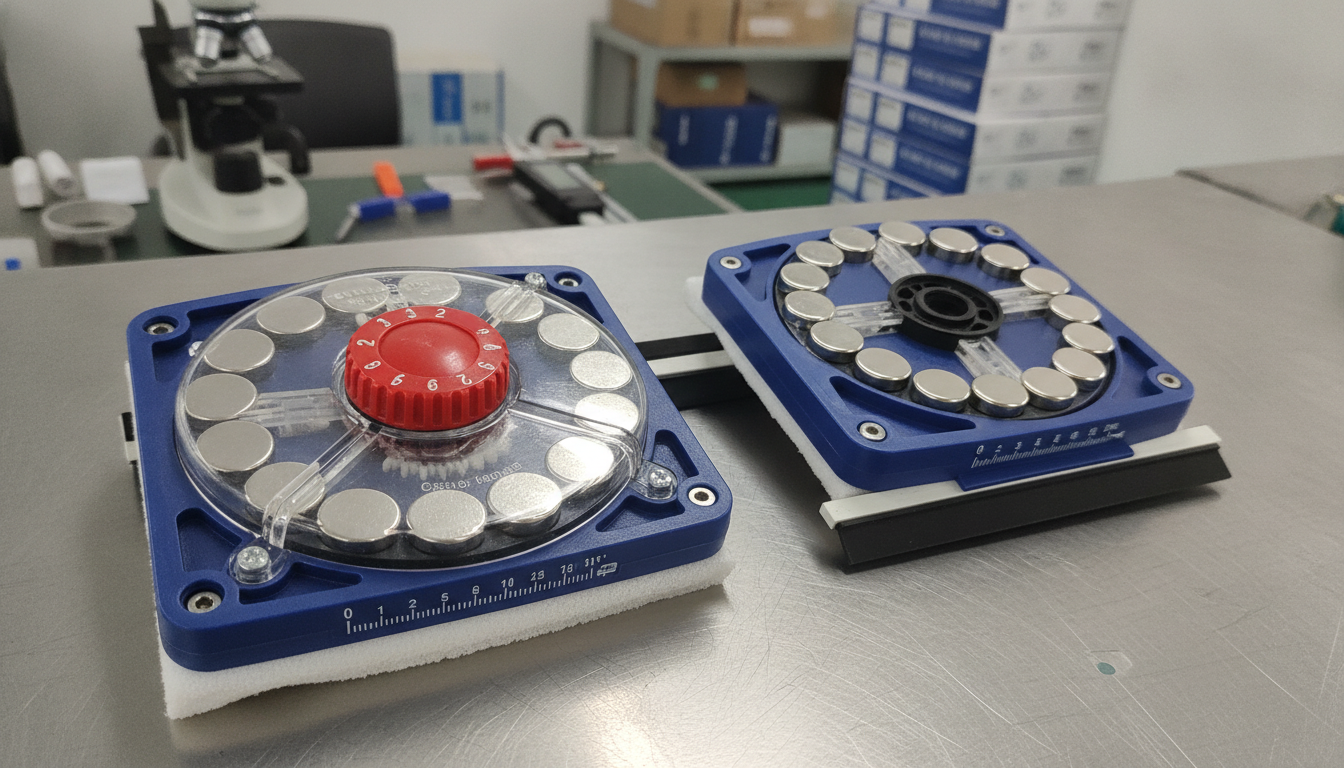
Fixed-strength magnetic cleaners optimize for one thickness band. Adjustable models use a sliding mechanism or rotating dial to vary the effective magnetic gap, accommodating a range of glass thicknesses with a single unit.
Adjustable models suit distributors serving mixed commercial and residential accounts, because a single product line addresses both 18mm residential double glazing and 28mm commercial insulated units. Fixed-strength models remain common in budget retail channels where buyers self-select by stated thickness range.
Selecting the Right SKU for 20-30mm Glass
Four adjustable SKU ranges cover the spectrum from single panes to thick insulated glazing: 3-30mm, 5-35mm, 8-40mm, and 10-45mm. For magnetic strength for 20-30mm thick glass, two SKUs apply.
5-35mm Adjustable SKU
This SKU spans the majority of residential and light-commercial double glazing. A 20mm insulated unit sits comfortably in the middle of the adjustment range, allowing the operator to dial in enough force to prevent slip without making lateral movement stiff. The 5-35mm range uses NdFeB magnets and a 6-stage adjustment dial.
Typical applications include:
- Residential double glazing: 4mm + 12mm air gap + 4mm (20mm total)
- Office curtain walls: 6mm + 16mm cavity + 6mm (28mm total)
- Retail storefronts: 5mm + 14mm argon gap + 5mm (24mm total)
8-40mm Adjustable SKU
This SKU addresses thicker commercial insulated glazing and provides a safety margin when glass thickness approaches 30mm. The stronger magnet assembly generates higher pull force at maximum adjustment, which matters on vertical high-rise facades where wind pressure and water weight add dynamic loads. The 8-40mm SKU also uses NdFeB magnets with 6-stage adjustment.
Typical applications include:
- High-rise office towers: 8mm tempered + 18mm cavity + 8mm (34mm total, though 30mm is more common)
- Acoustic double glazing: 6mm + 20mm cavity + 8mm laminated (34mm total)
- Retrofit installations: Where exact thickness is uncertain and a higher-force unit provides operational confidence
Buyers in Germany with 36mm insulated glass needed an adjustable magnetic window cleaner; 36mm sits inside the 10-45mm SKU with room to spare, though 30mm and below remain far more common in both residential and commercial construction.
Pull-Force Specifications and Testing
Marketing thickness ranges tell buyers which glass the unit fits. Pull-force specifications, measured in Newtons or kilograms-force, quantify the actual holding power at minimum, midpoint, and maximum adjustment settings.
A rigorous factory test protocol measures pull force at three points within each SKU range:
- Minimum thickness: 5mm for the 5-35mm SKU, confirming the unit does not generate excessive snap-together force on thin glass
- Midpoint thickness: 20mm for the 5-35mm SKU, representing the most common residential double-glazing specification
- Maximum thickness: 35mm for the 5-35mm SKU, verifying the unit maintains sufficient grip at the upper limit
Importers sourcing for facility-management contracts should request these three data points in writing before placing volume orders. A supplier that cannot provide pull-force numbers likely relies on competitor teardowns rather than in-house testing, raising the risk that batch-to-batch magnet variance will cause field failures.
In practice: Magnetic force has to match glass thickness, because a unit tuned for thin single glazing loses its grip across a thick double-glazed pane.
Magnet Material and Long-Term Performance
Two magnet materials dominate the magnetic window cleaner market: NdFeB (neodymium-iron-boron) and ferrite. Material choice directly affects pull force at 20-30mm distances and long-term magnetic stability.
NdFeB Magnets
NdFeB magnets deliver the highest energy product of any permanent-magnet material, generating strong pull force even across wide air gaps. Every Fonoran adjustable SKU from 5-35mm through 10-45mm uses NdFeB magnets to maintain grip on thick insulated glass. NdFeB resists demagnetization under normal use, though prolonged exposure above 80°C can cause permanent loss. Window cleaning rarely approaches this temperature, so thermal demagnetization is not a field concern.
The primary operational advantage: an NdFeB-based 5-35mm unit generates sufficient force at 25mm to support a 1.2-kilogram external pad plus water film and friction, while a ferrite unit of the same size would require the operator to press inward continuously to prevent downward slip.
Ferrite Magnets
Ferrite magnets cost less and resist corrosion without plating, but deliver roughly one-third the energy product of NdFeB. Ferrite works well in fixed-strength cleaners designed for thin single-pane glass (3-8mm), where the short magnetic gap allows even a weaker material to generate adequate holding force. The FN-Classic 3-8mm SKU uses ferrite magnets because the application does not require the expense of NdFeB.
Ferrite loses effectiveness beyond 15mm in most cleaner geometries. Buyers report that ferrite-based units marketed for ‘5-24mm’ glass work acceptably at 12mm but slip frequently at 20mm, particularly during vertical strokes.
Safety Factors and Drop Prevention
The external cleaning unit becomes a falling object if magnetic force proves insufficient. High-rise window cleaning introduces liability exposure that ground-level residential use does not.
Three design features mitigate drop risk:
- Safety cord: A tether connecting the internal and external units catches the external pad if magnetic grip fails. CE-certified models include this cord as standard equipment.
- Adjustable force with visual indicators: A numbered dial or color-coded adjustment mechanism helps operators select the correct setting for measured glass thickness, reducing the chance of under-tuning.
- Grip-loss warning: Some models include a friction indicator or audible click when the external unit begins to slip, giving the operator time to increase magnetic force before full detachment occurs.
Facility-management firms purchasing for high-rise contracts should verify that the supplier’s CE certificate covers the specific SKU being quoted. A factory may hold CE certification for one model while selling additional SKUs that have not undergone third-party testing. Fonoran’s CE certificate (Shenzhen Wuxiang Testing, certificate WUX202105142249ENC) applies to the full magnetic window cleaner product range, including all four adjustable SKUs.
Common Buyer Mistakes with 20-30mm Glass
Procurement errors at the specification stage create field problems that surface only after installation.
Ordering Based on Single-Pane Thickness
Buyers measure one pane of a double-glazed window and order a cleaner rated for that single-pane thickness. A 6mm outer pane plus a 6mm inner pane totals 12mm of glass, but the air gap between them adds another 12-20mm. The actual thickness the magnet must span is 24-32mm, not 12mm. This error leads to units that arrive, fail to grip, and require return shipping.
Ignoring Low-E Coatings
Low-emissivity coatings on insulated glazing consist of thin metallic layers that reflect infrared radiation. These coatings do not meaningfully affect magnetic permeability at the thicknesses used (typically 10-50 nanometers), so they do not interfere with magnetic window cleaners. Buyers occasionally assume the metallic layer will block the magnetic field and avoid magnetic cleaners entirely, when in fact the coating has no operational impact.
Choosing Excessive Magnetic Strength
A unit rated for 10-45mm glass will work on 20mm double glazing, but the operator must keep the adjustment dial at the low end of the range. If the dial is left at maximum, the magnets snap together with enough force to make lateral movement jerky and tiring. The tool can feel difficult to control, and operators may assume the product is defective when the actual issue is over-tuning. Buyers should match the SKU range to the installed glass thickness rather than ordering the highest-capacity model available.
Procurement Criteria for Distributors
Distributors selling into facility-management and window-cleaning contractor channels should evaluate suppliers on six technical and commercial criteria.
- Pull-force test data: Request written specifications showing force in Newtons or kilograms at minimum, midpoint, and maximum thickness for the SKU you plan to stock.
- Batch consistency: Ask how the factory controls magnet strength variance. Reputable manufacturers test every production batch and reject lots that fall outside tolerance.
- Certification scope: Confirm the CE certificate (or other mark required in your market) lists the exact model number you are quoting. Generic certificates that do not name specific products offer no compliance assurance.
- MOQ and lead time: Fonoran’s MOQ starts from 2 units for stock models, allowing distributors to test the market before committing to container volumes. Private-label programs require 500 units minimum.
- After-sales support: Verify the supplier provides replacement parts (cleaning pads, safety cords, adjustment mechanisms) separately, so end users can extend product life without discarding the entire unit.
- Warranty terms: Standard terms cover manufacturing defects for 12 months. Clarify whether magnetic-strength degradation falls under warranty or is considered wear-and-tear.
A wholesale magnetic window cleaner program that includes technical data sheets and operator training materials reduces the support burden on your internal team, because contractors can self-serve for glass-thickness selection and adjustment-dial settings.
Regional Glazing Systems and Magnetic Compatibility
Double-glazing specifications vary by climate zone and building code, affecting which magnetic-cleaner SKU suits each market.
United Kingdom and Northern Europe
UK building regulations favor double glazing with U-values below 1.4 W/m²K, typically achieved with 4mm panes and 16-20mm cavities filled with argon gas. Total thickness commonly falls between 24mm and 28mm. The 5-35mm adjustable SKU covers this range with margin for variation. Laminated inner panes, required in some security applications, add 1-2mm but remain within the SKU span.
North America
ENERGY STAR guidelines in the United States and Canada drive adoption of low-E coatings and gas fills, but pane thickness and cavity width vary more widely than in Europe. Residential double glazing ranges from 18mm to 28mm, while commercial curtain walls can reach 32mm. Distributors serving both segments should stock the 5-35mm SKU for residential accounts and the 8-40mm SKU for commercial high-rise projects.
Australia and Middle East
Hot-climate double glazing prioritizes solar-heat rejection over thermal insulation. Low-E coatings face outward, and cavities are often narrower (12-16mm) to reduce material cost where heating load is minimal. Total thickness typically measures 20-24mm, well within the 5-35mm SKU range. The Australian market also sees significant use of tinted glass, which does not affect magnetic permeability.
Operational Best Practices for 20-30mm Glass
Correct adjustment and technique extend product life and reduce the risk of external-unit detachment.
Setting Initial Magnetic Force
Measure total glass thickness with a caliper or ruler before first use. Set the adjustment dial to the corresponding position: for 24mm glass on a 5-35mm unit, start at position 3 or 4 on a 6-stage dial. Wet both sides of the glass with cleaning solution, then position the external unit against the outer pane and bring the internal unit into contact. The magnets should engage firmly without snapping together abruptly. If lateral movement feels stiff, reduce the force setting by one notch. If the external unit slides downward under its own weight, increase force by one notch.
Vertical vs Horizontal Strokes
Vertical strokes on tall windows require higher magnetic force than horizontal strokes, because gravity pulls the external unit downward throughout the stroke. Operators cleaning high-rise facades should set force one notch higher than the minimum required for horizontal movement, then test on a small section before committing to a full window.
Maintenance and Magnetic-Strength Checks
Magnetic strength does not degrade under normal use, but cleaning-pad wear and frame damage can create gaps that reduce effective holding force. Inspect the pad surface monthly for embedded grit or torn microfiber, both of which prevent flush contact and allow the external unit to tilt. Replace pads when the microfiber loses its texture or the foam backing compresses. Check the safety cord for fraying at the same interval.
Comparing Magnetic Cleaners to Alternative Methods
Magnetic window cleaners compete with water-fed poles, squeegees on extension poles, and rope-access systems for exterior glass cleaning. Each method suits different building types and glass thicknesses.
Magnetic cleaners eliminate the need for scaffolding, ladders, or harnesses on buildings up to four stories, making them the most cost-effective solution for residential and light-commercial properties with 20-30mm double glazing. Water-fed poles require ground-level access around the building perimeter and leave the interior pane uncleaned. Rope-access systems suit high-rise towers but require certified operators and liability insurance that small contractors cannot afford.
Frequently Asked Questions
Can one magnetic cleaner work on both 15mm and 30mm glass?
Yes, adjustable models with 6-stage force settings cover wide thickness ranges. The 5-35mm SKU accommodates both 15mm and 30mm glass by allowing the operator to dial in the appropriate magnetic strength for each application. Fixed-strength models optimized for 15mm will not generate sufficient holding force at 30mm, so adjustable units are essential for distributors serving mixed accounts.
Do low-E coatings interfere with magnetic window cleaners?
No, low-emissivity coatings consist of metallic layers only 10-50 nanometers thick, far too thin to affect magnetic permeability. Magnetic fields pass through low-E glass with the same strength as uncoated glass of the same thickness. Buyers can use magnetic cleaners on low-E double glazing without operational concerns, provided the total glass thickness including the air gap falls within the cleaner’s rated range.
How do I verify pull-force claims before ordering in volume?
Request written test data showing force in Newtons or kilograms-force at minimum, midpoint, and maximum thickness for the specific SKU. A supplier that provides these three data points likely conducts in-house testing and can demonstrate batch consistency. Order samples and measure pull force with a spring scale or force gauge at your target glass thickness before committing to container volumes. Reputable factories welcome this verification step and provide test protocols on request.
What happens if I use a 10-45mm SKU on 20mm glass?
The unit will function, but the operator must keep the adjustment dial at the lowest setting to avoid excessive magnetic force. If the dial is left at maximum, the magnets will snap together abruptly and make lateral movement stiff and jerky. This does not damage the glass but makes the tool tiring to operate. Matching the SKU range to the installed glass thickness provides better control and a smoother cleaning experience.
Magnetic strength for 20-30mm thick glass requires careful SKU selection and adjustment-dial tuning to balance holding force against operational smoothness. Fonoran’s 6,500m² Taizhou facility produces adjustable magnetic window cleaners across four SKU ranges, with the 5-35mm and 8-40mm models addressing the majority of residential and commercial double-glazing specifications. Our 60+ skilled workers ship 50,000+ units per day to distributors in 60+ countries, with MOQ from 2 units for stock models and 500 units for private-label programs. Every unit includes CE certification (Shenzhen Wuxiang Testing, certificate WUX202105142249ENC) and a drop-prevention safety cord as standard equipment. Request a technical data sheet and MOQ quote for your target glass thickness, or review the full adjustable magnetic cleaner range to identify the SKU that matches your market requirements.
Written by the Fonoran Export Team.