Which Magnetic Window Cleaner Works Best for Triple Glazed Windows?

No standard magnetic window cleaner works reliably on triple glazed windows because triple-pane units typically measure 32-48mm total thickness, far exceeding the 20-28mm range most adjustable models handle. The outer magnet loses grip mid-clean and falls when the glass exceeds the tool’s rated thickness. Only cleaners specifically engineered for 30mm+ insulated glazing, with stronger neodymium magnets and wider adjustment ranges, maintain coupling through thick triple-pane assemblies common in German passive-house and KfW-certified buildings.
Key Takeaways
- Triple-glazed windows in Germany commonly measure 36-44mm total thickness when accounting for three panes of glass plus two insulating cavities filled with argon or krypton gas.
- Magnetic window cleaners lose grip when the glass thickness exceeds the tool’s effective magnetic coupling range, causing the exterior unit to detach and fall during cleaning.
- Adjustable-force models designed for thick insulated glazing use neodymium magnets to maintain attraction across wide air gaps, while basic ferrite-magnet tools work only on thin single-pane glass.
- Safety tethers prevent the outer unit from falling to the ground but do not solve the operational interruption when the magnet detaches mid-stroke.
- Professional window-cleaning contractors serving commercial buildings with triple glazing typically use water-fed poles or rope-access systems rather than magnetic tools.
- Buyers in the EU should verify that any magnetic cleaner carries a valid CE mark with third-party test documentation covering mechanical safety and materials compliance before placing bulk orders.
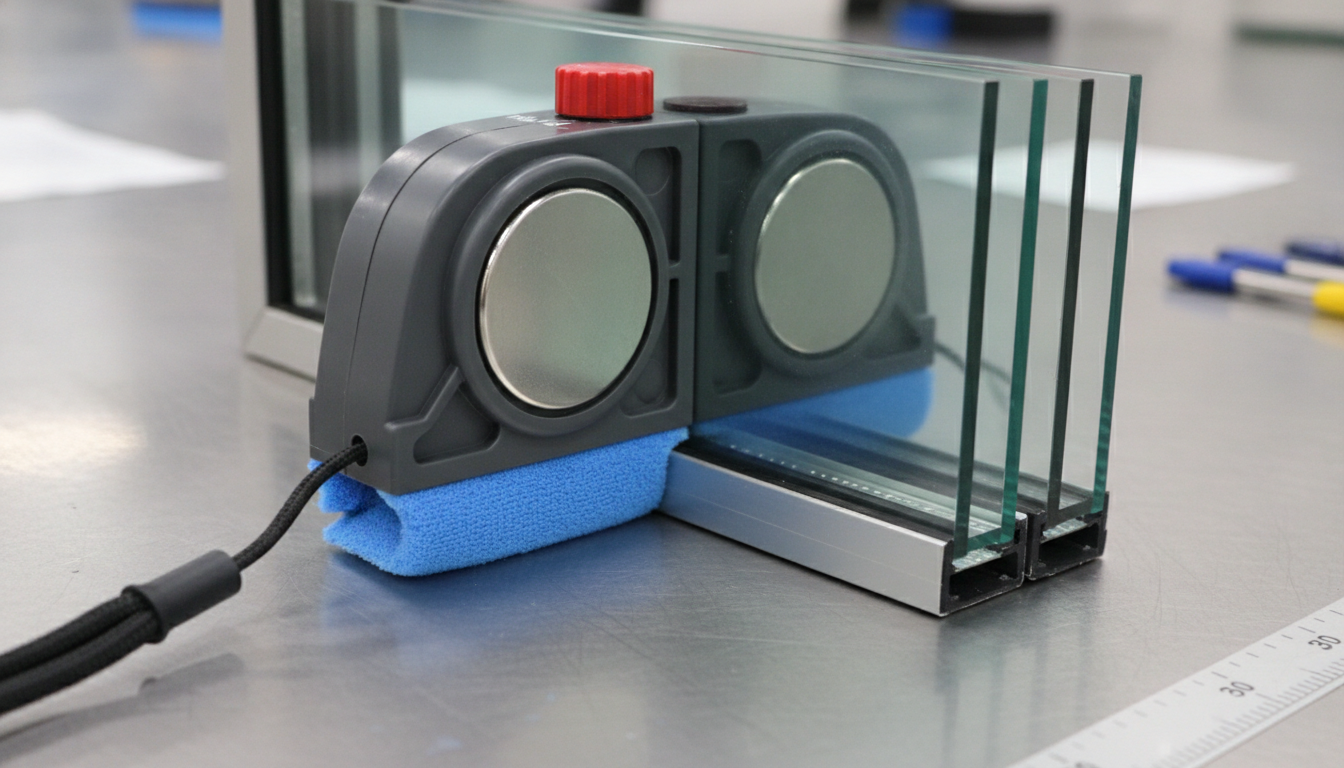
Why Triple Glazing Breaks Standard Magnetic Cleaners
Triple-glazed windows are engineered for thermal insulation and sound dampening, not for easy exterior cleaning. The assembly stacks three panes of glass separated by two sealed cavities, each filled with inert gas. Total unit depth depends on pane thickness and cavity width, but passive-house-certified triple glazing in Germany typically measures 36mm or more from outer surface to inner surface. Standard magnetic window cleaners are rated for much thinner assemblies.
Glass Pane and Cavity Dimensions
Each glass pane in a triple-glazed unit is usually 4mm thick, contributing 12mm to the total. The two cavities between panes are each 12-16mm wide, adding another 24-32mm. Low-emissivity coatings and warm-edge spacers add negligible thickness but do affect magnetic permeability slightly. The combined assembly often reaches 40-44mm, well beyond the 20-28mm maximum that most adjustable magnetic cleaners can bridge.
Magnetic Coupling Distance
Magnetic attraction weakens with the square of distance. A cleaner that holds firmly across 20mm of double glazing may generate only 30-40% of that force at 40mm. When the exterior unit’s weight exceeds the diminished magnetic pull, the coupling breaks and the outer half slides down or falls away. The interior operator feels the resistance vanish mid-stroke, and cleaning stops until the units are re-aligned.
Argon and Krypton Gas Fill
Triple-glazed units are filled with argon or krypton gas to reduce convective heat transfer. These gases are non-magnetic and do not directly interfere with magnetic fields, but the wider cavity they occupy increases the air gap the magnet must span. A 16mm argon-filled cavity presents the same magnetic challenge as 16mm of air; the gas itself is irrelevant, but the physical separation is the limiting factor.
What Glass Thickness Actually Means for Magnetic Cleaners
Buyers often confuse pane thickness with total unit thickness. A product rated for ‘8mm glass’ does not mean it works on an 8mm-thick window assembly; it means the tool is designed for a single 8mm pane with no insulating cavity. When evaluating a magnetic window cleaner for triple glazed windows, the critical specification is the maximum total unit depth the magnet can bridge, not the thickness of any individual pane.
How to Measure Total Unit Thickness
Place a straight edge or ruler perpendicular to the window surface. Measure from the outer face of the exterior pane to the inner face of the interior pane. This dimension includes all three glass layers and both sealed cavities. If the window is already installed and you cannot access the edge, consult the building specification sheet or the window manufacturer’s data plate, which typically lists the insulated-glazing-unit (IGU) makeup as a formula such as ‘4-16-4-16-4’ (three 4mm panes separated by two 16mm cavities, totaling 44mm).
Why Adjustable Force Matters
Adjustable magnetic cleaners allow the operator to increase or decrease the attractive force by repositioning internal magnet blocks or rotating a dial. Higher force settings prevent detachment on thick glass but make the tool harder to slide smoothly. Lower settings reduce friction on thin glass but risk losing grip. For triple glazing, the cleaner must offer enough adjustment headroom to maintain secure coupling at 35-45mm without requiring excessive effort to move the units across the pane.
Magnet Material: NdFeB vs Ferrite
Neodymium-iron-boron (NdFeB) magnets deliver higher magnetic flux density than ceramic ferrite magnets of the same size. A cleaner using NdFeB magnets can maintain attraction across a thicker air gap, making neodymium the preferred material for insulated double glazing and essential for any attempt at triple glazing. Ferrite-magnet tools are limited to thin single-pane applications and will not couple reliably beyond 10-12mm total thickness.
In practice: A home user in Germany with 36mm insulated glass needed an adjustable magnetic window cleaner; 36mm sits inside certain high-capacity SKU ranges with room to spare, but standard models would not bridge that gap.
Which Models Claim Triple-Glazing Compatibility
Several brands market adjustable magnetic cleaners with upper thickness limits of 35-40mm. These tools are designed primarily for thick insulated double glazing but are sometimes promoted as suitable for triple-pane units. Real-world performance depends on whether the actual installed triple-glazing thickness falls within the tool’s rated range and whether the magnet strength remains sufficient at the upper limit.
Claimed Thickness Ranges
Products advertised as ‘universal’ or ‘for single, double and triple glazing’ often specify a range such as 2-40mm or 5-35mm. The lower bound accommodates thin single panes; the upper bound is intended for thick double-glazed or slim triple-glazed assemblies. A 40mm maximum will handle some triple-glazing configurations but not the 44-48mm units common in German KfW 40 and passive-house projects.
Adjustable-Force Mechanisms
Higher-end models use a rotating dial or sliding lever to reposition internal magnet arrays. Increasing the setting moves the magnets closer to the glass surface or stacks additional magnet elements in series, boosting the field strength. This adjustability is critical for triple glazing, where a fixed-force tool optimized for 20mm double glazing will either fail to couple at 40mm or create excessive friction if over-magnetized.
Safety Tethers and Fall Prevention
Most magnetic cleaners include a safety cord that tethers the exterior unit to the interior handle. If the magnet detaches, the cord prevents the outer half from falling multiple stories to the ground. The tether does not prevent detachment; it only mitigates the consequences. On triple glazing, where magnetic grip is marginal, the exterior unit may detach repeatedly during a single cleaning session, forcing the operator to stop, retrieve the dangling unit and re-align it against the glass. This interruption undermines the productivity advantage magnetic cleaners are supposed to deliver.
Real-World Performance Issues on Triple Glazing
Buyer reviews and contractor feedback reveal consistent problems when magnetic cleaners are pushed beyond their effective thickness range. These issues are not defects in the tool itself but rather mismatches between the product’s design envelope and the installed glazing specification.
Frequent Detachment During Cleaning
The outer unit loses grip and falls when the magnet is underpowered or the glass is thicker than the product’s effective range. A safety strap may prevent loss, but it does not solve the cleaning interruption. Operators report having to re-seat the exterior unit every few strokes, turning a ten-minute job into a frustrating half-hour effort. The problem worsens on larger panes where the operator must reach farther, increasing the lateral force that can break the magnetic coupling.
Poor Tracking and Edge Coverage
Users report that some models move poorly unless the window is kept very wet, miss the edges, and have difficulty following the inside unit. On triple glazing, the increased magnetic gap amplifies any misalignment between the interior and exterior halves. The outer unit lags behind the inner unit’s motion, leaving streaks or unwiped zones. Achieving full edge-to-edge coverage requires multiple passes and careful technique, reducing the time savings magnetic tools are meant to provide.
Streaking and Finish Quality
Even when the tool works on triple glazing, buyers may still experience streaks and need practice to achieve a clean finish. The thicker glass assembly dissipates heat more slowly, so condensation and soap residue dry at different rates than on single glazing. Magnetic cleaners rely on simultaneous interior and exterior wiping to achieve a streak-free result; if the exterior pad loses contact or pressure due to weak magnetic coupling, the cleaning solution dries unevenly and leaves visible marks.
Component Durability Under Stress
Some buyers describe poor plastic quality, broken components, and the gripper or base failing during use. Operating a magnetic cleaner at the upper limit of its thickness range places maximum stress on the handle, hinge and pad-mounting hardware. Repeated detachment and re-seating cycles accelerate wear on the safety tether and attachment points. Tools designed for 20mm double glazing but pressed into 40mm triple-glazing service may fail mechanically before the end of their expected service life.
Cold-Weather Grip Loss
Magnetic cleaners may lose grip in cold conditions or fail to maintain a seal on some insulated units and coated glass. Low-emissivity coatings on triple glazing are metallic films that can slightly attenuate magnetic fields. Cold glass causes the rubber or microfiber cleaning pads to stiffen, reducing surface contact area and increasing the likelihood of slippage. In northern Germany and Scandinavia, winter cleaning sessions may see higher detachment rates than summer work on the same windows.
Alternative Cleaning Methods for Triple-Glazed Windows
Professional window-cleaning contractors serving commercial buildings with triple glazing typically use water-fed poles or rope-access systems rather than magnetic tools. These methods avoid the thickness-limitation problem entirely and are better suited to the larger pane sizes and greater heights common in modern energy-efficient construction.
Water-Fed Pole Systems
A water-fed pole delivers purified water through a brush head mounted on an extendable carbon-fiber or aluminum pole. The operator stands on the ground and scrubs the exterior glass from below, rinsing with deionized water that dries spot-free without wiping. Pole systems work on any glazing thickness and eliminate the need for ladders, scaffolding or magnetic coupling. They are the dominant method for high-rise and commercial triple-glazed facades in Germany.
Rope Access and Bosun’s Chair
For buildings above the reach of water-fed poles, technicians descend on ropes or sit in a bosun’s chair suspended from the roof. This approach provides direct manual access to the exterior glass, allowing the use of squeegees, scrapers and traditional cleaning solutions. Rope access is labor-intensive and requires certified training, but it delivers the highest-quality finish on heavily soiled or coated glass where magnetic tools would struggle.
Interior-Only Cleaning with Acceptance of Exterior Soiling
Some facility managers clean only the interior surface of triple-glazed windows and accept moderate exterior soiling between scheduled professional cleanings. This approach is common in residential settings where the exterior is difficult to reach and the windows face low-traffic areas. Interior cleaning can be done safely with a standard squeegee or microfiber cloth, avoiding the complexity and risk of exterior access.
Squeegee on Extension Pole
A traditional squeegee mounted on a telescoping pole allows the operator to reach second- or third-story windows from the ground or a stable platform. This method works on any glass thickness and does not depend on magnetic attraction. The trade-off is reduced control and visibility compared to working at arm’s length, and the operator cannot apply simultaneous interior and exterior pressure the way a magnetic cleaner does.
What to Look For When Sourcing Magnetic Cleaners
Distributors and wholesalers evaluating magnetic window cleaners for resale in Germany should prioritize verifiable specifications, third-party certification and supplier transparency. The market includes many products with optimistic thickness claims that do not hold up under field conditions.
Verified Maximum Thickness Rating
Request test documentation showing the maximum glass thickness at which the cleaner maintains secure coupling under normal cleaning force. A spec sheet listing ‘5-40mm’ is not sufficient; ask for the test protocol and pass/fail criteria. Independent third-party testing is preferable to supplier self-certification. Compare the claimed maximum thickness to the typical triple-glazing dimensions in your target market to ensure a realistic safety margin.
Magnet Type and Quantity
Confirm that the product uses neodymium magnets for any thickness claim above 25mm. Ferrite-magnet tools will not perform reliably on thick insulated glazing. Ask how many individual magnet elements are in each half of the cleaner and whether the design allows field replacement if a magnet cracks or loses strength over time. Avoid suppliers who cannot or will not disclose magnet material and configuration.
Adjustability Range and Ease of Use
Evaluate how the force-adjustment mechanism works. A six-stage dial or slider gives the operator finer control than a two-position switch. Test whether the adjustment can be made quickly during cleaning or requires disassembly and reassembly. Tools that are difficult to adjust in the field will be set once and left at a compromise setting that is either too weak for thick glass or too strong for thin glass, reducing versatility.
Pad Material and Replaceability
Cleaning pads wear out and must be replaced. Check that replacement pads are available as a separate SKU and that the attachment method is enough to survive repeated removal and reinstallation. Microfiber pads are effective on lightly soiled glass but may not scrub off heavy dirt or mineral deposits. Some models offer interchangeable scrubbing and polishing pads for different soil levels.
CE Marking and Compliance Documentation
Buyers in the EU should verify that any magnetic cleaner carries a valid CE mark with third-party test documentation covering mechanical safety and materials compliance before placing bulk orders. The CE mark indicates that the product meets European health, safety and environmental protection standards. Request a copy of the Declaration of Conformity and the test reports from the notified body that issued the certificate. Our CE-certified magnetic window cleaner line includes third-party test documentation for every model, issued by Shenzhen Wuxiang Testing under certificate number WUX202105142249ENC.
Minimum Order Quantity and Lead Time
Factory-direct suppliers typically require higher minimum order quantities than trading companies but offer better unit economics and access to customization. Confirm the MOQ for stock models, the lead time for production runs and the payment terms before committing. Smaller importers may prefer a trading partner who can consolidate mixed-container orders, while larger distributors benefit from direct factory relationships that support private-label and OEM development.
Why Fonoran Does Not Claim Triple-Glazing Compatibility
Our factory produces magnetic window cleaners covering 3-45mm glass thickness across four adjustable SKUs, the widest range in the industry. We do not market these tools as suitable for triple-glazed windows because the majority of triple-pane assemblies exceed 45mm total thickness, and we will not make performance claims our products cannot reliably meet in the field.
Honest Specification and Customer Success
Our 6,500m² Taizhou factory has 60+ skilled workers producing magnetic cleaners for distributors in 60+ countries. We ship 50,000+ units per day from Ningbo port, and our reputation depends on products that perform as specified. Claiming triple-glazing compatibility for a 45mm-maximum tool would generate returns, complaints and lost trust when buyers discover the limitation on actual 48mm passive-house windows. We prefer to guide buyers toward the correct tool for their glazing type rather than stretch a specification to close a sale.
What Our Range Does Cover
The four adjustable SKUs span 3-30mm, 5-35mm, 8-40mm and 10-45mm. These ranges cover single glazing, standard double glazing and thick insulated double glazing. The upper SKUs are built for thick insulated double glazing up to 45mm; we do not offer a triple-pane model. For passive-house triple glazing, measure the installed thickness first and confirm with us before ordering; we do not offer a triple-pane model.
NdFeB Magnets Across the Range
Every SKU uses neodymium-iron-boron magnets except the FN-Classic 3-8mm model, which employs ferrite magnets for cost efficiency on thin single-pane applications. The NdFeB models deliver the magnetic flux density required to bridge insulating cavities and maintain secure coupling at the upper end of each thickness range. Six-stage adjustable force allows fine-tuning for different pane counts and cavity widths within the rated span.
MOQ from 2 Units for Stock Models
Distributors can order stock SKUs with a minimum of 2 units, making it practical to test multiple thickness ranges before committing to container volumes. Private-label orders require 500 units minimum, and new-mold OEM projects are quoted individually. This flexibility supports both small importers entering the market and established wholesalers scaling proven product lines.
Practical Recommendations for Buyers
Selecting the right magnetic window cleaner for triple glazed windows requires matching the tool’s verified maximum thickness to the actual installed glazing specification, not relying on marketing claims or universal-fit promises.
Measure First, Specify Second
Obtain the IGU makeup formula from the window manufacturer or measure the total unit depth with a caliper or depth gauge. Add a 5mm safety margin to account for measurement error and manufacturing tolerance. Use this adjusted figure as the minimum maximum-thickness rating when evaluating magnetic cleaners. A 42mm window requires a tool rated for at least 47mm, not a 40mm-maximum model pushed to its limit.
Request Test Evidence
Ask suppliers for test reports showing successful coupling and cleaning on glass assemblies matching your target thickness. Video demonstrations on actual triple-glazed windows are more credible than spec-sheet claims. Independent third-party testing is the gold standard, but even supplier-conducted field tests with documented methodology provide more assurance than unsupported marketing copy.
Plan for Operational Limitations
Even the best magnetic cleaner will perform less smoothly on 40mm+ triple glazing than on 20mm double glazing. Train operators to expect slower cleaning speeds, more frequent re-alignment and the possibility of detachment on large panes or in cold weather. Budget additional labor time per window compared to thinner glazing, and equip crews with backup tools such as extension-pole squeegees for situations where the magnetic cleaner cannot maintain coupling.
Consider Hybrid Cleaning Strategies
Use magnetic cleaners for accessible lower-story triple-glazed windows where detachment risk is manageable, and deploy water-fed poles or rope access for upper stories and difficult-to-reach facades. This hybrid approach maximizes productivity on easy windows while ensuring safety and finish quality on challenging installations. Not every window in a building needs the same cleaning method.
Evaluate Total Cost of Ownership
A magnetic cleaner that costs 30% more but includes replaceable pads, a safety tether and verified performance on thick glazing may deliver lower total cost over three years than a cheaper tool that fails frequently and requires constant re-purchasing. Factor in replacement-part availability, warranty terms and the supplier’s responsiveness to quality issues when comparing quotes. Our complete magnetic window cleaner product range includes detailed specifications, replacement-part SKUs and third-party CE certification documentation to support informed purchasing decisions.
Frequently Asked Questions
Can any magnetic window cleaner work on all types of triple glazing?
No magnetic window cleaner works on all types of triple glazing because triple-pane assemblies vary widely in total thickness, from compact 32mm units to heavy-duty 48mm passive-house configurations. A tool rated for 35mm maximum will couple successfully on slim triple glazing but fail on thicker assemblies. Buyers must match the cleaner’s verified maximum thickness rating to the specific IGU makeup installed in their building, adding a safety margin to account for manufacturing tolerance and real-world operating conditions. Universal-fit claims should be verified with test documentation showing performance on the actual glass thickness in question.
Why does the outer unit keep falling off when cleaning triple-glazed windows?
The outer unit falls off because the magnetic attraction weakens with the square of distance, and triple glazing places a much larger air gap between the interior and exterior magnets than the tool was designed to bridge. When the glass thickness exceeds the cleaner’s effective coupling range, the magnetic pull becomes insufficient to support the weight of the exterior unit plus the lateral force applied during cleaning strokes. Increasing the adjustable-force setting can help if the tool has enough magnetic headroom, but many cleaners marketed for double glazing simply lack the magnet strength required for 35mm+ assemblies. Frequent detachment is a sign of a fundamental mismatch between tool capacity and glazing specification.
How do I measure my window thickness to choose the right magnetic cleaner?
Measure the total depth from the outer face of the exterior pane to the inner face of the interior pane using a caliper, depth gauge or straight ruler placed perpendicular to the glass surface. This dimension includes all glass layers and all sealed cavities. If the window is already installed and the edge is inaccessible, consult the building specification sheet, window manufacturer’s data plate or installer’s documentation, which typically lists the IGU makeup as a formula such as ‘4-16-4-16-4’, meaning three 4mm panes separated by two 16mm cavities for a total of 44mm. Add a 5mm safety margin to your measured or specified thickness when selecting a magnetic cleaner’s maximum rating to ensure reliable coupling under field conditions.
Matching magnetic force to glazing thickness is the single most important factor in achieving reliable, streak-free cleaning on modern insulated windows. Triple-glazed assemblies push most standard tools beyond their design limits, and attempting to use an underpowered cleaner wastes time, risks damage from dropped units and frustrates operators. Measure your installed glass thickness accurately, verify supplier claims with test documentation and choose a tool with proven performance in your thickness range. Ready to source magnetic window cleaners with verified specifications and third-party CE certification? Contact our export team for MOQ, lead time and technical data sheets tailored to your market.
Written by the Fonoran Export Team.