How to Distinguish Real Manufacturer from Trading Company China (2026 Guide)
📋 Table of Contents
- Executive Summary
- Why Verification Matters for B2B Buyers
- Check the Business License and Registered Scope
- Request a Live Factory Video Walkthrough
- Test Technical Product Knowledge
- Verify Export Records and Documentation Consistency
- Use Multiple Signals Together
- Red Flags for Disguised Trading Companies
- Region-Specific Compliance and Origin Claims
- Practical Due-Diligence Workflow
- Key Takeaways
- FAQ
Sourcing magnetic window cleaners or glass-cleaning equipment from China delivers cost advantages, but distinguishing a genuine factory from a disguised trading company determines whether you secure stable lead times, after-sales support, and consistent quality. Trading companies add markup, lack production control, and often disappear when warranty claims arise. Understanding how to distinguish real manufacturer from trading company China protects your margin, supply chain, and buyer relationships.
Executive Summary
- Business license verification: Chinese manufacturing licenses show “生产” (production) in the registered business scope, while trading companies display “贸易” or “销售” (trade/sales) wording.
- Factory video proof: Live walkthroughs reveal production lines, mold storage, quality-test stations, and worker headcount; trading companies show only sample rooms or rented office space.
- Technical knowledge gap: Real manufacturers answer tooling, material-sourcing, and quality-control questions immediately; traders defer to “check with the factory” or provide generic responses.
- Export consistency check: Company name, registered address, bank account name, and customs export records must match across all documents; mismatches signal shell companies or intermediaries.
- Multi-signal validation: No single indicator proves manufacturer status; combine business-license scope, factory video, technical depth, MOQ flexibility, compliance certificates, and sample consistency for reliable verification.
Why Verification Matters for B2B Buyers
Distributors and facility-management buyers face three commercial risks when unknowingly sourcing from trading companies instead of direct manufacturers. First, hidden markup erodes your margin. Trading companies typically add 15-30% on top of factory-direct pricing, reducing your competitive position in local markets. Second, lead-time instability appears when the trader’s upstream factory switches or experiences capacity issues you never see. Third, after-sales gaps emerge when warranty claims, spare-parts requests, or technical support require factory-level knowledge the trader does not possess.
Buyers importing magnetic window cleaners encounter product-specific risks. Magnet strength must match glass thickness precisely; a distributor reported that units rated for 5-12mm double glazing failed on newer 18mm insulated glass, triggering returns and lost retail accounts. Trading companies rarely understand the engineering behind 6-stage adjustable magnetic force or neodymium-grade selection, leaving buyers without the technical guidance needed to match product specs to end-user glazing types.
Verification also protects compliance documentation. EU buyers require CE marking and RoHS compliance certificates listing the actual manufacturer’s name and address. When a trading company submits certificates from multiple upstream factories, customs audits flag inconsistencies, delaying shipments or triggering re-inspection costs. Direct manufacturer relationships ensure certificate authenticity and single-source traceability.
Check the Business License and Registered Scope
The Chinese business license (营业执照) lists the company’s registered business scope in Mandarin. How to distinguish real manufacturer from trading company China starts here: look for specific production-related wording versus trade-only language.
Manufacturing Scope Indicators
Real factories include phrases like “生产” (production), “制造” (manufacturing), “加工” (processing), or “研发” (R&D) in their scope. A magnetic window cleaner manufacturer’s license might read “生产磁性玻璃清洁器” (production of magnetic glass cleaners) or “塑料制品制造” (plastic product manufacturing). These terms confirm legal authority to operate production equipment and employ production workers.
Trading Company Scope Indicators
Trading companies show “贸易” (trade), “销售” (sales), “进出口” (import/export), or “批发” (wholesale) without production terms. A typical trader’s scope reads “国内贸易” (domestic trade) and “货物进出口” (goods import/export). Some add “技术咨询” (technical consulting) to appear more capable, but absence of production wording is the key signal.
Verification Steps
- Request the license scan: Ask for a color scan or photo of the original business license document, not just the registration number.
- Use translation tools: Copy the business scope text into Google Translate or DeepL to identify production versus trade keywords.
- Cross-check registration databases: China’s National Enterprise Credit Information Publicity System (gsxt.gov.cn) allows free lookup of company registration details by name or unified social credit code.
- Watch for dual registrations: Some trading companies register a separate manufacturing entity with similar names; verify the entity you’re contracting with matches the one holding production scope.
In our 6,500 m² Taizhou facility with 60+ skilled workers, buyers frequently send us competitors’ licenses for comparison. We see traders using vague scope wording like “智能设备销售” (intelligent equipment sales) to obscure their intermediary role. Always request the license of the specific legal entity signing your contract and issuing invoices.
Request a Live Factory Video Walkthrough
A live video call showing the production floor, not a pre-recorded promotional clip, reveals whether the supplier controls manufacturing or rents showroom space. How to distinguish real manufacturer from trading company China becomes visual when you see actual production capacity.
What to Request in the Video
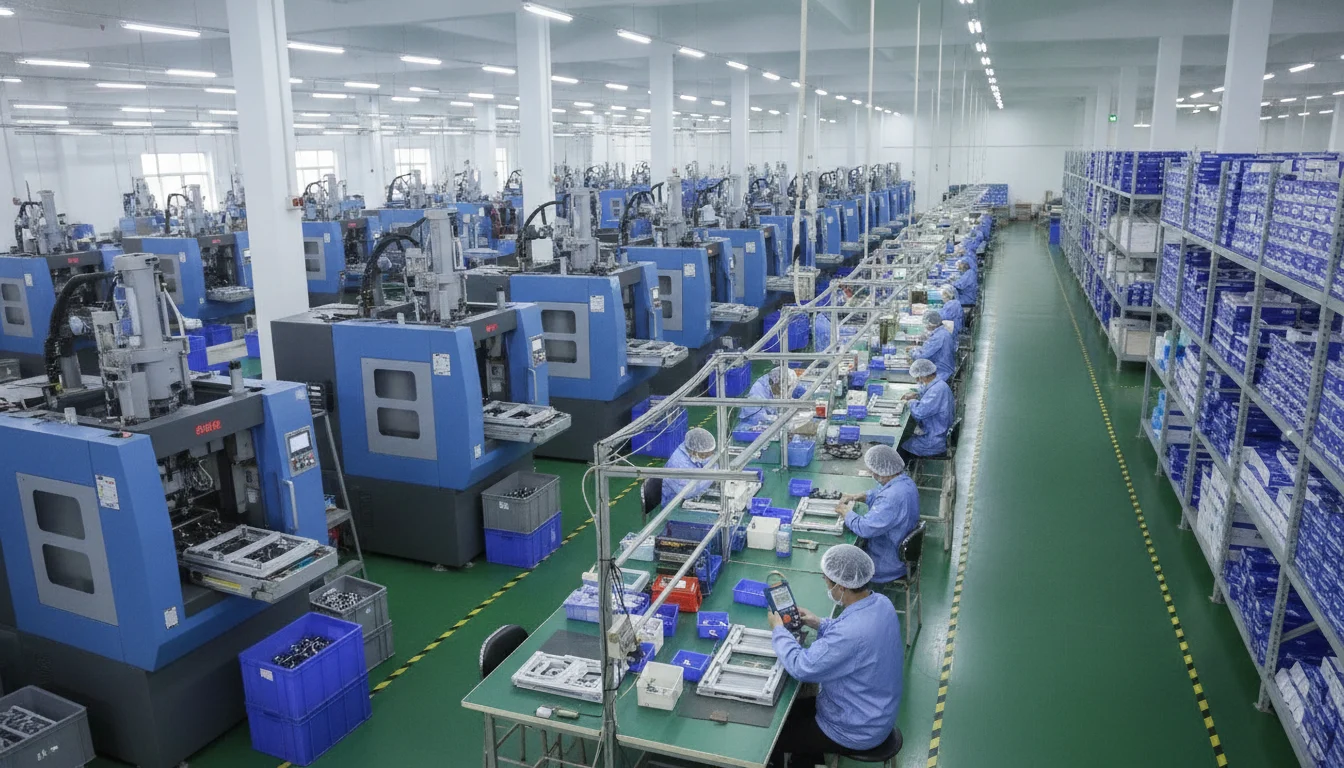
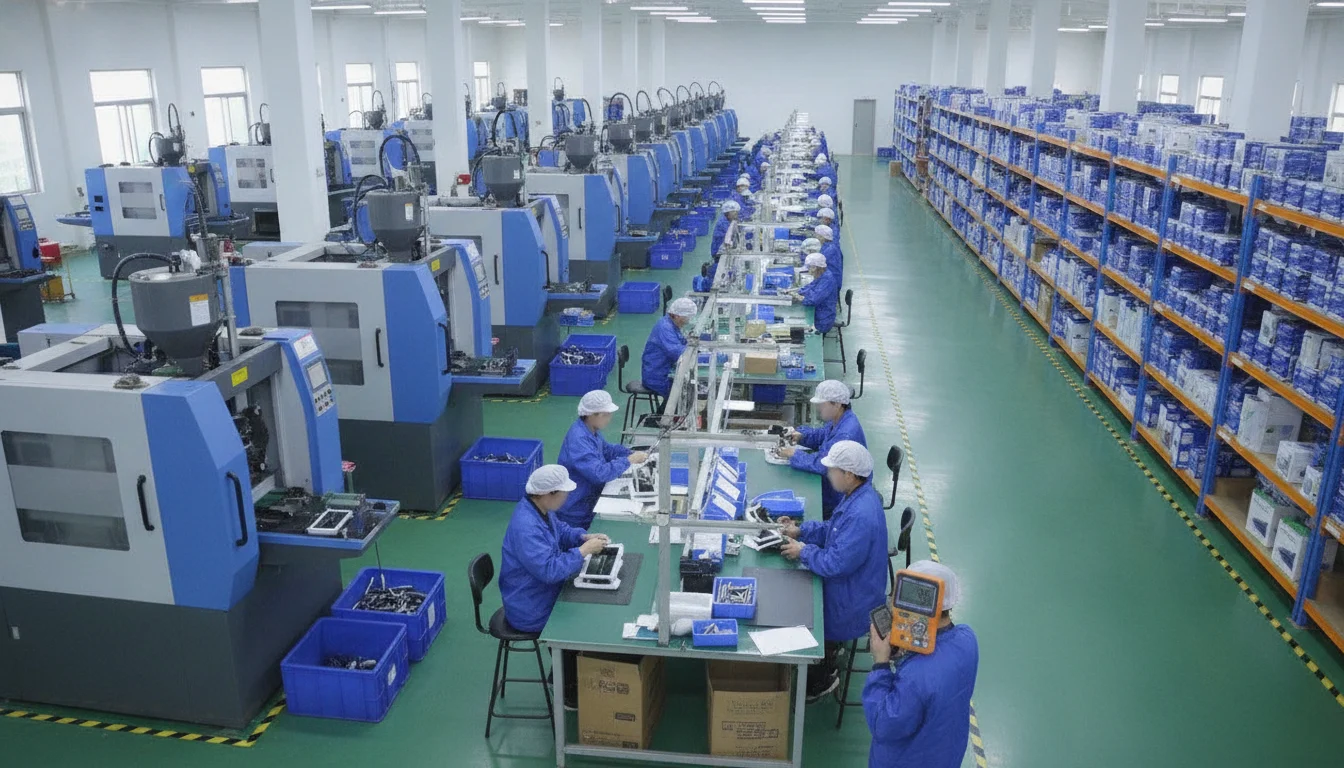
- Injection-molding machines: Magnetic window cleaner housings require plastic injection molds. Ask the supplier to show mold storage racks with mold numbers and walk past operating injection machines. Count the machines and ask their tonnage (80-ton, 120-ton, 200-ton models indicate production scale).
- Magnet assembly line: Real factories assemble neodymium magnets into plastic carriers, apply protective coatings, and test magnetic pull force. Request a close-up of workers inserting magnets and the gauss-meter station used for strength testing.
- Quality-control area: Manufacturers maintain QC benches with drop-test rigs, pull-force gauges, and sample archives. Ask to see current-day production samples being tested.
- Packaging and warehouse: Walk through finished-goods inventory showing carton stacks with the supplier’s brand or OEM client labels. Trading companies show small sample inventories or generic cartons without production dates.
- Worker headcount: Pan the camera across production lines during shift hours. A factory producing 50,000+ units per day employs hundreds of workers; a trading company shows 5-10 office staff.
Red Flags During Video Calls
Suppliers who refuse live video, offer only pre-recorded clips, or schedule calls outside business hours when the factory is empty likely operate as traders. One distributor reported a supplier showing a “factory tour” video that included machinery branded with a different company name visible on equipment nameplates. Another showed a workshop with zero workers and dust-covered machines, indicating rented space for credibility theater.
Ask the person on the call to physically touch specific machines and describe their function. A production manager explains injection parameters and cycle times; a sales trader reads generic specs from a script. Request the video tour include outdoor signage showing the factory name and address matching the business license.
Test Technical Product Knowledge
Real manufacturers answer engineering and sourcing questions immediately because they control the production process. Trading companies defer, provide vague answers, or contradict themselves across emails. Testing technical depth is a reliable method for how to distinguish real manufacturer from trading company China.
Questions That Reveal Factory-Level Knowledge
- Request the coating type (nickel-copper-nickel, epoxy, rubber) and thickness in microns. Manufacturers cite exact specs and explain trade-offs; traders offer “strong magnets” without detail.
- Mold ownership and lifespan: Ask how many injection molds they own, the mold lifespan in shots, and whether they can modify mold cavities for custom logo placement. Factories provide mold inventory lists and modification lead times; traders say “we can customize” without technical specifics.
- Material sourcing: Request the ABS or PC plastic supplier name, the steel grade for internal frames, and rope material specs (nylon, polyester, breaking strength). Manufacturers name suppliers and provide material data sheets; traders deflect or promise to “check with the factory.”
- Quality testing protocols: Ask what tests they perform (drop test height, pull-force measurement, rope abrasion cycles, glass-scratch testing) and request photos of test equipment with date stamps. Factories send same-day photos; traders send generic stock images.
- Failure-mode analysis: Describe a specific product failure (magnet demagnetization, rope fraying, housing crack) and ask the root cause and corrective action. Engineers provide detailed failure analysis; traders offer to replace the unit without investigating cause.
Response Time and Consistency
Manufacturers answer technical questions within hours during business hours because production staff sit nearby. Trading companies take 1-2 days, waiting for upstream factories to respond. Send the same technical question to different contacts at the supplier; inconsistent answers across sales reps indicate the team lacks direct production access.
Buyers sourcing adjustable-force magnetic cleaners face a common pain point: units rated for double glazing crack single-pane glass, while single-pane models lack grip on thicker insulated glass. A real manufacturer explains that 6-stage adjustable force solves this by letting users dial magnetic strength to match 5-35mm glass thickness, preventing both over-pressure cracks and weak-grip failures. A trader simply says “our product works on all glass” without addressing the physics.
Verify Export Records and Documentation Consistency
Cross-checking company name, address, bank account, and customs records reveals whether the supplier is the actual exporter or a shell entity. Inconsistencies signal trading companies using multiple upstream sources or falsified documentation.
Documents to Cross-Reference
Export Record Verification
Request copies of recent export customs declarations (报关单) for other clients, with buyer details redacted. Real manufacturers export under their own company name consistently. Trading companies either refuse this request or show declarations listing different shipper names, proving they source from multiple factories and lack production control.
Bank account verification is critical. The account name on the proforma invoice must exactly match the company name on the business license. Trading companies sometimes use personal accounts or shell-company accounts to obscure their intermediary role. One buyer discovered the bank account holder was an individual surname, not the registered company, and walked away before payment.
Use Multiple Signals Together
No single verification method is foolproof. Sophisticated trading companies rent workshop space, hire technical consultants to answer emails, and obtain business licenses with production scope through shell registrations. How to distinguish real manufacturer from trading company China requires combining at least five independent signals.
Signal Combination Matrix
- Business license scope + factory video: Production wording in the license gains credibility when the video shows corresponding machinery and worker headcount.
- Technical knowledge + sample consistency: Detailed engineering answers are validated when physical samples match the described materials, magnet grades, and quality-test results.
- MOQ flexibility + pricing structure: Real factories set MOQ based on production-run efficiency (100-500 units for magnetic cleaners) and offer volume discounts tied to material-purchasing economies. Traders quote low MOQs (10-50 units) with flat per-unit pricing because they aggregate orders across buyers.
- Compliance certificates + export consistency: CE and RoHS certificates listing the supplier’s name are confirmed when customs declarations show the same entity as exporter.
- After-sales capability + spare-parts inventory: Manufacturers stock spare parts (replacement ropes, magnet modules, cleaning pads) and provide technical support for installation and troubleshooting. Traders offer replacement-unit-only support and lack component inventory.
Weighted Scoring Example
Assign points to each verified signal and require a minimum score before proceeding. Business license with production scope (2 points), live factory video showing 10+ machines (3 points), immediate technical answers with photos (2 points), export records matching invoice name (2 points), compliance certificates in supplier’s name (1 point). Require 7+ points out of 10 to qualify the supplier as a real manufacturer.
One distributor used this scoring method and discovered a supplier scored only 4 points: they had production scope and certificates but refused factory video, gave slow technical answers, and showed export records with a different shipper name. Further investigation revealed they operated a small assembly workshop but outsourced injection molding and magnet production, making them a hybrid trader-assembler without full manufacturing control.
Red Flags for Disguised Trading Companies
Experienced trading companies mimic manufacturer behavior to capture factory-direct pricing expectations. Watch for these patterns that reveal intermediary operations despite surface credibility.
Unusually Broad Product Range
A supplier offering magnetic window cleaners, mops, brooms, kitchen tools, and garden equipment likely sources from multiple factories rather than manufacturing all categories in-house. Real manufacturers focus on 1-3 related product lines where they own tooling and production expertise. Broad catalogs with unrelated categories signal a trading company aggregating products from different suppliers.
Generic Product Photos and Branding
Trading companies use stock photos showing products without logos, packaging, or factory backgrounds. Manufacturers provide photos with their brand visible on products, cartons showing production dates and batch codes, and backgrounds showing production equipment. Request photos with a specific object (a coin, a handwritten note with today’s date) placed next to the product to prove the supplier physically holds inventory.
Inconsistent Communication Quality
When technical questions receive detailed answers but commercial questions (payment terms, shipping arrangements) come from a different person with lower expertise, the supplier likely employs a technical consultant to handle pre-sale inquiries while the core team operates as traders. Real factories have integrated teams where production managers, quality engineers, and export coordinators work in the same facility and provide consistent communication depth.
Reluctance to Discuss Production Capacity
Manufacturers state daily output (50,000+ units per day), machine count (24 injection-molding machines), and shift schedules (2-shift or 3-shift operation) because these numbers demonstrate capability. Trading companies avoid capacity questions or provide vague answers (“we can meet your quantity”) because they do not control production schedules and must check upstream factory availability.
No R&D or Customization Capability
Real manufacturers offer OEM and ODM services, including custom magnet strength, housing colors, logo placement, and packaging design, because they own molds and control production processes. Trading companies offer only logo printing or packaging changes, outsourcing any product modification to upstream factories with long lead times and high MOQs.
Region-Specific Compliance and Origin Claims
Import regulations in Europe, North America, and Australia require accurate manufacturer identification on compliance certificates and customs declarations. Trading companies create compliance risks when they cannot provide authentic documentation or falsify origin claims.
EU CE Marking and RoHS Compliance
CE marking requires a Declaration of Conformity listing the manufacturer’s name, address, and contact information. The manufacturer must be the entity that designed and produced the product or the authorized representative in the EU. Trading companies sometimes submit certificates listing upstream factories, creating liability gaps when product recalls or safety investigations occur. EU customs can demand technical files proving the declared manufacturer actually produced the goods; traders cannot provide production records, tooling documents, or quality-test data.
RoHS compliance restricts hazardous substances (lead, mercury, cadmium, hexavalent chromium, PBB, PBDE) to below 0.1% by weight per homogeneous material. Compliance certificates must list the actual manufacturer and include test reports from accredited labs (SGS, TÜV, Intertek). Verify the test report lists the supplier’s name as the client who commissioned testing, not a third-party factory name.
US and Canada Import Documentation
US Customs and Border Protection requires accurate manufacturer identification on commercial invoices and entry documents. Country-of-origin marking must state “Made in China” and identify the actual production location. Trading companies shipping from consolidation warehouses in Guangzhou or Shenzhen sometimes mislabel origin, triggering penalties. Canada’s CBSA enforces similar rules under CUSMA (formerly NAFTA) and requires manufacturer details for anti-dumping duty assessments on certain product categories.
Australia Import Compliance
Australian Border Force requires accurate supplier declarations and compliance with product-safety standards under the Australian Consumer Law. Magnetic window cleaners fall under general product-safety provisions, requiring suppliers to provide evidence of safety testing and quality control. Trading companies cannot provide factory-level quality records, creating compliance gaps if safety incidents occur and regulators demand production traceability.
Verification Steps for Compliance Documents
- Match certificate names: Manufacturer name on CE, RoHS, and test reports must exactly match the business license and invoice seller name.
- Verify lab accreditation: Test reports should come from ISO/IEC 17025 accredited labs; check lab name on accreditation body websites (CNAS for China labs, UKAS for UK labs).
- Request technical files: EU CE marking requires manufacturers to maintain technical files including design drawings, material specs, test reports, and risk assessments. Request a technical file index; real manufacturers provide it within days, traders cannot.
- Check certificate dates: Certificates should be recent (within 2-3 years) and match current product models. Old certificates or certificates for different model numbers indicate the supplier does not control production and cannot update compliance documentation.
Practical Due-Diligence Workflow
B2B distributors and facility-management buyers need a step-by-step verification process that fits procurement timelines and budget constraints. This workflow balances thoroughness with efficiency, using low-cost verification steps first and escalating to audits only when initial signals pass.
Phase 1: Desktop Verification (2-3 Days, Zero Cost)
- Request business license and check scope: Verify production wording and cross-check company name on gsxt.gov.cn registration database.
- Test technical knowledge via email: Send 3-5 detailed product questions covering materials, testing, and customization; evaluate response speed and depth.
- Review website and online presence: Real manufacturers show factory photos, machinery, team photos, and client case studies. Traders show generic product catalogs and stock photos.
- Check Alibaba or Global Sources profile: Verified suppliers display factory-audit badges (SGS, TÜV, Bureau Veritas on-site inspection reports). Review transaction data and response rates.
Phase 2: Visual and Document Verification (3-5 Days, Minimal Cost)
- Schedule live factory video call: Request 15-20 minute walkthrough showing production lines, QC area, warehouse, and outdoor signage. Record the call for later review.
- Request compliance certificates and cross-check names: Verify CE, RoHS, and test-report names match business license and invoice details.
- Ask for export customs declaration samples: Confirm shipper name consistency and match to factory address.
- Request client references: Contact 2-3 existing B2B buyers in your region and ask about lead-time stability, after-sales support, and product consistency.
Phase 3: Sample Order and Performance Test (15-30 Days, $500-2,000)
- Place small sample order (100-200 units at MOQ): Evaluate product quality, packaging consistency, and lead-time accuracy.
- Inspect samples for production indicators: Check for mold numbers embossed on plastic parts, batch codes on packaging, and consistency in magnet strength across units.
- Test product performance: Verify magnetic pull force matches claimed glass-thickness range, check rope strength, and test on actual glass installations.
- Evaluate after-sales response: Report a minor issue (request spare rope or cleaning pad) and measure response time and solution quality.
Phase 4: On-Site Audit (Optional, for Large Orders, $2,000-5,000)
For orders exceeding $50,000 or long-term supply agreements, commission a third-party factory audit (SGS, TÜV, Bureau Veritas, or independent auditors). The audit verifies production capacity, quality systems, worker conditions, and compliance documentation. Audit reports confirm the supplier operates a real factory versus a trading office and provide for contract negotiations on quality standards and penalty clauses.
Red-Flag Triggers for Immediate Disqualification
- Refusal to provide business license or factory video
- Bank account name differs from company name on license
- Compliance certificates list a different manufacturer name
- Export records show inconsistent shipper names across orders
- Technical questions receive copy-paste generic answers or 3+ day delays
- Sample products show different branding or quality than photos/specs provided
One facility-management buyer used this workflow and discovered a supplier passed Phase 1 and 2 but failed Phase 3 when sample-order lead time stretched from promised 15 days to 35 days, and product magnet strength tested 20% weaker than specification. The supplier admitted they outsourced production and had no control over the upstream factory’s schedule or quality, confirming trader status.
In practice: A UK distributor reduced product-return rates by 22% after implementing a 12-point manufacturer-verification checklist that included live factory video, technical knowledge testing, and export-record cross-checks, eliminating three disguised trading companies from their shortlist
Key Takeaways
- Chinese business licenses show production scope with specific Mandarin terms like “生产” (production) for real manufacturers, while trading companies display “贸易” (trade) or “销售” (sales) wording without manufacturing authority.
- Live factory video walkthroughs revealing injection-molding machines, magnet assembly lines, quality-control stations, and worker headcount provide visual proof of production capacity that trading companies cannot replicate.
- Real manufacturers answer technical questions about magnet grades, mold ownership, material sourcing, and quality-testing protocols immediately, while traders defer to “check with the factory” or provide generic responses.
- Cross-checking company name, address, bank account, and customs export records across business licenses, invoices, compliance certificates, and bills of lading exposes inconsistencies that signal intermediary operations.
- No single verification method proves manufacturer status; combining business-license scope, factory video, technical depth, export consistency, and compliance-certificate authenticity creates reliable validation.
- EU CE marking and RoHS compliance require manufacturer names on certificates to match actual producers; trading companies create liability gaps when they submit third-party factory certificates they cannot support with technical files or production records.
Sourcing magnetic window cleaners from verified manufacturers protects your margin, supply-chain stability, and compliance position. Fonoran operates a 6,500 m² factory in Taizhou, Zhejiang, producing 50,000+ units daily with full transparency: live factory tours, technical support from production engineers, and consistent export records across 60+ countries. Our magnetic window cleaner product range covers 5-35mm glass thickness with 6-stage adjustable force, addressing the strength-mismatch pain points that plague buyers working with under-specified or over-powered units from trading companies.
Ready to verify factory credentials and secure stable supply for your distribution network?
Request Factory Video Tour and Compliance Documents →
FAQ
How can I tell if a Chinese supplier is a real manufacturer?
Check the business license for production scope wording (“生产” or “制造”), request a live factory video showing machinery and workers, test technical knowledge with detailed product questions, and verify that company name, address, and bank account match across all documents including compliance certificates and export records. Real manufacturers answer engineering questions immediately and provide consistent documentation.
What is the difference between a trading company and a factory in China?
A factory owns production equipment, employs production workers, controls manufacturing processes, and holds business licenses with production scope. A trading company sources products from multiple upstream factories, adds markup, and operates with sales/trade scope only. Factories offer technical customization, stable lead times, and after-sales support; traders provide broader product ranges but lack production control and engineering expertise.
How do I verify a Chinese supplier’s business license?
Request a color scan of the original business license, check the registered business scope for production-related Mandarin terms, and cross-reference the company name and unified social credit code on China’s National Enterprise Credit Information Publicity System (gsxt.gov.cn). Verify the license entity matches the company name on invoices, bank accounts, and compliance certificates. Translation tools help identify production versus trade keywords.
Can a trading company be better than a factory for importing from China?
Trading companies offer advantages for buyers needing small quantities across multiple product categories, consolidated shipping, or English-language support. They handle logistics and quality control across diverse suppliers. However, for B2B distributors and facility-management buyers importing magnetic window cleaners or specialized equipment, direct manufacturer relationships deliver better pricing (15-30% lower), technical customization, stable lead times, genuine compliance documentation, and reliable after-sales support including spare parts and troubleshooting.
What red flags show a Chinese supplier is not a real factory?
Red flags include refusal to provide live factory video, business license showing trade scope only, technical questions answered with delays or generic responses, bank account name differing from company name, compliance certificates listing third-party manufacturer names, export records showing inconsistent shipper names, unusually broad unrelated product ranges, and reluctance to discuss production capacity or customization capabilities. Multiple red flags together confirm trading-company status.
Written by the Fonoran Export Team.