How to Verify CE Certificates from Magnetic Window Cleaner Suppliers (2026 Guide)

CE certificate verification from a magnetic window cleaner supplier requires requesting the full certificate and EU Declaration of Conformity, confirming that the notified body is authorized for your product category, matching the certificate scope to the exact SKU you are ordering, and asking for supporting test reports before payment. A genuine certificate names the manufacturer, lists the applicable directives and harmonized standards, carries a unique certificate number, and includes the notified body’s four-digit identification code. Certificates issued for one model cannot legally cover a different SKU, glass-thickness range, or electrical configuration.
📋 Table of Contents
- Executive Summary
- What Documents to Request from Your Supplier
- How to Verify Notified Body Authorization
- Match Certificate Scope to Your SKU
- Cross-Check Test Reports and Technical File
- Verify Product Labeling and Packaging
- Germany-Specific Importer Obligations
- Red Flags That Signal Invalid Certificates
- Key Takeaways
- Frequently Asked Questions
Executive Summary
- Document request: Ask every supplier for the full CE certificate, EU Declaration of Conformity, and supporting test reports before placing an order, and confirm that all three name the same manufacturer and product model.
- Notified body check: Verify that the four-digit notified body code on the certificate matches an organization authorized for your product category by searching the official NANDO database maintained by the European Commission.
- SKU scope matching: Confirm that the certificate explicitly covers the model number, glass-thickness range, magnet type, and electrical configuration you are purchasing, because certificates issued for one SKU do not extend to others.
- Test report traceability: Request test reports that reference the same certificate number, product description, and test date, and check that the tested sample matches the production specification you will receive.
- Germany importer duty: German importers must ensure the manufacturer has compiled a technical file, that the product carries correct CE marking and German-language documentation, and that their own contact details appear on the product or packaging as the responsible party within the EU.
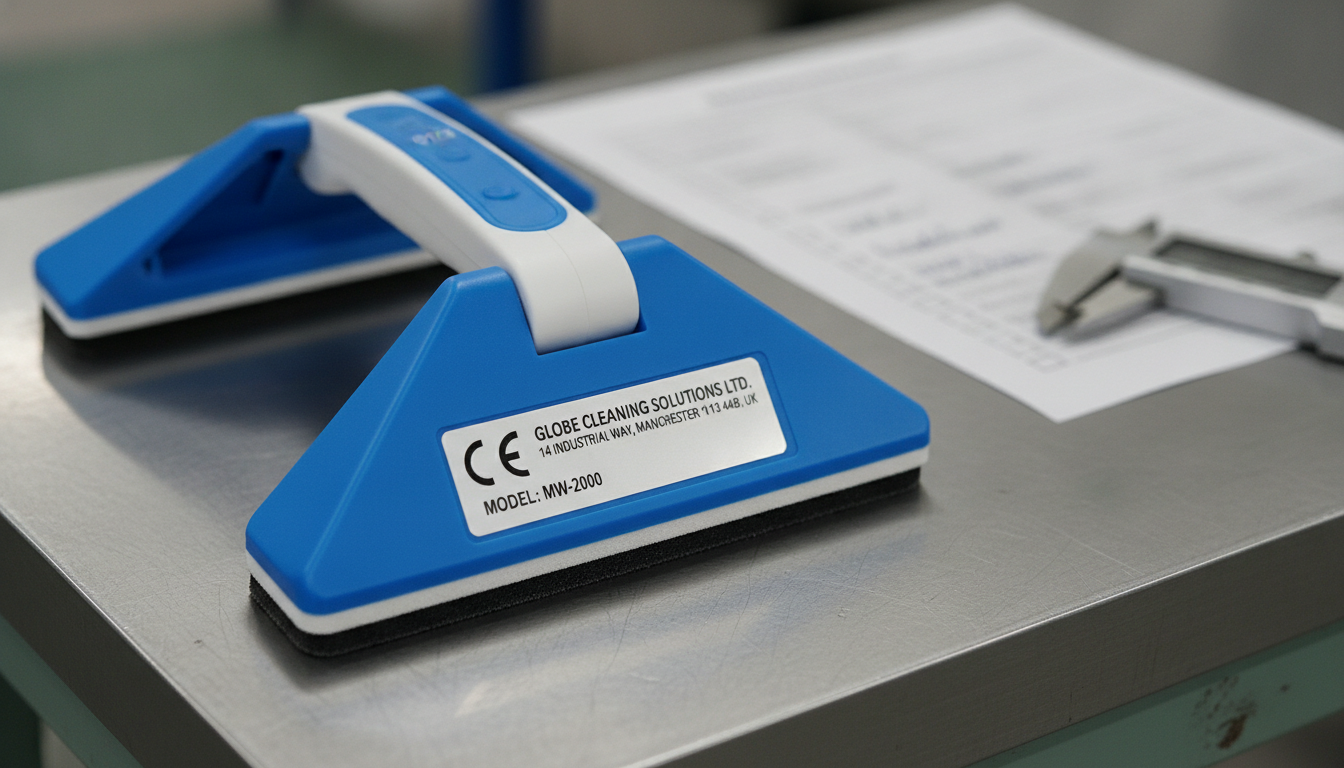
What Documents to Request from Your Supplier
Start ce certificate verification for any magnetic window cleaner supplier by requesting three core documents before you commit to payment. A complete compliance package includes the CE certificate itself, the EU Declaration of Conformity, and at least one supporting test report. Each document serves a distinct legal purpose, and together they form the audit trail that customs and market-surveillance authorities expect to see.
CE Certificate
The CE certificate is issued by a third-party notified body and confirms that representative samples of the product have been tested against harmonized European standards. The certificate must name the manufacturer, list the applicable EU directives, cite the harmonized standards used for testing, and carry a unique certificate number and issue date. Our magnetic window cleaner product range holds CE certification (certificate number WUX202105142249ENC) issued by Shenzhen Wuxiang Testing, covering the models we export to Germany, France, the UK, and other EU markets.
EU Declaration of Conformity
The Declaration of Conformity is a legal statement signed by the manufacturer declaring that the product meets all applicable EU requirements. It must reference the same directives and standards as the CE certificate, identify the manufacturer and the product by model or SKU, and include the manufacturer’s name and address. This document is the manufacturer’s formal assumption of liability, and it must be made available to authorities on request.
Supporting Test Reports
Test reports detail the actual measurements, test conditions, sample descriptions, and pass/fail results from the laboratory that conducted the conformity assessment. Request reports that match the certificate number and product description, and check that the tested sample specification aligns with the unit you will receive. Buyers report discovering that a supplier’s certificate was issued for a manual non-electrical model while the quoted SKU included a motorized spray function, a mismatch that invalidates the certification and creates customs-clearance and liability risk.
How to Verify Notified Body Authorization
Not every testing laboratory is legally authorized to issue CE certificates for every product category. The European Commission maintains the NANDO database, a public registry of notified bodies and the specific directives and product categories each is authorized to certify. Verifying notified body authorization is a critical step in ce certificate verification from a magnetic window cleaner supplier, because a certificate issued by an unauthorized body has no legal standing.
Search the NANDO Database
Visit the NANDO database at the European Commission’s official portal and search by the four-digit notified body number that appears on the CE certificate. The search result will display the organization’s name, country, contact details, and a list of directives and product scopes for which it is authorized. Confirm that the listed scopes include the product category that applies to your magnetic window cleaner, typically household appliances or general product safety depending on whether the unit includes electrical components.
Check Directive Alignment
Magnetic window cleaners without electrical parts typically fall under the General Product Safety Directive, while models with battery-powered spray systems or motorized components require certification under the Low Voltage Directive or the Electromagnetic Compatibility Directive. The notified body’s authorization must cover the specific directive cited on the certificate. A body authorized only for machinery safety cannot issue a valid certificate for an electrically powered window cleaner.
Verify Certificate Authenticity
Some notified bodies, including Nemko and TÜV, offer online certificate-finder tools that allow buyers to search by certificate number and confirm authenticity and validity. Enter the certificate number provided by your supplier and check that the returned record matches the manufacturer name, product description, and issue date on the document you received. A certificate that does not appear in the issuing body’s database is either expired, fabricated, or belongs to a different manufacturer.
Match Certificate Scope to Your SKU
A single supplier may hold valid CE certification for one model while selling other SKUs that have never been tested. Effective ce certificate verification from a magnetic window cleaner supplier requires confirming that the certificate explicitly covers the exact model number, glass-thickness range, magnet material, and any electrical features of the unit you are ordering. Certificates are SKU-specific, not blanket approvals for an entire product line.
Model Number and Product Description
Compare the model number or product description on the certificate with the SKU quoted in your purchase order. The certificate should name the product in sufficient detail to distinguish it from other models in the supplier’s range. A certificate issued for a 5-35mm adjustable magnetic cleaner does not cover a 3-30mm model, a 10-45mm model, or a fixed-magnet design, even if all are sold by the same factory.
Glass Thickness and Magnet Specification
Magnetic force and glass-thickness compatibility are performance-critical parameters that affect safety and product liability. The certificate or supporting test report should specify the glass-thickness range the unit was tested against and the magnet material used. Our 6,500 m² Taizhou factory produces four adjustable SKUs covering 3-30mm, 5-35mm, 8-40mm, and 10-45mm glass, with NdFeB magnets in every SKU except the FN-Classic 3-8mm model, which uses Ferrite. Buyers ordering for thick insulated double glazing must confirm that the certificate scope includes the upper thickness limit they require.
In practice: A home user in Germany with 36mm insulated glass needed an adjustable magnetic window cleaner; the FN-Ultra 10-45mm SKU was quoted because 36mm sits within that range with room to spare, and the buyer requested the certificate to confirm the tested thickness envelope before ordering.
Electrical and Battery Components
If the quoted model includes a battery-powered spray tank, motorized rotation, or any electrical circuit, the certificate must cover those features under the applicable electrical-safety directive. A certificate issued for a purely mechanical magnetic cleaner does not extend to a variant that adds a rechargeable battery and pump. Buyers report customs delays when the declared product description on the commercial invoice included electrical features that the accompanying CE certificate did not mention.
Cross-Check Test Reports and Technical File
Test reports provide the technical evidence behind the CE certificate, and the technical file is the manufacturer’s internal dossier of design, risk-assessment, and quality-control documentation. Cross-checking these documents against the certificate and the physical product is a core step in ce certificate verification from a magnetic window cleaner supplier, because discrepancies between tested samples and production units are a common source of non-compliance.
Test Report Content
A valid test report identifies the tested sample by model number and description, lists the harmonized standards applied, details the test methods and acceptance criteria, records the measured results, and states whether the sample passed or failed each test. The report must reference the same certificate number as the CE certificate and carry the same notified body name and logo. Check that the tested sample description matches the SKU you are ordering, including glass-thickness range, magnet type, materials, and any electrical ratings.
Technical File Access
EU law requires the manufacturer to compile and maintain a technical file that includes design drawings, risk assessments, production quality-control procedures, and copies of all test reports and certificates. While the manufacturer is not obliged to share the entire file with every buyer, requesting access to specific sections demonstrates due diligence and allows you to verify that the supplier has genuinely completed the conformity-assessment process. Buyers placing large or repeat orders often include a technical-file audit clause in their purchase agreement.
Production Consistency
The tested sample must represent the production version of the product. Ask the supplier whether any design changes, material substitutions, or component-sourcing changes have occurred since the test date on the report. A certificate issued in 2022 for a unit with a specific magnet grade and handle material does not automatically cover a 2026 production run if the supplier has switched to a different magnet supplier or changed the handle plastic. Buyers concerned about magnet retention and durability should confirm that the production magnet specification matches the tested sample, because a weaker magnet can cause the unit to lose grip and fall during use.
Verify Product Labeling and Packaging
The CE marking itself, the manufacturer nameplate, and the accompanying documentation must meet specific format and content requirements. Verifying these elements before shipment is a practical final step in ce certificate verification from a magnetic window cleaner supplier, because incorrect labeling can trigger customs holds and market-surveillance penalties even when the product itself is compliant.
CE Marking Format
The CE mark must be affixed visibly, legibly, and indelibly to the product or, when the product’s size or nature does not allow it, to the packaging and accompanying documents. The mark must follow the prescribed proportions and minimum height, and it must be followed by the four-digit notified body number if third-party certification was required. A magnetic window cleaner that required notified-body testing must display both the CE symbol and the notified body code, not the CE mark alone.
Manufacturer Identification
The product, packaging, or accompanying documentation must identify the manufacturer by name and postal address. If the product is being imported into the EU by a distributor or importer, that party’s name and address must also appear, because the importer assumes legal responsibility for the product’s conformity. German buyers must ensure their own contact details are added to the product or packaging before the goods enter the EU market.
Language and Documentation
Instructions, warnings, and safety information must be provided in the language of the country where the product will be sold. For Germany, this means German-language user manuals, safety labels, and any required warnings about glass-thickness limits or drop risks. Buyers ordering for resale across multiple EU countries should request multilingual documentation or arrange translation before distribution.
Germany-Specific Importer Obligations
Germany enforces strict product-safety and market-surveillance rules, and importers bear legal responsibility for ensuring that products entering the German market meet all applicable EU requirements. Understanding these obligations is essential for ce certificate verification from a magnetic window cleaner supplier when the destination is Germany.
Importer as Responsible Party
Under the Product Safety Act (Produktsicherheitsgesetz), the importer must verify that the manufacturer has carried out the required conformity-assessment procedures, that the product carries correct CE marking, and that the necessary documentation is available. The importer’s name and address must appear on the product or packaging, and the importer must retain a copy of the EU Declaration of Conformity for ten years. Market-surveillance authorities can request this documentation at any time, and failure to produce it can result in fines and product recalls.
Technical File and Conformity Documentation
Before placing a magnetic window cleaner on the German market, confirm that the manufacturer has compiled a complete technical file and that the EU Declaration of Conformity references the correct directives and standards. Request a copy of the Declaration and verify that it is signed, dated, and includes the manufacturer’s full legal name and address. German customs and market-surveillance authorities routinely audit imported goods, and missing or incomplete documentation is one of the most common findings.
Recall and Traceability Obligations
Importers must maintain records that allow rapid identification and withdrawal of non-compliant products. This includes batch numbers, production dates, and the identity of the manufacturer and any intermediary suppliers. If a magnetic window cleaner is found to pose a safety risk, such as magnets falling out during use or the unit dropping from the glass, the importer must notify the relevant authorities and cooperate in any recall or corrective action. Buyers concerned about product durability and liability should include warranty and recall-cooperation clauses in their purchase agreements.
Red Flags That Signal Invalid Certificates
Certain patterns and omissions are strong indicators that a CE certificate is not genuine or does not legally cover the product being sold. Recognizing these red flags is a practical skill in ce certificate verification from a magnetic window cleaner supplier, and it helps buyers avoid costly compliance failures.
- Generic product description: A certificate that describes the product only as ‘magnetic window cleaner’ or ‘cleaning tool’ without specifying model number, glass-thickness range, magnet type, or electrical features is too vague to provide meaningful conformity assurance and may have been issued for a different product entirely.
- Missing notified body details: A certificate that lacks a four-digit notified body code, does not name the issuing laboratory, or carries a logo that does not match any entry in the NANDO database is likely fabricated or issued by an organization not authorized to certify the product category.
- Expired or undated certificate: CE certificates do not have a fixed expiration date, but they become invalid if the product design, materials, or manufacturing process changes after the test date. A certificate with no issue date, or one that predates the supplier’s founding year, should be questioned.
- Reused certificate across multiple SKUs: Buyers report discovering that a supplier presented the same certificate number for multiple models with different glass-thickness ranges and magnet materials. Each distinct SKU requires its own conformity assessment, and a certificate issued for one model cannot be reused for another.
- Mismatch between certificate and product label: The model number, manufacturer name, and CE marking on the physical product must match the details on the certificate. A product labeled with one model code but accompanied by a certificate for a different code is non-compliant.
Key Takeaways
- Request the full CE certificate, EU Declaration of Conformity, and supporting test reports from every magnetic window cleaner supplier before placing an order, and confirm that all three documents name the same manufacturer and product model.
- Verify that the notified body listed on the certificate is authorized for your product category by searching the official NANDO database maintained by the European Commission, and check that the certificate number appears in the notified body’s own online registry where available.
- Confirm that the certificate scope explicitly covers the model number, glass-thickness range, magnet material, and any electrical features of the SKU you are ordering, because certificates are model-specific and do not extend to other variants in the supplier’s range.
- Cross-check the test report against the certificate and the production specification to ensure that the tested sample matches the unit you will receive, and ask whether any design or material changes have occurred since the test date.
- German importers must ensure the product carries correct CE marking and German-language documentation, that their own contact details appear on the product or packaging as the responsible party, and that they retain a copy of the EU Declaration of Conformity for ten years.
- Red flags include generic product descriptions, missing notified body codes, expired or undated certificates, reused certificate numbers across multiple SKUs, and mismatches between the certificate and the product label or packaging.
Frequently Asked Questions
What is the difference between a CE certificate and an EU Declaration of Conformity?
The CE certificate is issued by a third-party notified body and provides independent test evidence that a product meets harmonized European standards. The EU Declaration of Conformity is a legal statement signed by the manufacturer declaring that the product complies with all applicable EU directives and that the required conformity-assessment procedures have been completed. Both documents are required, and they must reference the same product, directives, and standards. The certificate provides the technical proof, while the Declaration is the manufacturer’s formal assumption of legal responsibility.
How can I check whether a notified body is authorized for magnetic window cleaners?
Search the NANDO database on the European Commission’s official website using the four-digit notified body code that appears on the CE certificate. The search result will list the directives and product categories the body is authorized to certify. Magnetic window cleaners typically fall under the General Product Safety Directive if they are purely mechanical, or the Low Voltage Directive and Electromagnetic Compatibility Directive if they include electrical components. Confirm that the notified body’s listed scopes include the relevant directive and product category for your specific model.
Does a CE certificate issued for one magnetic window cleaner model cover other models from the same supplier?
No. CE certificates are SKU-specific and apply only to the product model, glass-thickness range, magnet material, and electrical configuration that was tested and described in the certificate and supporting test reports. A certificate issued for a 5-35mm adjustable magnetic cleaner does not cover a 3-30mm model, a 10-45mm model, a fixed-magnet design, or a variant that adds electrical features. Each distinct SKU requires its own conformity assessment and certificate. Buyers must request the certificate that matches the exact model number they are ordering.
Ready to verify compliance and place your order with confidence?
Request CE documentation and a quote →
Written by the Fonoran Export Team.