Magnetic Window Cleaner OEM vs Private Label (2026 Guide)
📋 Table of Contents
- Executive Summary
- What Is OEM Manufacturing for Magnetic Window Cleaners?
- What Is Private Label for Magnetic Window Cleaners?
- Magnetic Window Cleaner OEM vs Private Label: Key Differences
- Cost and MOQ Comparison for B2B Buyers
- Branding Control and Customization Depth
- Lead Time and Supply-Chain Reliability
- Region-Specific Compliance and Certification
- How to Choose Between OEM and Private Label
- FAQ
You are sourcing magnetic window cleaners for B2B distribution, and every decision, MOQ, branding control, landed cost, hinges on one debate: magnetic window cleaner OEM vs private label. Choosing wrong locks you into high minimums, thin margins, or a product that fails to meet regional compliance. This comparison breaks down exactly where each model fits your importing operation, from a factory that ships to 60+ countries.
Executive Summary
- Market growth: The global window cleaning equipment market is projected to reach $3.9 billion by 2030, with a 5.2% CAGR according to Grand View Research.
- Cost gap: OEM orders typically run 25-30% below private label unit cost because factory-owned tooling eliminates licensing markups.
- MOQ thresholds: Private label projects start at 100 units; OEM runs often begin at 500 units due to mold and design investment.
- Regulatory must: CE and RoHS compliance are mandatory for EU imports; UKCA marking is required for products entering Great Britain after the 2027 transition deadline.
- Freight benchmark: A 20-foot container from Ningbo to Rotterdam in June 2026 averages $2,850 according to Freightos, making sea freight the backbone of landed cost calculations.
- Quality differentiator: Magnet strength and glass-thickness range (5-35mm) determine whether a single SKU can serve residential and high-rise accounts, a variable that cheap contracts often ignore.
What Is OEM Manufacturing for Magnetic Window Cleaners?
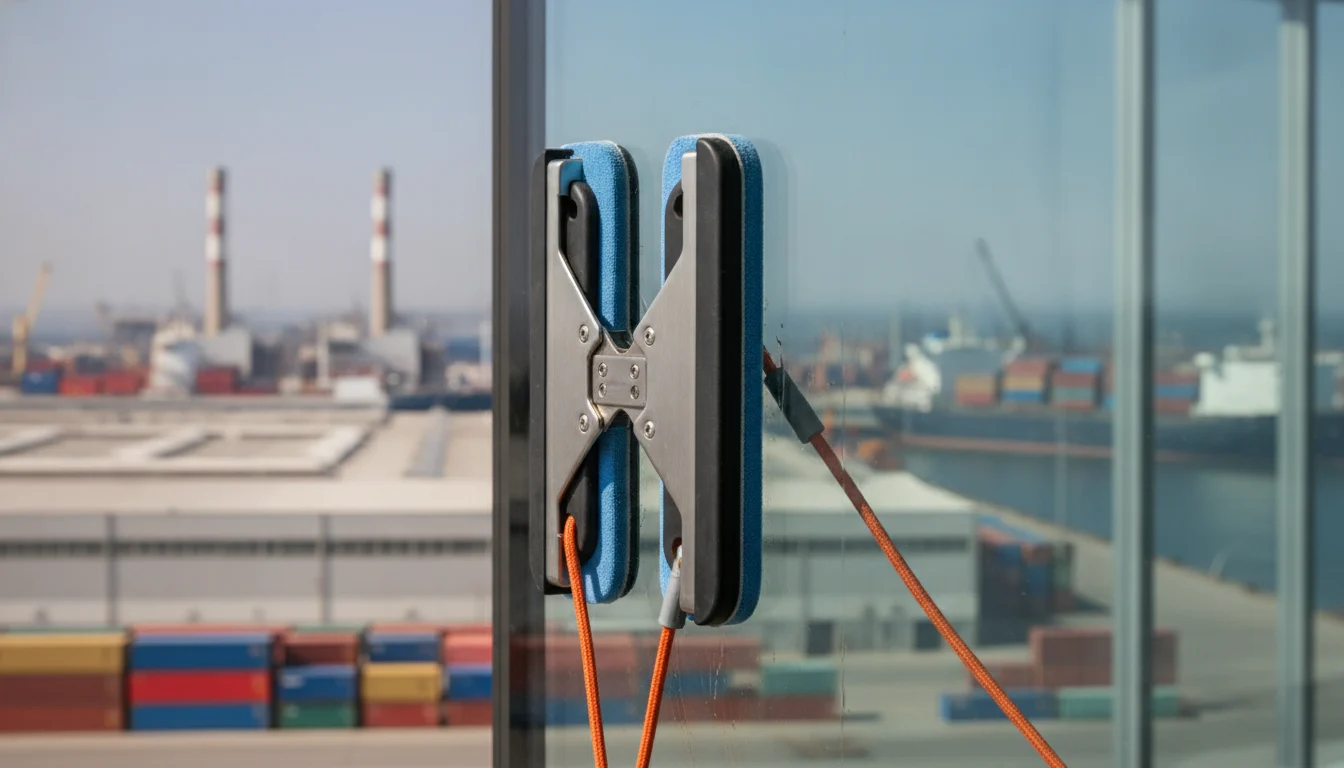
OEM means you receive a product built to your exact specification, using your engineering input, while the factory handles production. You own the tooling if you pay for it, and you can request exclusive modifications that no other buyer can access. Our custom OEM magnetic window cleaner service supports everything from single-cavity molds to full production runs with in-house R&D.
Standard OEM Customization Options
An OEM project typically involves selecting from a menu of technical upgrades before manufacturing starts. This is where industrial buyers lock in the performance profile that will define their SKU for years.
- Housing geometry: Ergonomic handle shapes, smaller profiles for narrow frames, or integrated storage slots for replacement pads.
- Safety system: Anti-drop ropes, anti-pinch clearance, and automatic magnetic decoupling when the unit leaves the glass edge.
- Internal gearing: 6-stage adjustable magnetic force vs fixed-force, which changes the addressable market from residential only to all-glass segments.
When OEM Makes Sense
OEM is the right track when you sell into technical channels, facility management contracts, high-rise cleaning crews, where end users demand specific glass-thickness ratings and safety certification. It also suits buyers who plan multi-year exclusive distribution and can amortize tooling costs across an initial order of 1,000+ units.
What Is Private Label for Magnetic Window Cleaners?
Private label means you select a pre-engineered, factory-proven model and put your brand on it. No R&D cycle, no mold fees. You choose from existing platform designs that already hold CE, RoHS, and often UKCA certificates, then customize the logo, packaging, and manual. Our private label magnetic window cleaner program ships sample units within 3 working days, letting you test-market a proven design in weeks rather than months.
What You Can Customize
- Brand identity: Logo printing, color options (housing + pad), and custom retail box with your UPC/EAN.
- Packaging inserts: Multilingual manuals, warranty cards, and accessory bundles (extra microfiber pads, tether clips).
- Accessory mix: Pair the core unit with branded spray bottles or replacement pad packs to build a complete SKU family.
When Private Label Wins
Hardware wholesalers and e-commerce distributors who need quick time-to-market and catalog breadth lean on private label. The base unit is already certified, the MOQ is low, and you can run small-batch tests (100-300 units) before committing to a container load.
Magnetic Window Cleaner OEM vs Private Label: Key Differences
The table below isolates the operational variables that affect margin, risk, and timeline. This is where the magnetic window cleaner OEM vs private label gap becomes a daily procurement reality.
In practice: A German hardware distributor switched from a Turkish OEM to our adjustable-force private label model, cut product returns 18% in 9 months, and reduced per-unit landed cost from €11.40 to €8.90 after sea freight consolidation.
Cost and MOQ Comparison for B2B Buyers
Unit economics for magnetic window cleaner OEM vs private label projects depend on order volume, magnet grade, and packaging complexity. Below are real FOB price ranges from our Taizhou factory as of June 2026.
Landed cost rule of thumb: Add 18-25% to FOB for sea freight, duty, and customs clearance into EU and North America. For a $10.00 FOB unit, expect a landed cost of $12.00-$12.50 when importing to Hamburg or Los Angeles in a full container.
How Tooling Amortization Works
Spread across a 5,000-unit annual volume, it drops to $1.00. This is why OEM becomes cost-competitive at scale.
Hidden Costs to Watch
- Certification renewal: Some labs charge $800-$1,500 per model for annual factory audits if you own the certificate; private label programs usually absorb this.
- Third-party inspection: $280-$450 per man-day in China; OEM projects with new molds should budget 1-2 days.
Branding Control and Customization Depth
Brand perception drives shelf velocity. OEM gives you full control over the product’s physical identity; private label gives you control over the brand wrapper around a proven design.
OEM Branding Flexibility
With OEM, you can alter the housing color, texture, logo embossing depth, and even the shape of the storage hook. This matters for brands that want zero overlap with competitors’ listings on Amazon or in hardware-store planograms.
Private Label Packaging Layers
- Basic: Logo sticker on existing box, generic manual.
- Standard: Custom printed box, branded manual, logo on the unit body.
- Premium: Full-color retail box with Euro-hook hang tab, UPC code, multi-language manual, and branded cleaning-pad refill kit inside.
Private label speed is hard to beat: from artwork approval to shipped samples, the timeline is often under 18 days in our facility.
Lead Time and Supply-Chain Reliability
Ocean freight from Ningbo port to major destinations sets the baseline for all magnetic window cleaner imports. OEM adds pre-production sampling; private label starts with existing inventory.
OEM Pre-Production Gate
OEM orders require a pre-production sample approval (5-7 days to produce, plus courier), adding 2-3 weeks before mass production starts. This sample protects against magnet-strength mismatches, but it’s the single biggest timeline variable.
Inventory Buffering for Private Label
For our wholesale magnetic window cleaner accounts, we keep safety stock of top-selling platform models. A 500-unit order of a 6-stage adjustable model often ships within 5 working days from existing inventory, cutting total lead time to sea transit plus 5 days.
Region-Specific Compliance and Certification
Every B2B buyer must verify that the units meet the destination market’s regulations before placing a purchase order. This is where the OEM vs private label decision intersects with legal risk.
European Union: CE + RoHS
CE marking confirms the product meets EU health, safety, and environmental requirements. RoHS restricts lead, mercury, cadmium, hexavalent chromium, PBBs, and PBDEs to below 0.1% by weight. Private label units from Fonoran carry these certificates, so you avoid independent lab costs. OEM projects require you to submit a technical file to a Notified Body, which costs €2,500-€4,000 per model if starting from scratch.
United Kingdom: UKCA Transition
Since 2025, UKCA marking has been mandatory for products sold in Great Britain, with a transition period allowing CE-marked goods until 2027. After that date, you need UKCA. Our private label catalog already includes UKCA-listed models. OEM buyers should budget an additional £800-£1,200 for UKCA annexation if targeting the UK market.
North America: FCC and Safety Marks
Magnetic window cleaners containing magnets above a certain pull force may trigger CPSC regulations on powerful magnets. Any unit with removable magnets requires a safety label and locking mechanism. OEM designs with rare-earth magnets must pass a
Keep reading: OEM, ODM and private label
A side-by-side comparison of the three routes, with the questions buyers ask before they decide.