Best Window Squeegee: Professional Grade vs Consumer Models (2026 Buyer Guide)

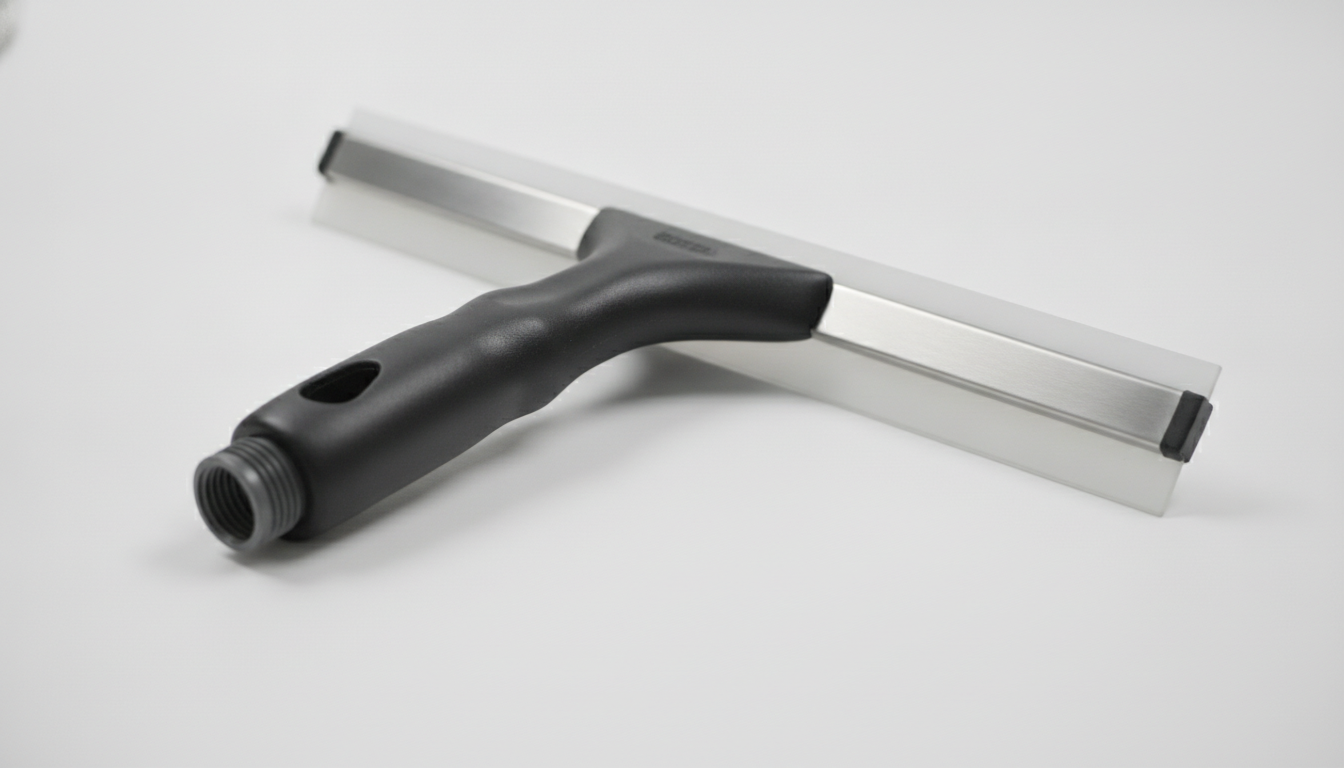
The best window squeegee for commercial procurement depends on blade material, handle ergonomics, and compatibility with your glass specifications. Professional-grade squeegees use silicone or natural rubber blades ranging 12-18 inches wide, mounted on stainless-steel channels with contoured handles that maintain consistent pressure across panes. For B2B buyers sourcing cleaning tools at scale, verify blade lifecycle (typically 200-500 windows per edge), replacement-part availability, and whether the unit integrates with extension poles for high-rise or hard-to-reach glass.
Executive Summary
- Blade material determines streak performance: Silicone edges resist UV degradation and last longer on exterior glass, while natural rubber offers better flexibility for varied pane contours.
- Handle design affects control and fatigue: Contoured grips with rubberized surfaces reduce wrist strain during extended cleaning sessions, critical for facility-management teams and window-cleaning contractors.
- Width selection matches pane size: 12-inch squeegees suit residential and narrow commercial windows; 18-inch models cover large storefront and office glass faster but require more arm strength.
- Extension-pole compatibility expands reach: Professional squeegees with threaded sockets accept standard ACME or Euro-thread poles, enabling safe ground-level cleaning of second-story and skylights.
- Replacement parts drive total cost of ownership: Blade refills cost 30-60% less than complete units; verify your supplier stocks channel-specific replacement rubbers before committing to bulk orders.
Blade Material: Streak-Free Performance and Durability
Blade composition directly impacts water removal and edge longevity. Professional-grade squeegees use two primary materials, each suited to different glass environments.
Silicone Blades
Silicone edges resist ozone, UV exposure, and temperature extremes better than rubber. They maintain flexibility in cold weather and do not harden after prolonged sun exposure, making them the preferred choice for exterior commercial glass in climates with wide seasonal temperature swings. Silicone blades typically deliver 300-500 windows per edge before requiring replacement. The material’s chemical resistance also prevents degradation when used with alkaline or acidic cleaning solutions common in facility-management workflows.
Natural Rubber Blades
Natural rubber offers superior conformability to slightly uneven or textured glass surfaces. The material compresses more readily than silicone, maintaining contact across pane irregularities that cause streaking with stiffer edges. However, natural rubber degrades faster under UV exposure and loses elasticity in freezing conditions. Expect 200-350 windows per edge in mixed indoor-outdoor use. Buyers sourcing for interior office towers or climate-controlled retail spaces often favor natural rubber for its lower upfront cost and better performance on standard float glass.
Edge Geometry and Streak Prevention
Blade thickness ranges from 5mm to 8mm on professional models. Thicker edges maintain rigidity under pressure, preventing the blade from folding back and leaving water trails. The edge angle, typically 30 to 45 degrees, determines how aggressively the rubber wipes. A 30-degree angle removes more water per pass but wears faster; a 45-degree angle extends blade life at the cost of requiring more overlapping strokes. Magnetic window cleaner product range units pair replaceable squeegee blades with adjustable magnetic force, allowing operators to match blade pressure to glass thickness without manual handle adjustment.
Users report streaking when the rubber edge is too stiff, worn, or poorly aligned, even on products marketed as professional quality. Inspect blade edges weekly under angled light; any nicks, flat spots, or hardened sections require immediate replacement to maintain streak-free results.
Handle Design: Control, Ergonomics, and Operator Fatigue
Handle geometry determines how effectively an operator can maintain consistent blade pressure across a pane and how quickly fatigue sets in during extended cleaning sessions.
Contoured vs Straight Handles
Contoured handles with finger grooves and palm rests distribute grip force across the hand, reducing localized pressure points that cause cramping. Straight handles offer better control for corner work and narrow mullions but require stronger grip strength. Facility-management teams cleaning dozens of windows per shift typically prefer contoured designs; window-cleaning contractors working varied pane sizes often carry both types.
Material and Surface Texture
Professional squeegee handles use polypropylene or aluminum cores wrapped in rubberized thermoplastic elastomer (TPE). TPE maintains grip when wet and insulates hands from cold metal channels in winter conditions. Aluminum handles add 40-60 grams compared to polypropylene but provide better rigidity for 18-inch and wider blades, preventing handle flex that causes uneven pressure distribution.
Swivel and Fixed Heads
Swivel-head squeegees allow the blade to pivot 180 degrees, enabling operators to pull water in any direction without repositioning their stance. This feature reduces shoulder strain on large panes and skylights. Fixed-head models offer more precise control for detailed work around frames and sills. Some buyers say the handle feels awkward or lacks enough control for corners, edges, and narrower panes, particularly with swivel mechanisms that introduce play at the pivot joint.
- Ergonomic contour: Reduces grip force required by 20-30% compared to cylindrical handles, measurable via dynamometer testing during repetitive cleaning tasks.
- TPE coating thickness: 2-3mm provides optimal balance between cushioning and handle diameter; thicker coatings increase hand fatigue for operators with smaller grips.
- Swivel lock mechanism: Look for models with a thumb-actuated lock that secures the head at 45-degree intervals, preventing unwanted rotation mid-stroke.
Squeegee Width: Matching Blade Length to Pane Dimensions
Blade width affects coverage speed, maneuverability, and operator control. Professional buyers select width based on the dominant pane size in their facility portfolio.
12-Inch Squeegees
Twelve-inch blades suit residential windows, narrow office panes, and detailed work around mullions and dividers. The shorter length allows single-hand operation and precise control in tight spaces. Operators can complete a standard 24-by-36-inch window in three vertical strokes with minimal overlap. This width is the default choice for window-cleaning contractors serving mixed residential and small-commercial accounts.
14-16-Inch Squeegees
Mid-range widths balance coverage and control. A 14-inch blade covers a 30-by-48-inch pane in two strokes, reducing cleaning time by 25-30% compared to 12-inch models while maintaining single-hand maneuverability. This size category represents the best window squeegee choice for facility-management buyers maintaining office buildings, schools, and retail spaces with standardized window dimensions.
18-Inch and Wider Squeegees
Eighteen-inch blades are the professional standard for storefront glass, curtain walls, and large commercial panes. They reduce stroke count and cleaning time but require two-hand operation and stronger arm control to maintain even pressure. Operators report increased shoulder fatigue after 90 minutes of continuous use. Buyers sourcing for high-rise or large-format glass should verify that their cleaning teams have the physical capacity to use wide blades effectively before committing to bulk orders.
Width selection rule: Choose a blade width that covers 60-80% of your most common pane dimension. A blade wider than the pane creates control issues at edges; a blade narrower than 50% of pane width increases stroke count and labor time disproportionately.
Extension-Pole Compatibility: Reaching High-Rise and Hard-to-Access Glass
Extension-pole systems enable ground-level cleaning of second-story windows, skylights, and canopy glass, eliminating ladder use and associated fall risks.
Threaded Socket Standards
Professional squeegees feature threaded sockets that accept standard extension poles. The two dominant thread standards are ACME (common in North America) and Euro-thread (prevalent in Europe and Australia). ACME threads are coarser and lock faster; Euro-threads offer finer pitch and more secure engagement under lateral load. Verify your existing pole inventory before ordering squeegees to avoid thread mismatch. Some manufacturers supply dual-thread adapters, but these add 8-12cm to overall tool length and introduce a potential failure point.
Pole Material and Flex
Extension poles are manufactured from aluminum, fiberglass, or carbon fiber. Aluminum poles cost less but flex under load, making it difficult to maintain consistent blade pressure on glass more than 4 meters away. Fiberglass poles offer better rigidity and electrical insulation for work near power lines. Carbon-fiber poles provide the best stiffness-to-weight ratio but cost three to four times more than aluminum. A common frustration is that the product works well on standard windows but becomes less effective on larger or harder-to-reach glass without an extension system, particularly when using aluminum poles that flex and reduce blade contact pressure.
Water-Fed Pole Integration
Water-fed pole systems pump purified water through the extension pole to the squeegee head, eliminating the need for separate wetting and squeegeeing passes. Professional water-fed squeegees incorporate brush jets and blade channels in a single head. This configuration reduces cleaning time by 40-50% on large-format glass but requires a purification system (reverse osmosis or deionization) to prevent mineral spotting. Wholesale magnetic window cleaner buyers often pair magnetic units for interior double-glazed panes with water-fed pole squeegees for exterior high-rise facades, creating a complete facility-cleaning toolkit.
Replacement Parts: Blade Lifecycle and Total Cost of Ownership
Blade replacement costs accumulate quickly in commercial cleaning operations. Buyers sourcing at scale should evaluate replacement-part availability and cost before selecting a squeegee platform.
Channel-Specific Blade Refills
Most professional squeegees use proprietary blade-retention systems, clips, end caps, or tension channels, that lock replacement rubbers in place. Blade refills cost 30-60% less than complete squeegee assemblies, but only if your supplier stocks the correct profile for your channel model. Verify that replacement blades are available in bulk (typically sold in packs of 10 or 25) and confirm lead times for restock orders. Some buyers source complete squeegee units from one supplier and replacement blades from another, only to discover that blade profiles are not interchangeable across brands.
Blade Rotation and Edge Utilization
Professional-grade squeegee blades have two working edges. When the primary edge wears, operators flip the blade 180 degrees in the channel to use the opposite edge, doubling lifecycle before replacement. This capability requires blades with symmetrical cross-sections and channels with reversible retention clips. Single-edge blades cost 15-20% less but must be replaced twice as often, increasing long-term operational costs.
Lifecycle Calculation Example
A facility-management team cleaning 200 windows per week with a professional squeegee (300-window blade lifecycle) will replace blades every 1.5 weeks. At a replacement cost of $4 per blade and 35 replacements per year, annual blade expenditure totals $140 per squeegee. Buyers managing fleets of 10-20 squeegees should negotiate volume pricing on replacement blades and establish automatic reorder schedules to prevent stockouts that force crews to use worn edges.
In practice: Magnet strength has to match glass thickness, because a unit tuned for thin single glazing loses its grip across a thick double-glazed pane.
Professional-Grade vs Consumer Squeegees: Key Differences for B2B Buyers
Retail squeegees and professional models differ in materials, durability, and serviceability. Understanding these distinctions prevents buyers from sourcing consumer-grade tools that fail under commercial workloads.
Durability Under Commercial Workloads
Consumer squeegees are designed for occasional residential use, 10 to 20 windows per month. Professional cleaning crews often complete 50-100 windows per day. Consumer-grade channels warp under repeated pressure, causing uneven blade contact and streaking. Plastic end caps crack when dropped on concrete or tile floors, a common occurrence in commercial settings. Professional models use metal end caps and reinforced channel ribs that withstand drops from waist height without damage.
Serviceability and Downtime
Consumer squeegees become disposable waste when blades wear or handles break. Professional units allow field replacement of every wear component, blades, handles, end caps, and fasteners, minimizing downtime and reducing long-term procurement costs. A professional squeegee with a $25 initial cost and $4 blade replacements costs less over two years than a $12 consumer unit replaced six times.
Procurement Criteria: What B2B Buyers Should Verify Before Ordering
Distributors, wholesalers, and facility-management buyers should evaluate suppliers on these criteria before committing to bulk squeegee orders.
Minimum Order Quantities and Lead Times
Professional cleaning-tool suppliers typically set MOQs between 50 and 500 units per SKU. Lower MOQs increase per-unit costs but reduce inventory risk for buyers testing new product lines. Verify lead times for both stock items and custom configurations. Lead times for standard models and custom handle colors are confirmed at quotation; private-label packaging requires 15-20 days. Our custom magnetic window cleaner line operates with MOQ from 2 units for stock models and 500 units for private-label configurations, allowing buyers to test market demand before committing to container volumes.
Replacement-Part Availability
Request a replacement-part catalog and pricing sheet during initial supplier negotiations. Verify that blade refills, handles, and end caps are stocked items with lead times under two weeks. Some suppliers discontinue squeegee models without maintaining replacement-part inventory, forcing buyers to replace entire fleets when blades wear. Establish minimum stock commitments in your supply agreement to prevent this scenario.
Compliance and Certification
Cleaning tools sold in the European Union must carry CE marking and comply with RoHS restrictions on hazardous substances. North American buyers should verify that handle materials meet FDA food-contact standards if squeegees will be used in food-service or healthcare environments. Australian buyers require compliance with AS/NZS product-safety standards. Request copies of third-party test reports and certificates of conformity before placing orders. Our factory holds CE certification (third-party certificate, WUX202105142249ENC), with test documentation available for distributor review.
Warranty and Return Terms
Professional squeegees should carry a minimum 12-month warranty against manufacturing defects, channel warping, handle cracking, or premature blade delamination. Clarify whether warranty coverage includes blade wear or only structural failures. Return terms for defective goods should allow 30-60 days for inspection and claim filing, with supplier-paid return shipping for verified defects. Buyers managing large fleets should negotiate advance-replacement terms that ship new units before defective ones are returned, minimizing operational disruption.
Decision Framework: Selecting the Best Window Squeegee for Your Operation
Use this framework to match squeegee specifications to your facility profile and cleaning workflows.
- Glass type and thickness: Single-pane residential glass works with any professional squeegee; thick double-glazed or insulated glass requires stiffer blades and higher handle rigidity to prevent flex.
- Pane dimensions: Measure your most common window size and select a blade width covering 60-80% of that dimension; buyers with highly varied pane sizes should stock two widths (12-inch and 18-inch).
- Indoor vs outdoor use: Interior office glass favors natural rubber blades for conformability; exterior facades require silicone for UV resistance and temperature stability.
- Access requirements: Ground-level or ladder-accessible windows need only handheld squeegees; second-story or skylight glass requires extension-pole compatibility with ACME or Euro-thread sockets.
- Cleaning frequency: Daily or weekly cleaning justifies professional-grade units with replaceable blades; monthly or seasonal cleaning may allow consumer-grade disposables if labor costs outweigh tool costs.
- Operator experience: Trained professional crews can handle 18-inch blades and swivel heads; less-experienced facility staff perform better with 12-14-inch fixed-head models that require less technique.
Buyers sourcing the best window squeegee for mixed-use portfolios, combining residential, commercial, and high-rise properties, should establish a tiered toolkit: 12-inch contoured-handle squeegees for detailed work, 18-inch straight-handle models for large panes, and water-fed pole systems for exterior facades above second-story height.
Key Takeaways
- Blade material determines streak-free performance and lifecycle: silicone resists UV and temperature extremes for exterior glass, while natural rubber conforms better to textured or slightly uneven panes in climate-controlled interiors.
- Handle ergonomics directly affect operator fatigue and cleaning speed: contoured grips with TPE coatings reduce grip force requirements by 20-30%, critical for facility-management teams cleaning dozens of windows per shift.
- Squeegee width should cover 60-80% of your most common pane dimension: 12-inch blades suit residential and narrow commercial windows, 14-16-inch models balance coverage and control for standard office glass, and 18-inch blades reduce stroke count on storefront and curtain-wall installations.
- Extension-pole compatibility with ACME or Euro-thread sockets enables safe ground-level cleaning of second-story and skylight glass, eliminating ladder use and associated fall risks in commercial facilities.
- Replacement-blade availability and cost drive total cost of ownership: professional squeegees with field-replaceable, reversible blades cost less over two years than consumer-grade disposable units, provided suppliers stock channel-specific refills with lead times under two weeks.
- Professional-grade squeegees use virgin silicone or natural rubber blades, stainless-steel or anodized-aluminum channels, and bolted handle attachments that allow component replacement; consumer models use synthetic rubber blends, stamped-steel channels, and riveted assemblies that become waste when any part fails.
Frequently Asked Questions
What size window squeegee is best for commercial office buildings?
Fourteen to sixteen-inch squeegees represent the optimal size for standard commercial office windows, which typically measure 30 by 48 inches or 36 by 60 inches. A 14-inch blade covers these panes in two vertical strokes, reducing cleaning time by 25-30% compared to 12-inch models while maintaining single-hand maneuverability. Facility-management buyers should verify that their cleaning crews can maintain consistent blade pressure across the full width before ordering; operators with smaller hand sizes or less upper-body strength may perform better with 12-inch models despite the increased stroke count.
How often should professional squeegee blades be replaced?
Professional silicone blades last 300-500 windows before requiring replacement, while natural rubber blades deliver 200-350 windows per edge. Inspect blade edges weekly under angled light for nicks, flat spots, or hardened sections that cause streaking. Facilities cleaning 200 windows per week should budget for blade replacement every 1.5 to 2.5 weeks depending on blade material. Operators can double blade lifecycle by flipping reversible blades 180 degrees to use the opposite edge once the primary edge wears, a capability that requires symmetrical blade profiles and channels with reversible retention clips.
Are professional window squeegees worth the higher cost for facility management?
Professional squeegees cost two to three times more than consumer-grade models but deliver lower total cost of ownership in commercial cleaning operations. A professional unit with a $25 initial cost and $4 blade replacements every 300 windows costs less over two years than a $12 consumer squeegee replaced six times due to channel warping, handle cracking, or non-replaceable blade wear. Professional models also reduce labor costs through faster cleaning speeds, better ergonomics that lower operator fatigue, and extension-pole compatibility that eliminates ladder setup time for high or hard-to-reach glass.
What thread standard should I specify for extension-pole compatibility?
North American buyers should specify ACME thread sockets, which use a coarser pitch that locks faster and dominates the regional market. European and Australian buyers should request Euro-thread sockets, which offer finer pitch and more secure engagement under lateral load. Verify your existing pole inventory before ordering squeegees to avoid thread mismatch; mixing standards requires dual-thread adapters that add 8-12cm to tool length and introduce potential failure points. Buyers sourcing for multinational facility portfolios should maintain separate ACME and Euro-thread squeegee stocks rather than relying on adapters.
Selecting the best window squeegee for your commercial cleaning operation requires matching blade material, width, and handle design to your specific glass types, pane dimensions, and operator capabilities. Professional-grade units with replaceable silicone or natural rubber blades, stainless-steel channels, and extension-pole compatibility deliver lower total cost of ownership than consumer models in high-volume facility-management and window-cleaning workflows. Verify replacement-part availability, MOQ terms, and compliance certifications before committing to bulk orders.
Ready to source professional-grade cleaning tools for your facility or distribution network?
Request a Product Quote →
Written by the Fonoran Export Team.