What Questions to Ask a Magnetic Window Cleaner Manufacturer Before Sampling (2026 Guide)

Before requesting samples from a magnetic window cleaner manufacturer, ask about glass-thickness compatibility across your target markets, adjustable magnetic-force ranges, fall-safety mechanisms, cleaning-pad durability, housing construction quality, export compliance documentation, MOQ for stock versus private-label orders, sample charges and credit policy, production capacity, and post-sample commercial terms. These questions expose whether a supplier can deliver consistent quality at the volumes you need, with the certifications your markets require, and the commercial flexibility your distribution model demands.
📋 Table of Contents
Executive Summary
- Glass-thickness verification: Confirm the manufacturer’s SKU range covers single-pane, double-glazed, and insulated glass in your target markets, with specific mm ranges for each model.
- Adjustable magnetic force: Ask how many adjustment stages the unit offers and whether force can be fine-tuned for varying glass thicknesses within a single SKU.
- Fall-safety mechanisms: Request details on safety-rope attachment strength, rope length, and what happens if the outer unit loses magnetic grip during use.
- Export documentation: Verify which product-safety certifications, test reports, and importer-of-record documents the factory provides for your destination countries.
- B2B commercial terms: Clarify MOQ for stock models versus private-label runs, sample charges, sample-credit policy, and whether tooling fees apply to custom packaging or branding.
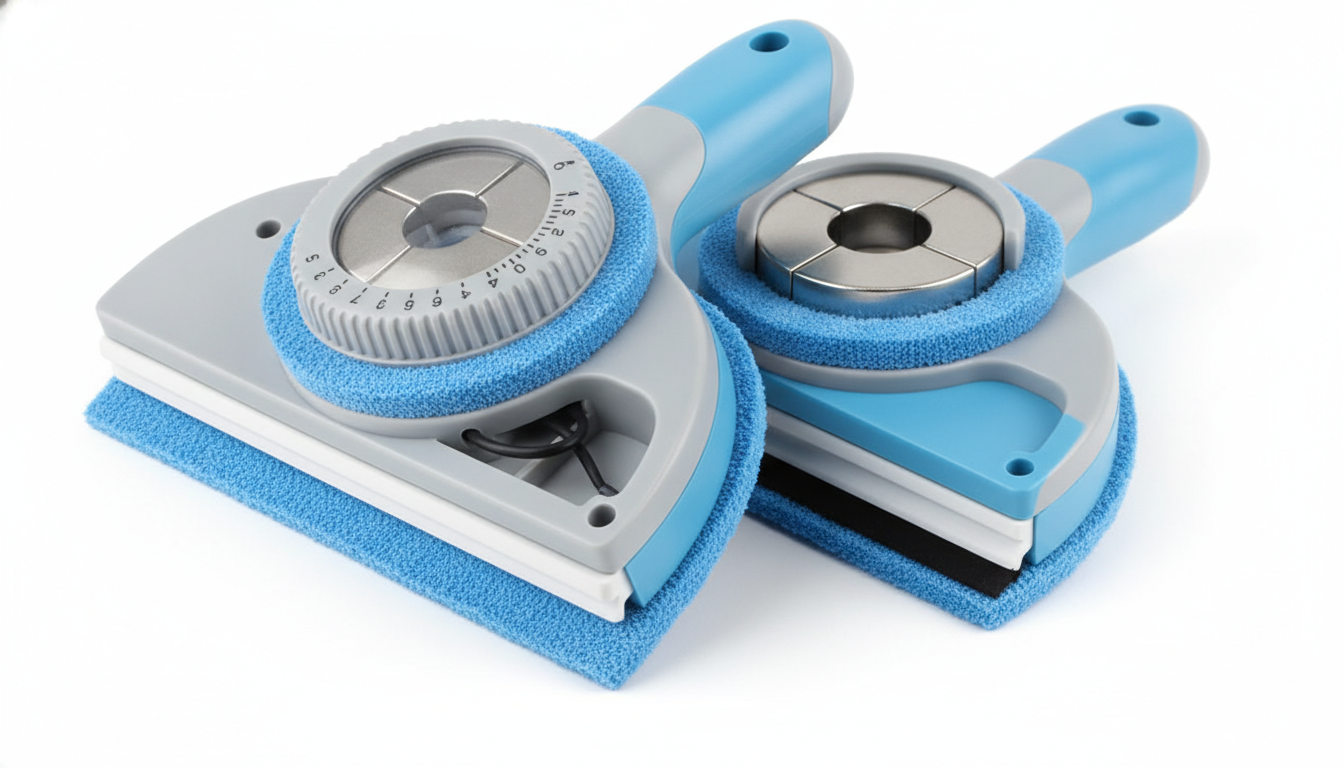
Glass Thickness Compatibility: Which Models Fit Your Markets?
The most common sampling failure is ordering a model rated for thin single-pane glass when your buyers install double-glazed units. Glass thickness determines magnetic-force requirements, and a mismatch causes the outer unit to fall or requires excessive effort to move.
Measure Glass Thickness Before You Request Samples
Single-pane residential glass in older buildings typically measures 3-8mm. Modern double-glazed units range from 15-30mm total thickness, including the air gap and two glass layers. Insulated glazing units (IGUs) with low-emissivity coatings can reach 35-45mm. Ask the manufacturer to confirm the exact mm range each SKU covers, not just a generic "fits double glazing" claim.
Fonoran’s adjustable range: Our four SKUs cover 3-30mm, 5-35mm, 8-40mm, and 10-45mm, the widest range in the industry. Each SKU uses 6-stage adjustable magnetic force to fine-tune grip within its thickness band.
Ask for a Glass-Thickness-to-SKU Chart
Request a written chart that maps glass construction types to specific model numbers. The chart should list single-pane, double-glazed, and IGU thicknesses separately, with the recommended SKU for each. A supplier who cannot provide this chart in writing either lacks technical depth or sells fixed-force units marketed with vague compatibility claims.
Verify Air-Gap Impact on Magnetic Strength
Double-glazed units have an air or argon gap between two glass panes. This gap weakens magnetic coupling because the magnet must work across a greater total distance. Ask whether the quoted mm range accounts for the full assembly thickness, including spacers and seals, or only the combined glass thickness. Misunderstanding this distinction is a frequent cause of units falling off during field use.
In practice: A home user in Germany with 36mm insulated glass needed an adjustable magnetic window cleaner; 36mm sits inside the 10-45mm SKU with room to spare, ensuring the magnet maintains grip across the thick IGU assembly.
Magnetic Force Adjustability: How Many Stages Does the Unit Offer?
Fixed-force magnets either grip too weakly and fall or grip too strongly and become difficult to move. Adjustable-force designs let users dial in the optimal strength for their specific glass thickness, reducing both drop risk and operator fatigue.
Count the Adjustment Stages
Ask how many discrete force settings the unit provides. Entry-level models may offer two or three positions, while professional-grade units provide six or more. More stages mean finer control, which matters when a single SKU must serve both thin single-pane and thick double-glazed installations. Our magnetic window cleaner product range uses 6-stage adjustment across all four thickness SKUs, allowing precise tuning within each band.
Clarify Magnet Material and Force Retention
Most manufacturers use NdFeB (neodymium-iron-boron) magnets for their high strength-to-weight ratio. Some budget models use ferrite magnets, which are heavier and weaker but more resistant to demagnetization over time. Ask which material the factory uses and whether force retention has been tested over repeated use cycles. Neodymium magnets can lose strength if exposed to high temperatures during shipping or storage, so request storage and handling guidance.
Test Separation Force During Sampling
When you receive samples, measure how much pull force is required to separate the two halves at each adjustment stage. This test reveals whether the adjustment mechanism actually changes magnetic coupling or merely repositions the magnet without altering effective force. A genuine adjustment should produce a noticeable difference in separation effort between the lowest and highest settings.
Safety Features and Drop Prevention: What Happens If the Magnet Fails?
The outer unit sits on the exterior face of a window, often many stories above ground. If magnetic grip fails, the unit falls. Buyers in liability-conscious markets require fall-safety features, and distributors face returns and complaints when those features underperform.
Safety-Rope Specification
Every magnetic window cleaner should include a safety rope that tethers the outer unit to the inner unit or to a fixed anchor point inside the building. Ask for rope material (nylon, polyester, or braided composite), rated breaking strength in kilograms or newtons, and total rope length. A rope that is too short limits the usable window area; a rope that is too weak provides false security. Request written confirmation of the rope’s load rating and whether it has been third-party tested.
Attachment-Point Strength
The rope is only as strong as its attachment point. Ask whether the attachment loop is sewn, heat-sealed, or mechanically fastened, and whether it is integrated into the housing or added as an aftermarket feature. Check whether the attachment point is reinforced and whether the factory has conducted pull tests to verify it will not tear out under shock load if the unit falls.
Behavior After Magnetic Separation
If the outer unit loses magnetic grip, does it dangle freely on the rope, or does the rope retract or lock? Some designs include a rope-lock mechanism that arrests the fall within a short distance, reducing impact force on the window frame and the rope itself. Ask the manufacturer to describe what happens in a separation event and whether the design has been drop-tested.
Cleaning Performance and Pad Durability: Will the Unit Deliver Streak-Free Results?
A magnetic window cleaner that falls off gets returned. A unit that leaves streaks gets returned and generates negative reviews. Cleaning performance depends on pad material, pad geometry, water distribution, and how well the housing maintains even pressure across the glass surface.
Pad Material and Replacement Availability
Cleaning pads wear out. Ask what material the pads are made from (microfiber, felt, sponge, or a layered composite), how many cleaning cycles the factory estimates before replacement, and whether replacement pads are sold separately. Distributors need a clear answer on spare-part availability and pricing, because buyers in commercial cleaning expect to replace pads every few months under daily use.
Streak and Lint Performance
Streaks result from uneven pressure, low-quality pad material, or water channels that leave residue. Lint comes from shedding fibers. During sampling, clean the same window section multiple times and inspect for streaks under different lighting angles. Wipe a dry microfiber cloth over the cleaned area and check for lint transfer. A pad that sheds fibers on the first use will perform worse over time.
Water-Spot Resistance
Hard water leaves mineral deposits that dull glass and require additional cleaning passes. Ask whether the factory has tested the pads with hard water and whether the design includes a squeegee edge or water-wicking channels to remove excess moisture. Some designs combine a scrubbing pad on one side with a squeegee blade on the other, reducing water spots and cutting cleaning time.
Export Compliance and Documentation: Which Certifications Does the Factory Hold?
Customs authorities and market-surveillance bodies in the EU, UK, North America, and Australia require product-safety documentation for consumer goods. Missing or incomplete certificates delay shipments, trigger inspections, and expose importers to fines.
CE Marking for the European Economic Area
Magnetic window cleaners sold in the EU and EEA must carry CE marking and comply with applicable directives, typically the General Product Safety Directive and, if the unit includes electronic components, the Low Voltage Directive or EMC Directive. Ask the manufacturer for a copy of the CE certificate, the Declaration of Conformity, and the test reports from the notified body or accredited laboratory. Verify that the certificate covers the specific model you plan to import, not a different SKU or an older design.
Fonoran holds CE certification (third-party certificate WUX202105142249ENC, issued by Shenzhen Wuxiang Testing) for our magnetic window cleaner range. We provide the Declaration of Conformity and test reports with every B2B shipment.
UKCA Marking for Great Britain
Since Brexit, Great Britain requires UKCA marking for many product categories. Ask whether the factory has completed UKCA assessment and whether the product is registered with the UK market-surveillance authority. Northern Ireland continues to recognize CE marking under the Northern Ireland Protocol, so clarify which marking applies to your distribution territory.
Material Declarations and Chemical Compliance
Some markets require declarations for restricted substances, particularly if the cleaning pads or housing materials contain plasticizers, flame retardants, or colorants. Ask whether the factory can provide a material-composition statement, a REACH declaration for the EU, or a California Prop 65 compliance letter for the United States. Even if these declarations are not legally required for your product category, having them on file accelerates customs clearance and satisfies due-diligence requirements for large retail chains.
Importer-of-Record Responsibilities
In the EU and UK, the importer of record must ensure the product bears the required marking, holds valid documentation, and includes user instructions in the local language. Ask the manufacturer whether they provide multilingual instruction sheets, whether the packaging includes space for the importer’s contact details, and whether the factory has experience supporting importers with market-surveillance inquiries.
Commercial Terms and B2B Flexibility: What Are the Real Costs and Lead Times?
Sample quality matters, but a sample that performs well is worthless if the commercial terms make the product uncompetitive in your market. The questions you ask a magnetic window cleaner manufacturer before sampling should cover MOQ, pricing structure, payment terms, lead times, and post-sample support.
MOQ for Stock Models Versus Private Label
Manufacturers typically quote different MOQs for stock models, private-label orders, and fully custom OEM projects. Stock models ship from existing inventory with minimal customization, so MOQs are lower. Private-label orders require custom packaging, labels, and barcodes, raising the MOQ. Fully custom designs involve tooling costs and longer lead times. Ask for the MOQ at each tier and whether the factory offers a sample-credit policy that offsets sample charges against the first production order.
Our 6,500m² Taizhou facility maintains stock for our four adjustable SKUs, allowing MOQ from 2 units for stock models. Private-label orders start at 500 units, and OEM tooling MOQs are quoted per project. We ship from Ningbo port to over 60 countries.
Sample Charges and Credit Policy
Most factories charge for samples to cover material, labor, and shipping costs. Ask whether sample charges are refundable, credited against the first order, or non-refundable. Clarify whether the credit applies only to orders above a certain value or MOQ threshold. Some suppliers waive sample charges for high-volume buyers or long-term partners, so state your projected annual volume when requesting samples.
Payment Terms and Currency
Standard B2B payment terms vary by supplier and buyer creditworthiness. Ask whether the factory requires full payment upfront, a deposit with balance due before shipment, or offers net terms for established customers. Clarify which currencies the factory accepts and whether exchange-rate fluctuations are absorbed by the buyer or the seller. For first-time orders, expect a deposit requirement, but negotiate the split and confirm it in writing before transferring funds.
Production Lead Time and Capacity
Lead time depends on order size, customization level, and the factory’s current production schedule. Ask for the lead time for stock models, private-label runs, and OEM projects separately. Request the factory’s daily or monthly production capacity to assess whether they can scale with your growth. A factory that produces a few hundred units per day may struggle to fulfill a container order on time, while a facility with higher capacity can absorb volume spikes and seasonal demand.
Our production lines ship 50,000+ units per day, ensuring consistent supply for distributors with recurring orders and the capacity to fulfill container volumes without extending lead times.
Reorder Pricing and Volume Discounts
Initial sample pricing rarely reflects the cost structure of a recurring relationship. Ask whether the factory offers volume discounts, tiered pricing based on annual commitment, or locked-in pricing for multi-order contracts. Clarify whether reorder pricing is guaranteed for a specific period or subject to change based on raw-material costs, labor rates, or currency fluctuations.
Quality Assurance and Testing: How Does the Factory Control Consistency?
A sample represents one unit from one production batch. Consistent quality across thousands of units requires documented QC processes, incoming-material controls, in-line inspection, and final pre-shipment checks.
Incoming-Material Inspection
Magnet strength, pad material, housing plastic, and safety-rope specifications must meet defined tolerances. Ask whether the factory inspects incoming materials against written specifications, whether suppliers provide material certificates, and what happens when a batch fails inspection. Factories that skip incoming inspection pass defects downstream, where they become field failures and returns.
In-Line and Final Inspection
Ask what percentage of units undergo in-line inspection during assembly and what defects the inspection catches. Request the factory’s acceptable quality limit (AQL) for critical, major, and minor defects. A factory that cannot state its AQL or claims zero defects either lacks a formal QC system or is not being transparent. Typical AQLs for consumer goods range from 1.5 to 2.5 for critical defects and 2.5 to 4.0 for major defects.
Pre-Shipment Inspection and Test Reports
Before a container ships, a third-party inspection company or the factory’s own QC team should conduct a final check. Ask whether pre-shipment inspection is included in the quoted price, whether you can appoint your own inspector, and whether the factory provides test reports for magnet strength, safety-rope breaking strength, and pad abrasion resistance. Factories that resist third-party inspection often have quality issues they prefer to conceal.
Defect Threshold and Warranty Handling
No production run is perfect. Ask what defect rate the factory considers acceptable, how defects are classified, and what happens if the defect rate exceeds the agreed threshold. Clarify the warranty period, whether the factory replaces defective units or issues credit, and who pays return shipping for warranty claims. Distributors need a clear, written warranty policy to manage their own customer commitments.
Key Takeaways
- Glass-thickness compatibility is the most common cause of magnetic window cleaner failures; verify the exact mm range each SKU covers and whether it accounts for air gaps in double-glazed units before requesting samples.
- Adjustable magnetic force reduces both drop risk and operator fatigue; ask how many adjustment stages the unit offers and whether the mechanism produces measurable differences in separation force.
- Safety-rope specifications should include material type, breaking strength, and attachment-point construction; request pull-test data and ask what happens if the outer unit loses magnetic grip during use.
- Export compliance documentation varies by destination market; confirm which certifications the factory holds, whether test reports and Declarations of Conformity are provided, and whether multilingual instructions are available.
- MOQ, sample charges, and payment terms differ for stock models, private-label orders, and OEM projects; clarify each tier separately and ask whether sample charges are credited against the first production order.
- Quality consistency depends on documented incoming-material inspection, in-line checks, and pre-shipment inspection; ask for the factory’s AQL, defect thresholds, and warranty policy in writing.
Frequently Asked Questions
How do I verify a factory’s production capacity before placing a large order?
Request a factory audit report from a third-party inspection company, or arrange a video tour of the production floor. Ask for the number of production lines, daily output per line, and current utilization rate. Cross-check the stated capacity against the factory’s workforce size and facility area. A factory claiming high daily output with a small workforce or limited floor space is likely outsourcing production or overstating capacity.
What should I do if the sample performs well but the first production batch has quality issues?
Include a pre-shipment inspection clause in your purchase agreement that allows you or a third-party inspector to examine the finished goods before they leave the factory. Specify the AQL and the inspection standard (such as ANSI/ASQ Z1.4) in the contract. If defects exceed the agreed threshold, the contract should state whether the factory must rework the batch, offer a discount, or cancel the shipment without penalty. Document all defects with photos and inspection reports to support any claim.
Can I request a custom magnet strength or glass-thickness range not listed in the factory’s standard SKUs?
Most factories accept OEM requests for custom magnet configurations, but this typically requires tooling investment, longer lead times, and higher MOQs. Ask whether the factory has experience developing custom magnetic assemblies, what the tooling cost will be, and whether you will own the tooling or the factory retains it. Request a prototype or pre-production sample to verify the custom specification before committing to a full production run. Clarify intellectual-property ownership if the design involves proprietary features.
Requesting samples without asking the right questions wastes time and money. Verify glass-thickness coverage, adjustable-force stages, safety-rope specifications, export certifications, MOQ tiers, and quality-control processes before you commit to a supplier. A factory that answers these questions clearly and provides documentation to back its claims is positioned to support your distribution business over the long term.
Ready to request samples with full technical and commercial transparency?
Request Your Sample Quote →
Written by the Fonoran Export Team.