Microfiber Duster: B2B Sourcing Guide for Distributors (2026)
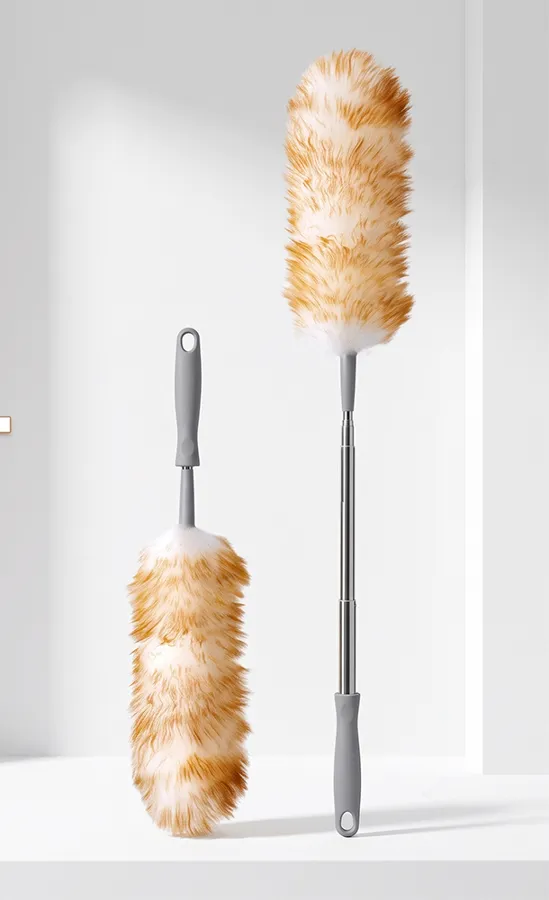
A microfiber duster is a reusable cleaning tool with synthetic split-fiber heads that trap dust electrostatically, designed for high-reach surfaces like ceiling fans, blinds, and crown molding. For B2B buyers, key specs include handle extension range (typically 30-100 inches), head material density (grams per square meter), washability cycles before fiber degradation, and MOQ thresholds for private-label orders.
📋 Table of Contents
Executive Summary
- Dust-Capture Mechanism: Split microfiber strands create electrostatic attraction, holding dust particles rather than redistributing them into the air.
- Durability Threshold: Wholesale buyers report fiber shedding and handle instability as the top two quality complaints; screen for fiber density above 200 GSM and locking-collar mechanisms rated for repeated extension cycles.
- Washability Standard: Commercial-grade microfiber dusters withstand 50+ machine-wash cycles at 60°C before noticeable fiber breakdown; verify washing instructions and dry-time claims with third-party test reports.
- MOQ for Private Label: Stock models typically require minimum orders starting from 2 units, while custom branding and packaging begin at 500 units for most factory-direct suppliers.
- Facility-Management Use Case: Large-site janitorial workflows favor color-coded microfiber duster sets to prevent cross-contamination between zones (e.g., restrooms vs. food-prep areas).
Why Microfiber Outperforms Traditional Dusters
Microfiber dusters trap dust through electrostatic charge rather than mechanical capture alone. Each fiber is split into wedge-shaped strands during manufacturing, creating microscopic hooks that hold particles until the head is washed. Feather dusters and untreated cloth simply push dust from one surface to another, requiring follow-up wiping.
Electrostatic vs. Mechanical Trapping
Split microfiber generates static electricity through friction as the head moves across surfaces. Dust particles, which carry a slight positive charge, adhere to the negatively charged fibers. This effect persists across multiple rooms before the head becomes saturated. Feather dusters lack this electrostatic property and rely solely on the barbs of natural feathers to snag larger debris, leaving fine dust airborne.
Reusability and Lifecycle Economics
A commercial-grade microfiber duster head withstands 50 to 100 wash cycles before fiber integrity declines. Disposable dusting wipes and refills generate recurring costs that exceed the purchase price of a reusable unit within three months of daily use. Facility-management buyers calculate cost-per-clean by dividing the duster’s landed cost by the number of washes it survives, making washability test data a critical procurement criterion.
Surface Compatibility
Microfiber’s soft, flexible strands clean delicate surfaces, glass, lacquered wood, electronics, without scratching. Feather dusters can leave quill fragments on sticky or textured surfaces, and disposable wipes may contain abrasive binders. Distributors serving high-end residential or commercial interiors prioritize scratch-free certification in supplier specifications.
Material Specs Distributors Must Verify
Material density, fiber split ratio, and blend composition determine a microfiber duster’s dust-holding capacity and wash durability. Buyers should request lab test reports for fiber weight, split count, and abrasion resistance before committing to container orders.
Fiber Density (GSM)
Grams per square meter (GSM) measures the mass of microfiber in the duster head. Heads below 200 GSM feel thin and shed fibers after a few washes. Mid-grade commercial dusters range from 220 to 280 GSM, balancing dust capture with quick drying. Premium models exceed 300 GSM but take longer to air-dry, which matters for high-turnover janitorial operations.
Fiber Split Ratio
Each microfiber strand is mechanically or chemically split into 4 to 16 wedge-shaped segments. Higher split counts create more surface area for dust adhesion but also increase manufacturing cost. Suppliers rarely publish split ratios; distributors can request microscope images or third-party textile reports to verify claims.
Polyester-to-Polyamide Blend
Most microfiber dusters use an 80/20 or 70/30 polyester-to-polyamide blend. Polyester provides structure and durability; polyamide (nylon) enhances electrostatic charge and water absorption. Blends skewed too heavily toward polyester dry faster but hold less dust. Blends with excess polyamide trap more particles but take longer to dry and cost more per kilogram of raw material.
Factory Insight: Our Taizhou facility produces household cleaning tools including dusters, squeegees, and mops. We ship from Ningbo port to 60+ countries, with MOQ from 2 units for stock models.
Durability Complaints and How to Screen Suppliers
Fiber shedding ranks as the most common buyer complaint in retail review data. Distributors mitigate this risk by requiring abrasion-cycle test reports and sample washing before placing bulk orders.
Fiber Shedding After Repeated Use
Low-density microfiber heads shed loose strands during the first few uses, leaving fibers on cleaned surfaces. This occurs when the textile is not heat-set properly during manufacturing or when the fiber blend includes short-staple polyester. Buyers report that dusters shedding more than a few visible fibers per wash cycle fail to meet commercial standards. Request a sample, wash it three times at 60°C, and inspect for loose threads before ordering.
Abrasion Resistance Testing
Abrasion testing simulates repeated friction against surfaces. Suppliers should provide Martindale abrasion test results showing the duster head withstands at least 10,000 cycles without visible pilling or fiber breakage. Labs measure this by rubbing the fabric against a standard wool surface under controlled pressure. Heads that fail below 8,000 cycles degrade quickly in daily janitorial use.
Stitching and Edge Binding
The seam where the microfiber head attaches to the handle core is the second most common failure point. Distributors should inspect samples for double-stitched seams with reinforced binding tape. Single-stitch construction unravels after 10 to 20 washes, especially when the duster is wrung out by hand. Ultrasonic-welded edges offer higher durability than traditional stitching but add cost.
Microfiber quality can be evaluated by measuring fiber shedding during repeated wash cycles, with lower fiber loss indicating better durability.
Handle Design: Stability at Full Extension
Extendable handles enable high-reach dusting without ladders, but poor locking mechanisms cause wobble and user fatigue. Distributors serving professional cleaning contractors prioritize handle rigidity and lock reliability over maximum extension length.
Telescoping Sections and Lock Types
Most extendable microfiber dusters use two to four nested aluminum or stainless-steel tubes. Twist-lock collars grip the inner tube through friction; flip-lock clamps use a lever to engage a notch. Twist locks are lighter and cheaper but loosen over time as the collar threads wear. Flip locks maintain tension longer but add weight and can pinch fingers during adjustment.
Material and Wall Thickness
Aluminum handles under 0.8 mm wall thickness bend when extended beyond 60 inches and loaded with the weight of a wet microfiber head. Stainless steel offers greater rigidity at the same wall thickness but increases the handle’s overall weight, which matters for overhead work. Distributors should request the handle’s outer diameter, wall thickness, and material grade (e.g., 6061 aluminum alloy) to calculate bending resistance.
Wobble Test Protocol
Extend the handle to its maximum length, lock it, and hold it horizontally at arm’s length. A well-designed handle deflects less than 10 degrees from horizontal under its own weight. Handles that droop more than 15 degrees feel unstable during ceiling-fan dusting and increase the risk of the head detaching. Perform this test on samples before committing to a purchase order.
Washability and Drying Time
Washable microfiber duster heads reduce long-term consumable costs, but buyers must verify washing temperature limits and drying time to fit operational workflows. Heads that take more than 12 hours to air-dry create inventory bottlenecks in high-turnover facilities.
Washing Temperature and Detergent Compatibility
Microfiber retains its electrostatic properties when washed at 60°C or below. Higher temperatures can melt the polyamide fibers and collapse the split structure. Fabric softeners coat the fibers with a waxy residue that blocks dust adhesion; distributors should specify ‘no fabric softener’ in care labels. Bleach weakens polyester over time, so chlorine-based cleaners are unsuitable for microfiber maintenance.
Drying Time and Air-Flow Requirements
A 250 GSM microfiber duster head air-dries in 8 to 10 hours when hung in a well-ventilated space. Thicker heads (300+ GSM) may require 14 to 16 hours or tumble drying on low heat. Facility managers operating two-shift cleaning schedules need enough spare heads to maintain continuous availability. Calculate the number of spare heads by dividing the drying time by the shift length, then rounding up.
Tumble-Dry Compatibility
Some microfiber blends tolerate low-heat tumble drying (below 50°C), which reduces drying time to under 2 hours. High heat shrinks the fibers and damages the electrostatic coating. Suppliers should provide tumble-dry test results showing the head retains at least 95% of its original dimensions and dust-capture performance after 20 cycles. Heads that shrink more than 5% no longer fit standard handle cores.
MOQ and Private-Label Options
Minimum order quantities vary by customization level. Stock models with generic branding start from as few as 2 units, while private-label packaging starts at 500 units per SKU; custom colors are quoted per project. Distributors entering new markets should order samples and small test batches before committing to branded inventory.
Stock Model MOQ
Factory-direct suppliers maintain inventory of popular configurations, typically 30-inch to 60-inch extendable handles with standard microfiber heads. These stock models carry MOQs as low as 2 units for sample evaluation. Distributors can mix SKUs within a single order to test multiple handle lengths or head densities before scaling up.
Private-Label Packaging and Branding
Custom packaging with the buyer’s logo, care instructions, and barcodes typically requires a 500-unit minimum per SKU. Suppliers charge a one-time setup fee for printing plates and die-cutting molds, which ranges widely depending on packaging complexity. Full-color printed sleeves cost more than simple sticker labels but enhance retail shelf appeal. Distributors should request digital proofs and physical mockups before approving the print run.
Custom Colors and Handle Finishes
Color-coded microfiber duster sets prevent cross-contamination in facility-management workflows. A hospital might use blue dusters in patient rooms, red in restrooms, and green in kitchens. Custom dye lots are quoted per project because of dye-batch setup cost. Anodized aluminum handles in custom colors (e.g., gold, matte black) also carry higher MOQs and longer lead times than standard silver or gray finishes.
- Stock Models: MOQ from 2 units, generic branding.
- Private-Label Packaging: MOQ 500 units per SKU, 15-20 day lead time, custom logo and care labels.
- Custom Colors: Minimum order quantities, lead times, and dye-batch setup fees are confirmed at quotation.
- OEM Handle Design: MOQ quoted per project, requires mold tooling for non-standard diameters or grip patterns.
Compliance and Certification for Export Markets
Microfiber cleaning tools sold in the EU require CE marking if they include electrical components (e.g., battery-powered rotation). Non-electric dusters fall outside the CE Directive scope but must comply with REACH substance restrictions, particularly for dyes and adhesives. RoHS compliance applies if the handle contains electronic parts like LED indicators. Distributors in the US face no federal certification requirement for manual dusters, but California Proposition 65 may apply if the product contains certain phthalates or heavy metals in the handle grip.
Key Takeaways
- Microfiber dusters trap dust electrostatically through split-fiber strands, reducing airborne particle redistribution compared to feather or disposable alternatives.
- Fiber density above 200 GSM and abrasion resistance exceeding 10,000 Martindale cycles indicate commercial-grade durability suitable for facility-management contracts.
- Handle stability at full extension depends on wall thickness (minimum 0.8 mm for aluminum) and locking-collar design; flip locks maintain tension longer than twist locks.
- Washability at 60°C without fabric softener preserves electrostatic properties; air-dry time ranges from 8 to 16 hours depending on GSM, affecting inventory turnover in multi-shift operations.
- Stock model MOQ starts from 2 units for sample evaluation, while private-label packaging requires 500 units; custom colors are quoted per project.
- Non-electric dusters generally fall outside CE directive scope, while dusters with electrical components carry extra EU requirements; US distributors should check California Proposition 65 for handle materials.
Frequently Asked Questions
How many washes does a microfiber duster head last?
Commercial-grade microfiber duster heads withstand 50 to 100 machine-wash cycles at 60°C before fiber breakdown becomes visible. Actual lifespan depends on fiber density (GSM), washing frequency, and whether fabric softener is avoided. Heads below 200 GSM typically fail after 30 washes, while premium 300+ GSM heads can exceed 100 cycles. Distributors should request third-party wash-durability test reports showing fiber retention after 50 cycles to verify supplier claims before bulk orders.
What causes microfiber duster handles to wobble at full extension?
Handle wobble results from insufficient wall thickness (below 0.8 mm for aluminum tubes), worn locking-collar threads, or excessive extension length relative to tube diameter. Handles that deflect more than 10 degrees from horizontal when extended and held at arm’s length feel unstable during overhead dusting. Flip-lock mechanisms maintain clamping pressure longer than twist locks, which loosen as threads wear. Distributors should perform a horizontal-deflection test on samples before ordering and specify minimum wall thickness and lock type in purchase orders.
Can microfiber dusters be tumble-dried?
Some microfiber blends tolerate low-heat tumble drying (below 50°C), reducing drying time from 10 hours to under 2 hours. High heat shrinks polyamide fibers and damages the electrostatic coating, causing the head to lose dust-capture performance. Suppliers should provide tumble-dry test results showing the head retains at least 95% of its original dimensions and electrostatic properties after 20 cycles. Heads that shrink more than 5% no longer fit standard handle cores, creating inventory waste. Facility managers with high-turnover cleaning schedules should verify tumble-dry compatibility before ordering.
Ready to source commercial-grade microfiber dusters with verified wash-cycle durability and flexible MOQ?
Request a Quote & Sample Pack →
Written by the Fonoran Export Team.