Window Squeegee Professional: B2B Sourcing & Bulk Specs (2026)

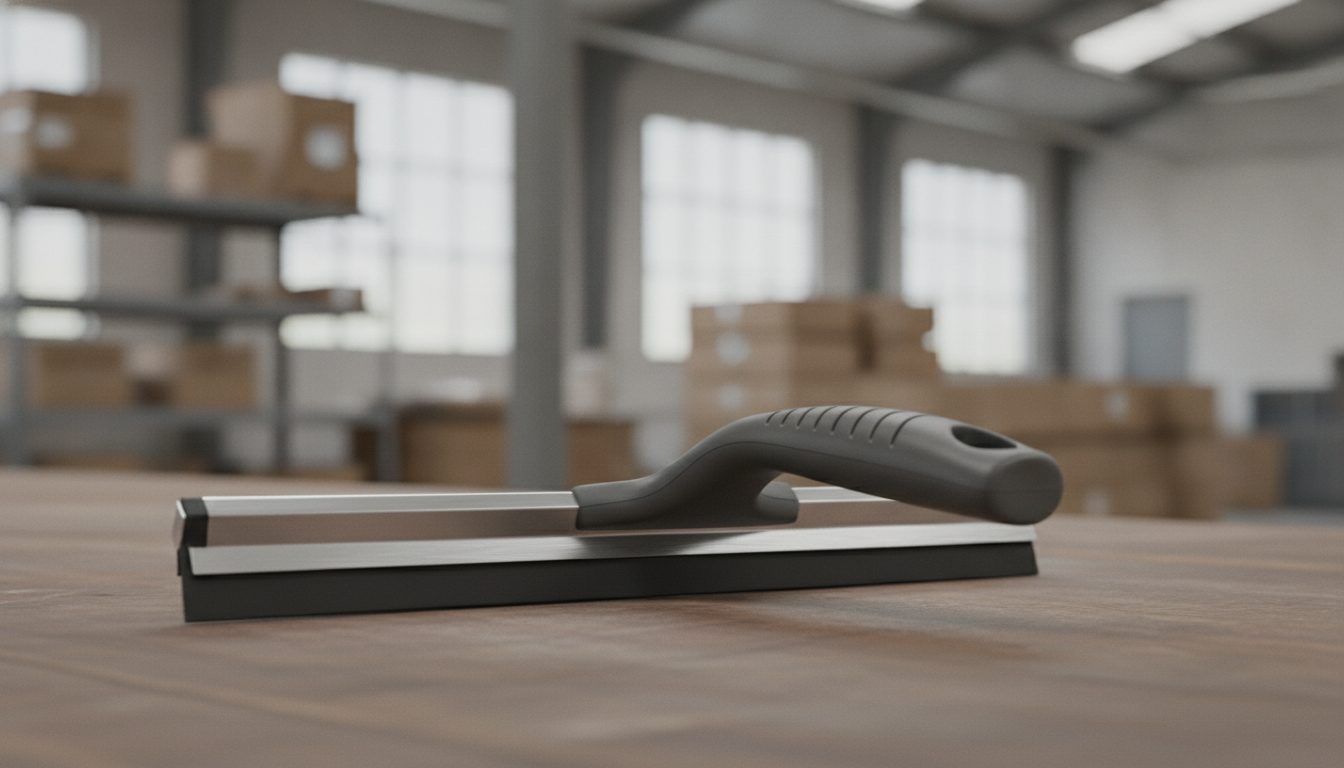
A window squeegee professional tool typically features a stainless-steel or brass channel, a natural rubber or silicone blade, and an ergonomic handle designed for all-day use. Distributors and facility-management buyers sourcing in bulk should verify blade durability (natural rubber degrades faster but wipes cleaner; silicone lasts longer), handle balance for fatigue reduction, and whether the supplier offers private-label packaging from reasonable MOQ thresholds.
Key Takeaways
- Professional-grade squeegees use natural rubber or silicone blades; natural rubber delivers streak-free results but requires seasonal replacement, while silicone resists UV and temperature extremes.
- Channel widths for commercial use range from 10 inches (tight corners, vehicle glass) to 18 inches (storefront and curtain-wall facades); wider channels reduce pass count but demand stronger wrist control.
- Magnetic window cleaners address high-rise and exterior-access challenges that pole-mounted squeegees cannot solve safely, covering glass thickness from 3mm single-pane to 45mm insulated double glazing.
- Buyers should confirm which directives apply to their specific model when selling cleaning equipment in the EUh embedded grips.
- Fonoran ships magnetic window cleaner product range from a 6,500m² Taizhou facility with MOQ from 2 units for stock models and 500 units for private-label runs, exported to 60+ countries.
Blade Material: Natural Rubber vs Silicone
Blade composition determines streak performance, replacement frequency, and total cost of ownership across a cleaning contract or distributor inventory cycle.
Natural Rubber
Natural rubber remains the default for streak-free glass in moderate climates. The material conforms to microscopic glass irregularities, sweeping water and detergent residue in a single pass when the blade edge is sharp. Ultraviolet exposure and ozone degrade the polymer within 6-12 months of daily outdoor use, causing the edge to harden and leave streaks. Window-cleaning contractors in temperate zones replace natural-rubber blades every season; facility teams managing interior atriums see 18-24 month service life because indoor UV is negligible.
Silicone
Silicone blades tolerate temperature swings from -20°C to +60°C without stiffening, making them the choice for year-round outdoor work in regions with harsh winters or desert heat. The trade-off is a slightly firmer wipe: silicone does not flex as intimately around glass texture, so a second pass is sometimes needed on heavily soiled panes. Distributors serving facility-management firms in the Middle East or Northern Europe stock silicone-blade squeegees to reduce callback rates tied to blade failure.
Dual-Edge and Reversible Blades
Some professional models feature a dual-edge rubber strip: when one edge dulls, the operator flips the blade 180° and continues. This design doubles usable life and cuts downtime during multi-story jobs where descending to replace a blade interrupts workflow.
Channel Width and Handle Ergonomics
Channel width, handle length, and grip design directly affect operator fatigue and the number of passes required to clear a given square meterage.
Handle Design
Fixed-handle squeegees suit ground-level and ladder work where the operator controls angle by wrist rotation. Swivel-head models let the blade pivot 180°, useful when cleaning both sides of a pane from a single position or working around mullion frames. Extension-pole compatibility is critical for buyers equipping teams that service second-story windows without scaffolding; the threaded socket should accept ACME or Euro-thread poles up to 6 meters without wobble.
Grip Material and Fatigue
Thermoplastic rubber (TPR) grips reduce hand fatigue during eight-hour shifts. Hard-plastic handles cause pressure points and blisters when wet; distributors serving professional contractors should verify that the grip material remains tacky when soapy water runs down the handle. Some high-end models embed a soft gel core that absorbs vibration during aggressive scrubbing, a feature valued by teams cleaning textured or patterned glass that requires extra pressure.
Scrubber-Squeegee Combo Tools
Combination tools pair a microfiber or synthetic scrubber sleeve on one side of the handle with a squeegee blade on the other, eliminating the need to switch implements mid-task.
When Combos Accelerate Workflow
For lightly soiled glass (weekly maintenance, interior partitions), a combo tool cuts task time by 30, 40% because the operator wets and scrubs in one motion, flips the tool, then squeegees without setting anything down. Facility-management teams cleaning office buildings favor this approach for routine touch-ups.
When Separate Tools Outperform Combos
Heavily soiled exteriors (post-construction dust, bird droppings, industrial fallout) require a dedicated scrubber with stiff bristles or an abrasive pad to break down grime before squeegeeing. Attempting this with a combo tool’s thin sleeve leaves residue that the squeegee blade then smears. Professional window-cleaning contractors working on new-build handovers or after sandstorms carry separate scrubbers and squeegees, accepting the extra weight for superior results.
In practice: Magnet strength must match glass thickness, because a unit tuned for thin single glazing loses grip across thick insulated double glazing, and an overpowered unit can crack delicate heritage glass.
Magnetic Window Cleaners vs Pole-Mounted Squeegees
Distributors and facility buyers often weigh magnetic cleaners against extension-pole squeegees when planning high-rise or exterior-access programs.
Cost and Deployment Considerations
A 6-meter carbon-fiber pole with a swivel head and quick-release clamp costs facility buyers roughly the same as a mid-tier magnetic cleaner, but the pole requires outdoor access (sidewalk, courtyard, scaffolding) that many urban high-rises lack. Magnetic units eliminate fall risk because the operator never leaves the building, a decisive advantage for high-rise magnetic window cleaner deployments in jurisdictions with strict work-at-height regulations. Water-fed pole systems deliver the longest reach but demand a deionization rig, regular resin replacement, and training in brush technique; total capital outlay runs three to five times higher than magnetic or manual squeegee solutions.
Bulk Procurement: MOQ and Private-Label Options
Hardware wholesalers and distributors entering the professional window-cleaning segment need clarity on minimum order quantities, lead times, and branding flexibility.
Stock-Model MOQ
Factory-direct suppliers of window squeegee professional tools offer stock-model MOQ from 2 units, with mixed-SKU container loads accepted once the buyer has completed an initial trial order. Fonoran’s magnetic window cleaner line ships with MOQ from 2 units for stock models, allowing distributors to test market fit before committing to container volumes.
Private-Label and Custom Branding
Private-label programs require 500, 1,000 units per design to justify custom-printed packaging, logo embossing on handles, and blade sleeves in the buyer’s brand colors. Lead time for the first private-label run is 15, 20 days (artwork approval, mold adjustment if handle shape changes, pre-production sample, bulk production, export documentation). Repeat-order lead time is confirmed at quotation because tooling is already on file. Buyers should budget for a one-time setup fee covering packaging plates and handle molds; this fee is typically amortized across the first two orders.
OEM and ODM Pathways
OEM (Original Equipment Manufacturer) arrangements let the buyer specify exact blade durometer, channel alloy, and handle geometry while the factory manages production. ODM (Original Design Manufacturer) partnerships go further: the factory’s engineering team co-develops a new squeegee design (for example, a quick-release blade cartridge or a telescoping handle) that the buyer brings to market under its own brand. ODM MOQ is confirmed at quotation because mold costs and prototyping are amortized over the initial production run. Our custom magnetic window cleaner and private label magnetic window cleaner services follow this model, with all commercial terms confirmed at quotation.
Compliance and Certifications for Export Markets
Distributors importing into the EU, UK, North America, or Australia must verify that cleaning tools meet regional safety and materials-restriction standards.
European Union: CE and RoHS
CE marking is mandatory for cleaning equipment sold in the EU; it signals conformity with the Low Voltage Directive (if the tool incorporates electrical components, such as a battery-powered scrubber) or the General Product Safety Directive for manual tools. RoHS (Restriction of Hazardous Substances) limits lead, mercury, cadmium, hexavalent chromium, and certain flame retardants to below 0.1% by weight in handles, grips, and any embedded electronics. Fonoran holds third-party CE certification (certificate WUX202105142249ENC issued by Shenzhen Wuxiang Testing), available for distributor due diligence upon request.
United Kingdom: UKCA
Post-Brexit, the UK accepts CE marking under a transitional arrangement, but from 2025 onward the UKCA (UK Conformity Assessed) mark becomes mandatory for goods placed on the Great Britain market (England, Wales, Scotland; Northern Ireland follows EU rules). Importers should confirm whether their supplier has initiated UKCA certification or plans to do so before the transition deadline.
North America: Material Safety and Labeling
The United States and Canada do not require pre-market certification for manual cleaning tools, but California Proposition 65 mandates warning labels if the product contains chemicals (such as certain plasticizers in rubber grips) known to cause cancer or reproductive harm above safe-harbor thresholds. Distributors serving the California market should request a Prop 65 compliance statement and, if needed, pre-printed warning labels in English and Spanish.
Australia: Voluntary Standards
Australia has no mandatory certification for non-electrical squeegees, and facility-management buyers conducting tender evaluations. Our magnetic window cleaner Australia shipments include RoHS and CE documentation, which Australian importers cite in their own product-safety declarations.
Supplier Verification Before Placing Bulk Orders
Hardware wholesalers and facility-procurement teams mitigate risk by auditing factory credentials, production capacity, and quality-control protocols before committing to container orders.
- Factory Ownership and Tenure: Verify the supplier owns or leases its production facility under a long-term contract; shell companies that subcontract all manufacturing cannot guarantee consistent quality or protect your mold investment. Fonoran operates a 6,500m² owned facility in Taizhou, Zhejiang, with 60+ skilled workers and a daily output exceeding 50,000 magnetic window cleaner units.
- Third-Party Certifications: Request scanned copies of CE, RoHS, or ISO certificates and cross-check the certificate number with the issuing body’s online registry. Forged certificates circulate widely; a five-minute lookup prevents costly customs holds.
- Production-Capacity Evidence: Ask for time-stamped photos of the assembly line, injection-molding machines, and finished-goods warehouse. A factory claiming 10,000 units per day should show multiple molding presses and a staging area large enough to hold several days’ output.
- Sample Quality and Consistency: Order pre-production samples from three different production batches (if the supplier has been operating for months) to check for variation in blade thickness, channel straightness, and handle-grip adhesion. Inconsistent samples signal inadequate process control.
- Payment Terms and Escrow: For first orders, propose a 30% deposit with the 70% balance held in trade escrow (Alibaba Trade Assurance, Payoneer Escrow, or bank-issued documentary credit) released only after you confirm goods match the approved sample. Suppliers confident in their quality accept escrow without hesitation.
Streak-Free Technique: What Distributors Should Train End Users
Distributors selling window squeegee professional tools to cleaning contractors or facility teams add value by including technique guidance in product documentation or on-site training sessions.
Blade Angle and Pressure
The squeegee blade should contact the glass at a 30, 45° angle, with firm but not crushing pressure. Too shallow an angle leaves water behind; too steep an angle causes the blade to skip and chatter, producing streaks. Operators learn optimal angle by feel within the first dozen windows, but initial training shortens the learning curve and reduces wasted cleaning solution.
Overlap and Direction
Each pass should overlap the previous stroke by 2, 3 cm to prevent unwiped strips. Top-to-bottom vertical strokes work best on tall panes (office partitions, storefront glass) because gravity pulls residual water downward, away from the cleaned area. Side-to-side horizontal strokes suit wide, short windows (residential casements, vehicle glass) where the operator can reach both edges without repositioning.
Blade Maintenance
Wipe the blade edge with a lint-free cloth after every three to four passes to remove grit that scratches glass and causes streaks. Inspect the edge weekly for nicks; a single 2 mm nick leaves a visible line across every pane. Distributors who stock replacement blades as a separate SKU capture recurring revenue and keep contractor customers loyal, because a contractor who cannot source blades quickly will switch to a supplier who can.
ROI Comparison: Magnetic Cleaners vs Manual Squeegee Programs
Facility-management buyers evaluating total cost of ownership compare capital outlay, labor hours, safety incidents, and consumable replacement across a 36-month contract cycle.
For buildings above three stories, magnetic cleaners eliminate scaffolding rental and work-at-height permits, delivering payback within 12, 18 months despite similar upfront unit cost. Ground-level and low-rise facilities see less dramatic savings, making pole-mounted squeegees the pragmatic choice when outdoor access is straightforward.
Fonoran Factory Capabilities and Service Model
Our 6,500m² Taizhou facility produces magnetic window cleaners covering 3, 45mm glass thickness across four adjustable SKUs (3-30mm, 5-35mm, 8-40mm, 10-45mm), the widest range in the industry. Each unit features six-stage adjustable magnetic force, letting facility teams and cleaning contractors dial the exact grip needed for single-pane, double-pane, or thick insulated glazing without switching tools. NdFeB magnets (except the FN-Classic 3-8mm SKU, which uses Ferrite) maintain pull strength across tens of thousands of cleaning cycles, and the safety tether prevents the outer unit from falling if magnetic grip is momentarily lost during repositioning.
We ship to 60+ countries from Ningbo port, with MOQ from 2 units for stock models and 500 units for private-label runs. Lead time, payment terms, and container load quantities are confirmed at quotation based on your order profile and destination. Our export team supports distributors, hardware wholesalers, and magnetic window cleaner for cleaning companies deployments with technical datasheets, compliance documentation (CE certificate WUX202105142249ENC, RoHS), and product-matching guidance to ensure the SKU you order fits the glazing your end customers encounter.
Frequently Asked Questions
What blade material lasts longest in outdoor climates?
Silicone blades outlast natural rubber in outdoor environments because they resist ultraviolet degradation and temperature extremes from -20°C to +60°C. Natural rubber delivers superior streak-free performance in moderate climates but hardens and cracks within 6, 12 months of daily UV exposure. Distributors serving facility-management firms in desert or arctic regions should stock silicone-blade squeegees to minimize callback rates tied to premature blade failure, while those in temperate zones can offer natural rubber for its unmatched wipe quality and lower unit cost.
How do I match squeegee channel width to building type?
Channel width should balance coverage speed against operator control. A 10, 12 inch channel suits tight mullions, vehicle glass, and residential casement windows where maneuverability matters more than pass count. A 14, 16 inch channel works for mid-rise office partitions and retail storefronts, reducing passes per square meter without overwhelming wrist strength. An 18, 22 inch channel accelerates work on high-rise curtain walls and airport terminals but demands strong forearm endurance and precise angle control. Facility buyers equipping mixed building portfolios often stock two widths to let teams choose the optimal tool per job.
Can one magnetic window cleaner handle both single-pane and double-glazed windows?
Yes, if the unit offers adjustable magnetic force across a range that spans both glass types. Single-pane windows typically measure 3, 8mm, while standard double glazing runs 20, 30mm; a fixed-strength magnet tuned for one thickness will either lose grip or risk cracking the other. Fonoran’s adjustable SKUs cover 3-30mm, 5-35mm, 8-40mm, and 10-45mm with six-stage force adjustment, letting a single unit adapt to the exact pane thickness without switching tools. Buyers should measure the thickest glass in their building portfolio and select the SKU whose upper limit exceeds that measurement by at least 5mm to ensure reliable grip.
Ready to source window squeegee professional tools or compare magnetic window cleaner options for your distribution channel or facility portfolio?
Request Product Specs & MOQ →
Written by the Fonoran Export Team.