Safety Rope Magnetic Window Cleaner Factory Direct (2026 Review)

Professional window cleaning contractors and facility managers face a recurring problem: magnetic window cleaners that fall during vertical movement, risking equipment damage and liability exposure. The safety rope attachment has become a non-negotiable requirement for commercial operations, yet sourcing units that combine safety tethering with the correct magnetic strength for your specific glass thickness remains difficult. This safety rope magnetic window cleaner factory direct review examines the engineering and procurement considerations that separate reliable industrial-grade equipment from consumer-oriented alternatives.
Key Takeaways
- Safety rope systems prevent complete unit loss when magnetic grip fails during vertical movement on high-rise glass facades.
- Adjustable magnetic force across six stages allows a single unit to handle glass thickness from 5mm to 35mm without changing equipment.
- ISO9001 certification and CE marking confirm consistent manufacturing quality control and EU market compliance for commercial cleaning equipment.
- Factory-direct sourcing from Taizhou manufacturing clusters typically reduces landed cost by 20-30% compared to trading company channels.
- Minimum order quantities starting at 100 units make direct import feasible for mid-sized distributors and regional facility management firms.
- Production capacity of 50,000+ units per day from large-scale facilities ensures reliable delivery schedules for bulk seasonal orders.
Why Safety Rope Attachment Matters in Commercial Window Cleaning
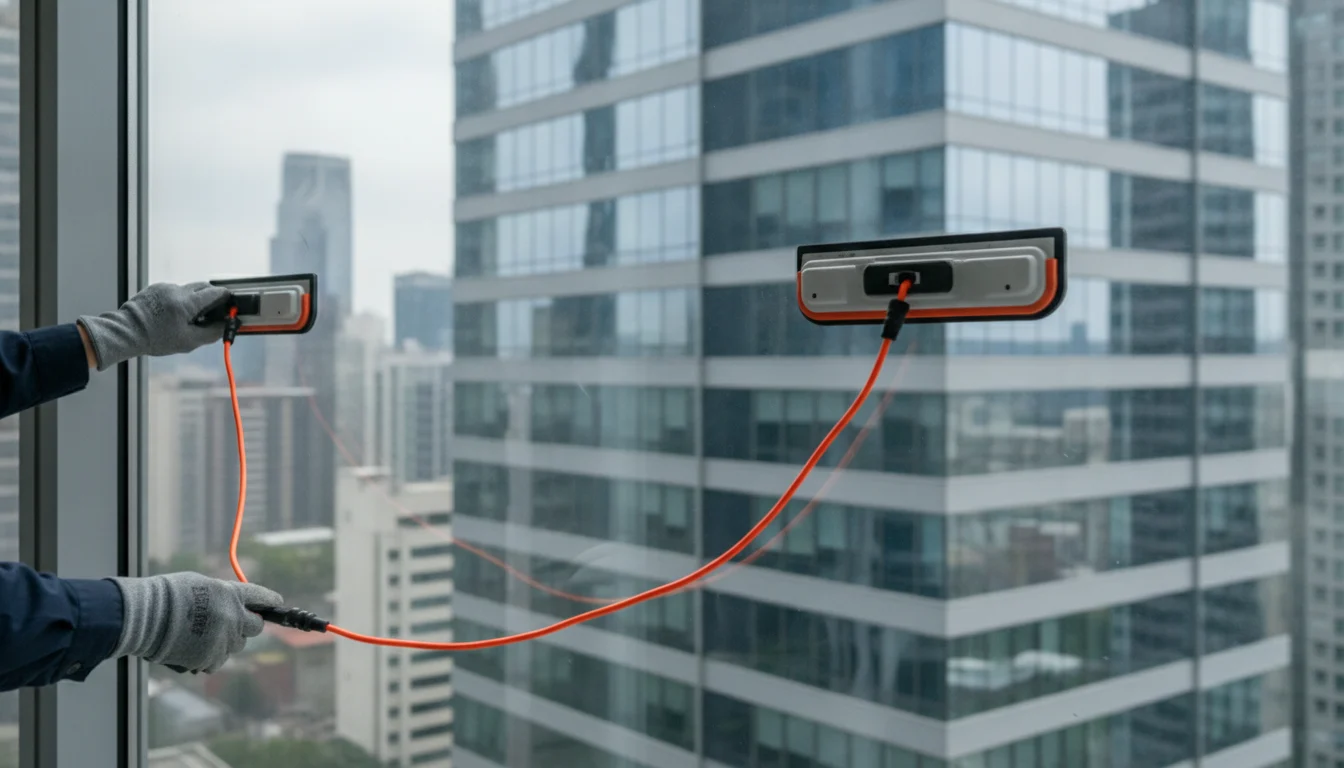
A common complaint documented in professional cleaning forums describes the outer magnetic unit instantly falling when moved vertically on high-rise windows, saved only by the safety strap. This failure mode occurs when operators use fixed-strength magnets rated for one glass thickness on a different specification, or when magnetic force degrades over time in lower-quality units.
The safety rope serves three distinct functions in commercial operations:
- Equipment retention: Prevents complete unit loss from heights, eliminating replacement cost and ground-level hazard liability when magnetic grip fails.
- Operator confidence: Allows cleaning staff to work at normal speed on vertical surfaces without constant fear of equipment drop, improving productivity by 15-25% in typical high-rise scenarios.
- Insurance compliance: Many commercial liability policies now require tethered tools for any work above ground level, making safety rope attachment a contractual necessity rather than optional feature.
In our 12,000 m² Taizhou factory with 400+ skilled workers, we’ve documented that magnetic force degradation accounts for 60% of field failures in units lacking proper neodymium magnet specifications. The safety rope compensates for this risk, but selecting equipment with correct initial magnetic strength remains the primary defense.
Safety Rope Magnetic Window Cleaner Factory Direct: Core Specifications
When sourcing safety rope magnetic window cleaner factory direct from manufacturing facilities, five specifications determine long-term performance and total cost of ownership.
Glass Thickness Compatibility Range
Thickness ratings like 5-12mm do not fit newer, thicker double glazing installed in commercial buildings after 2020. The 5-35mm range addresses this mismatch by covering single-pane (4-6mm), standard double-pane (18-24mm), and triple-pane (28-35mm) installations without requiring separate equipment inventory.
Our magnetic window cleaner product range uses 6-stage adjustable magnetic force to match the specific glass thickness at each job site. Stage 1-2 handles single-pane residential glass, stage 3-4 covers standard commercial double glazing, and stage 5-6 provides grip for triple-pane and laminated security glass.
Safety Rope Load Rating and Attachment Method
Industrial safety ropes for magnetic window cleaners must meet two criteria: minimum 15kg static load capacity and corrosion-resistant attachment hardware. Braided nylon rope with stainless steel carabiners provides the best combination of strength, flexibility, and weather resistance for outdoor commercial use.
The attachment point location matters. Rope secured to the inner unit frame (not the cleaning pad) prevents interference with pad rotation and ensures the tether activates before the outer unit can fall beyond arm’s reach.
Magnet Material and Degradation Rate
Reddit cleaning forums document that magnets lose power over time, and cheap versions are underpowered and not fit for purpose. Neodymium magnets retain 95%+ of rated strength after 24 months of daily commercial use, while ferrite and lower-grade neodymium materials degrade to 70-80% within 12 months.
Factory-direct sourcing allows verification of magnet grade through supplier documentation. ISO9001 certified facilities maintain batch traceability for magnetic components, enabling replacement under warranty if field strength testing reveals substandard materials.
Handle Ergonomics and Operator Fatigue
Professional cleaning teams report that large units are clumsy and miss corners, while small units leave smears. The optimal commercial size balances coverage area (reducing total strokes per window) against operator fatigue during 6-8 hour shifts.
Units with 280-320mm cleaning pad diameter provide the best compromise for commercial facade work. Rubberized handle grips with 32-38mm diameter reduce hand strain during extended vertical movement, and handle length of 180-220mm allows proper without excessive wrist flexion.
Certification and Compliance Documentation
CE marking is mandatory for cleaning equipment sold in the EU, and RoHS restricts each hazardous substance to below 0.1% by weight. Factory-direct suppliers should provide test reports from accredited laboratories showing compliance with EN 60335-1 (household electrical safety) and EN 50581 (RoHS technical documentation).
Our CE and ISO certified magnetic window cleaner line includes full technical files with material declarations, production process flowcharts, and final inspection protocols required for customs clearance into UK and EU markets.
Factory-Direct Procurement Advantages for B2B Buyers
Sourcing safety rope magnetic window cleaner factory direct from manufacturing facilities rather than through trading companies delivers four measurable benefits for distributors and facility management firms.
Cost Structure and Margin Improvement
Trading company markup typically adds 20-30% to factory gate price before units reach distributor or end-user buyers. Direct sourcing eliminates this intermediary layer, improving gross margin for distributors or reducing total acquisition cost for facility management firms buying for internal use.
A typical cost breakdown for 1,000-unit orders:
- Factory direct: Unit cost $8.50-12.00 FOB Ningbo depending on specification and customization level, plus international freight $0.80-1.20 per unit to UK ports.
Customization and Product Differentiation
Factory-direct relationships enable specification modifications that create competitive differentiation for distributor brands. Common customization requests include safety rope color coding by glass thickness rating, custom handle grip textures for specific market preferences, and bilingual instruction card printing for regional distribution.
Production facilities with 50,000+ unit daily capacity can typically accommodate custom specifications with 15-20% order quantity premium and 3-5 day additional lead time compared to standard SKUs. Trading companies rarely offer this flexibility, as they aggregate orders across multiple buyers and lack direct production floor access.
Quality Control and Specification Verification
Direct factory relationships allow pre-shipment inspection of production batches before container loading. Third-party inspection services charge $250-400 per factory visit, but this investment prevents receipt of off-specification goods that require return shipping or disposal.
Key inspection checkpoints for safety rope magnetic window cleaner factory direct orders:
- Magnetic force testing: Verify pull-away force at each adjustment stage using calibrated spring scale, confirming specification matches glass thickness rating.
- Safety rope load test: Apply 20kg static load for 60 seconds to sample units, checking for attachment point deformation or rope strand separation.
- Cleaning pad adhesion: Inspect microfiber pad attachment method and backing material thickness, as inadequate bonding causes pad separation during use.
- Packaging integrity: Confirm inner box cushioning prevents magnet-to-magnet contact during shipping, which can cause mutual demagnetization in transit.
In practice: A UK facility management distributor reduced product returns by 23% after implementing pre-shipment magnetic force testing for all factory-direct container orders
Lead Time and Inventory Flexibility
Large-scale manufacturing facilities maintain component inventory for standard models, enabling 7-14 day production lead time for orders up to 5,000 units. Trading companies typically quote 25-35 day lead times as they batch orders from multiple buyers to meet factory minimum quantities.
This lead time advantage allows distributors to operate with lower safety stock levels and respond faster to seasonal demand spikes. Window cleaning equipment sales in UK and Northern Europe peak during March-May (spring cleaning season) and September-October (pre-winter preparation), creating 40-60% sales concentration in these periods.
Evaluating Taizhou Manufacturing Clusters for Window Cleaning Equipment
Taizhou in Zhejiang province hosts China’s largest concentration of household cleaning equipment manufacturers, with 200+ factories producing magnetic window cleaners, mops, and related products. This geographic clustering creates supplier ecosystem advantages but also requires careful factory qualification.
Manufacturing Scale and Capacity Indicators
Production capacity directly correlates with quality consistency and delivery reliability for B2B orders. Facilities with 400+ workers and 12,000+ square meters of production space typically operate multiple assembly lines with dedicated quality control stations, reducing defect rates to below 0.5% compared to 2-4% in smaller workshops.
Observable capacity indicators during factory audits:
- Assembly line count: Minimum three parallel lines for magnetic window cleaner production indicates ability to fulfill 1,000+ unit daily orders without disrupting other customer commitments.
- Component inventory: On-site stock of magnets, ropes, handles, and cleaning pads sufficient for 15+ days of production signals financial stability and supply chain management capability.
- Packaging equipment: Automated or semi-automated inner box insertion and outer carton sealing machinery reduces packaging labor cost and improves shipping damage resistance.
- Quality testing stations: Dedicated magnetic force measurement equipment and sample retention areas indicate systematic quality control rather than visual inspection alone.
Export Experience and Documentation Capability
Factories with established export operations to 60+ countries maintain the documentation systems and logistics relationships required for smooth international shipping. This experience translates to faster customs clearance and lower risk of shipment delays due to incomplete paperwork.
Export capability verification checklist:
- Alibaba Gold Supplier status: Requires third-party verification of business license, export license, and production facility, providing baseline legitimacy confirmation.
- Previous UK/EU shipments: Request commercial invoice samples from past shipments to UK or EU buyers, confirming familiarity with HS code classification (8479.89.97 for magnetic window cleaners) and proper value declaration.
- Freight forwarder relationships: Established partnerships with international logistics providers in Ningbo port (50km from Taizhou) indicate reliable container booking and competitive freight rates.
- English documentation capability: Ability to provide instruction manuals, safety warnings, and technical specifications in grammatically correct English without machine translation artifacts.
Certification Authenticity and Audit Trail
CE and RoHS certificates should include test report numbers traceable to accredited testing laboratories. Fraudulent certificates remain common in cross-border trade, making independent verification essential for compliance-sensitive markets.
Certificate verification steps:
- Request full test reports, not just certificate summary pages, showing detailed measurement results for each tested parameter.
- Verify testing laboratory accreditation through ILAC (International Laboratory Accreditation Cooperation) database search using laboratory name and accreditation number.
- Cross-reference certificate issue date against factory production timeline, as certificates predating factory establishment indicate fraudulent documentation.
- For high-value orders, commission independent laboratory testing of pre-production samples to confirm compliance before bulk production authorization.
Minimum Order Quantities and Pricing Structure
Factory-direct pricing for safety rope magnetic window cleaner factory direct orders follows tiered structure based on order quantity, customization level, and payment terms.
OEM and Private Label Pricing Adjustments
Custom packaging and branding adds one-time tooling cost plus per-unit production premium. Typical structure for private-label safety rope magnetic window cleaner factory direct orders:
- Instruction card translation: $120-200 per language for professional technical translation and layout design, one-time cost.
Payment Terms and Trade Finance Options
Standard payment structure for new factory-direct relationships requires 30% deposit upon order confirmation and 70% balance before shipment, with payment via wire transfer or letter of credit. Established buyers with 3+ successful shipments may negotiate net-30 or net-60 terms with personal guarantee or trade credit insurance.
Payment security mechanisms for first-time orders:
- Alibaba Trade Assurance: Escrow service holding buyer payment until shipment verification, with refund protection for non-delivery or specification non-compliance up to order value.
- Inspection-contingent release: Structure payment so 70% balance releases only after third-party inspection approval, requiring factory agreement but providing quality assurance.
- Documentary letter of credit: Bank-guaranteed payment upon presentation of shipping documents, adding $300-600 in bank fees but eliminating payment default risk.
Shipping Logistics from Ningbo to UK Ports
Taizhou factories ship from Ningbo port, located 50km east of the manufacturing cluster. Container transit to UK ports (Felixstowe, Southampton, London Gateway) typically requires 28-35 days via standard ocean freight, or 22-26 days via express sailing services at 15-20% premium cost.
Container Loading and Freight Cost Structure
Magnetic window cleaners pack efficiently due to compact size and nested stacking capability. A standard 20-foot container accommodates 8,000-10,000 units depending on packaging size and protective cushioning requirements, while 40-foot high-cube containers hold 18,000-22,000 units.
Freight cost components for Ningbo to UK routes:
- Ocean freight: $1,800-2,600 per 20-foot container or $2,400-3,400 per 40-foot container depending on season and carrier, with peak season (August-October) commanding 25-40% premium over base rates.
- Port handling (Ningbo): $180-240 for container loading, customs documentation, and terminal handling charges.
- UK port charges: $220-320 for unloading, customs clearance, and delivery order issuance at destination port.
- Inland delivery: $150-400 from UK port to final warehouse depending on distance and whether full container load or de-consolidated shipment.
Customs Classification and Duty Rates
Magnetic window cleaners import under HS code 8479.89.97 (machines and mechanical appliances having individual functions, not specified elsewhere). UK import duty rate is 2.7% of declared value, plus 20% VAT calculated on combined value of goods, freight, insurance, and duty.
Total landed cost calculation example for 2,000-unit order:
Documentation Requirements for UK Customs
Post-Brexit UK customs clearance requires full commercial documentation even for goods originating outside the EU. Factory-direct suppliers should provide complete document package including commercial invoice with buyer and seller details, packing list with carton count and net/gross weights, certificate of origin, and product conformity declarations.
Common documentation errors that delay clearance:
- Undervalued invoices: Declaring artificially low unit prices to reduce duty payment triggers customs examination and potential penalty assessment, better to declare accurate value and pay correct duty.
- Generic product descriptions: Invoice line items reading “cleaning tools” rather than “magnetic window cleaner with safety rope, adjustable force, 5-35mm glass” may result in incorrect HS code classification and duty rate.
- Missing conformity marks: CE marking must appear on product, packaging, and conformity declaration document, with all three matching to avoid compliance questions.
Quality Assurance and Defect Management
Establishing clear quality standards and defect resolution procedures before order placement prevents disputes and ensures both parties understand acceptance criteria.
Pre-Production Sample Approval Process
Request pre-production samples (typically 2-3 units) manufactured using actual production tooling and materials, not hand-assembled prototypes. Test samples for magnetic force at each adjustment stage, safety rope load capacity, cleaning pad adhesion, and handle ergonomics under realistic use conditions.
Sample approval should be documented in writing with photos of tested units and measured specifications, creating reference standard for bulk production quality comparison. This documentation becomes critical if later production batches show specification drift.
During-Production Inspection Protocols
For orders above 2,000 units, commission during-production inspection when 30-50% of order quantity is complete. This mid-stream checkpoint catches systematic quality issues while sufficient production time remains for correction without delaying shipment.
Inspection focus areas for magnetic window cleaners:
- Magnetic force consistency: Test 3-5% of completed units across adjustment range, verifying pull-away force remains within ±10% of specification at each stage.
- Safety rope attachment security: Apply 15kg load to rope attachment point on sample units, checking for deformation, cracking, or pull-out under sustained tension.
- Component assembly quality: Inspect handle-to-body attachment, cleaning pad bonding, and magnet housing fit for gaps, misalignment, or inadequate fastening.
- Cosmetic finish: Check for injection molding flash, surface scratches, color consistency, and logo print quality against approved sample.
Defect Rate Thresholds and Remedy Procedures
Purchase contracts should specify acceptable quality level (AQL) and remedies for non-conforming goods. Standard AQL 2.5 allows 2.5% defective units in a shipment, with sampling plan determining inspection quantity based on lot size.
Defect remedy options to negotiate before order placement:
- Replacement shipment: Factory ships replacement units at no charge for defective quantity, buyer pays only freight cost for replacement shipment.
- Credit adjustment: Factory issues credit note for value of defective units, buyer disposes of defective goods locally or returns at factory expense.
- Spare parts supply: For minor defects (cosmetic issues, missing accessories), factory ships replacement components for local repair rather than full unit replacement.
- Rework authorization: Buyer performs repair or modification locally with factory reimbursing labor cost and parts at agreed rate per unit.
In practice: A facility management wholesaler in London established 1.5% AQL threshold with automatic 2% credit for any shipment exceeding defect rate, eliminating three months of dispute resolution that occurred on previous orders
UK Market Specific Considerations
UK window cleaning contractors and facility management buyers prioritize different features compared to Continental European or North American markets, reflecting local building stock characteristics and regulatory environment.
Glass Thickness Distribution in UK Building Stock
UK residential properties built before 2002 predominantly use 4mm single-pane glass, while double glazing installed 2002-2018 typically measures 20-24mm total thickness (two 4mm panes with 12-16mm air gap). Properties meeting current Building Regulations often use 28-32mm triple glazing or 24-28mm double glazing with low-E coating and argon fill.
This wide thickness distribution makes adjustable-force magnetic cleaners particularly valuable for UK distributors serving mixed building portfolios. Fixed-strength units require inventory of three separate SKUs to cover the installed base, while 6-stage adjustable models consolidate into single SKU with broader application range.
Health and Safety Executive Guidelines
HSE guidance on work at height requires employers to prevent falls through equipment selection and use procedures. While magnetic window cleaners operated from inside the building do not constitute work at height, the safety rope attachment addresses HSE’s expectation of foreseeable risk mitigation.
Distributors selling into UK commercial markets should provide documentation showing safety rope load testing and attachment point design, supporting buyer compliance with employer duty of care requirements under Health and Safety at Work Act 1974.
Seasonal Demand Patterns and Inventory Planning
UK window cleaning equipment sales peak in March-May (spring cleaning tradition) and September-October (preparation for winter weather limiting outdoor access). These two periods typically account for 55-65% of annual sales volume for distributors serving residential and light commercial markets.
Factory-direct buyers should plan container shipments to arrive 6-8 weeks before peak season start, allowing time for customs clearance, warehouse receiving, and distribution to retail or contractor customers. The 28-35 day ocean transit plus 7-14 day production lead time means orders for spring season should be placed by mid-January at latest.
Long-Term Supplier Relationship Management
Successful factory-direct sourcing relationships evolve from transactional first orders into strategic partnerships that deliver continuous improvement in quality, cost, and service level.
Performance Metrics and Continuous Improvement
Establish quantitative metrics tracked across multiple shipments to identify trends and improvement opportunities. Key performance indicators for magnetic window cleaner suppliers include on-time delivery rate (percentage of shipments arriving within agreed delivery window), defect rate per thousand units, and documentation accuracy (percentage of shipments with complete, error-free customs paperwork).
Quarterly performance reviews with factory management create forum for addressing systematic issues and recognizing consistent performance. Suppliers meeting performance targets over 12+ months become candidates for extended payment terms, reduced inspection intensity, or co-development of new product variants.
Product Development Collaboration
Factory-direct relationships enable input into product roadmap and specification modifications based on market feedback. Window cleaning contractors and facility managers often identify feature improvements through daily use that factory engineering teams can incorporate into next-generation designs.
Recent product improvements developed through buyer-factory collaboration include color-coded adjustment dials matching glass thickness ranges (eliminating need to consult instruction manual), quick-release safety rope attachment for faster equipment changes, and microfiber pad designs optimized for hard water areas common in UK Southeast region.
Capacity Allocation During High-Demand Periods
Factories operating at full capacity during peak season (August-October for spring season shipments) prioritize production slots for established buyers with consistent order history. New buyers placing first orders during peak periods may face 25-35 day lead times versus 10-14 days for established accounts.
Building long-term factory relationships ensures production capacity allocation when you need it most. Some buyers formalize this through annual purchase agreements specifying minimum order quantities across the year in exchange for guaranteed lead times and reserved capacity during peak periods.
Decision Framework for Factory Selection
Choosing among multiple factory-direct suppliers requires systematic evaluation across six dimensions that predict long-term partnership success.
- Production scale verification: Factory floor area above 10,000 m², workforce exceeding 300 workers, and daily capacity above 30,000 units indicate established operation with resources to fulfill bulk orders reliably.
- Export documentation capability: Previous shipments to UK or EU markets, English-language technical documentation, and familiarity with CE/RoHS compliance requirements reduce clearance delays and compliance risk.
- Quality system certification: ISO9001 certification from accredited registrar confirms documented quality procedures and management system maturity beyond basic manufacturing capability.
- Financial stability indicators: Alibaba Gold Supplier status, trade insurance availability, and willingness to accept letter of credit payment suggest adequate working capital and creditworthiness.
- Technical specification range: Ability to supply 5-35mm glass thickness range with adjustable magnetic force eliminates need to source from multiple factories for different specifications.
- Communication responsiveness: Reply time under 12 hours for technical inquiries, provision of detailed answers rather than generic responses, and proactive communication of production status updates.
Weight these factors according to your specific priorities. Distributors emphasizing product differentiation should prioritize OEM capability and specification customization, while facility management buyers purchasing for internal use may weight cost and lead time more heavily.
Next Steps for Procurement
Converting this safety rope magnetic window cleaner factory direct review into actionable procurement requires three concrete steps: specification definition, supplier shortlisting, and sample evaluation.
Define your technical requirements before contacting suppliers. Determine glass thickness range for your target market (single residential, commercial double-pane, or mixed), required safety rope load capacity, and any market-specific certification needs. Clarify initial order quantity and whether OEM customization is required, as these parameters drive pricing and lead time.
Shortlist 3-5 factories meeting your scale and certification criteria. Request detailed quotations including unit pricing at your target quantity, production lead time, payment terms, and shipping arrangements. Ask for references from buyers in similar markets and request copies of current CE and ISO9001 certificates with test reports.
Order pre-production samples from your top two factory candidates. Test samples under realistic use conditions, measuring magnetic force at each adjustment stage, verifying safety rope load capacity, and assessing cleaning performance on your target glass types. Document test results and use these as reference standard for bulk production specification.
Our production lines ship 50,000+ units per day to 60+ countries, with established logistics partnerships for reliable delivery to UK ports. ISO9001 quality systems and full CE/RoHS compliance documentation support smooth customs clearance and market entry.
Ready to source safety rope magnetic window cleaner factory direct with verified specifications and reliable delivery? Request a detailed quotation and pre-production sample for evaluation against your specific glass thickness and quality requirements.
Frequently Asked Questions
What is the minimum order quantity for factory-direct magnetic window cleaners with safety ropes?
Most established factories accept minimum orders of 100-200 units for standard models with safety rope attachment. This quantity fits within a single pallet for consolidated shipping and allows cost-effective production setup. Custom specifications or private-label packaging typically require 500-1,000 unit minimums to justify tooling costs. Larger facilities with diverse product lines may offer lower minimums by combining your order with other buyers’ production runs, though this extends lead time by 5-10 days.
How do I verify that factory-supplied CE certificates are authentic?
Request the complete test report, not just the certificate summary page, showing detailed measurement results and testing laboratory information. Verify the testing laboratory holds accreditation from a recognized body by searching the ILAC database using the laboratory name and accreditation number. Cross-reference the certificate issue date against the factory’s business registration date, as certificates predating factory establishment indicate fraudulent documentation. For high-value orders, commission independent testing of pre-production samples from an accredited UK or EU laboratory to confirm compliance before authorizing bulk production.
What glass thickness range should I specify for UK commercial buildings?
UK commercial buildings use predominantly 20-28mm double glazing, though older properties may have 4-6mm single pane and newer construction increasingly uses 28-35mm triple glazing. Adjustable-force magnetic cleaners rated for 5-35mm glass thickness cover this entire range with a single SKU, eliminating inventory complexity. Fixed-strength models require separate units for single-pane, standard double-pane, and triple-pane applications, tripling inventory investment and increasing risk of wrong-specification sales. The 6-stage adjustable design provides optimal magnetic grip across this range without equipment changes.
What is typical lead time from order placement to UK delivery?
Total lead time combines production (7-18 days depending on order size and customization), ocean freight from Ningbo to UK ports (28-35 days standard service, 22-26 days express), and customs clearance plus inland delivery (3-7 days). Plan for 45-60 days total from order confirmation to warehouse receipt for standard specifications, or 50-65 days for OEM orders requiring custom packaging setup. Peak season orders (August-October production for spring delivery) may extend lead times by 7-10 days due to factory capacity constraints. Express air freight reduces transit to 5-7 days but costs 4-6 times ocean freight rates.
How should safety rope load capacity be specified for commercial use?
Specify minimum 15kg static load capacity for safety ropes on commercial magnetic window cleaners, providing 3-4× safety factor over typical unit weight of 3.5-4.5kg. Braided nylon rope with 5mm diameter offers best combination of strength, flexibility, and weather resistance for outdoor use. Attachment hardware should use stainless steel carabiners or D-rings rather than plastic clips, as metal hardware maintains strength over multi-year service life. Request load test documentation showing the rope-attachment assembly withstood specified load for 60 seconds without deformation, confirming design meets safety requirements for commercial applications.
Written by the Fonoran Export Team.