Magnetic Window Cleaner Sampling Policy OEM Factory China (2026 Guide)
A magnetic window cleaner sampling policy oem factory china typically offers stock-model samples starting from 2 units with courier shipping at buyer cost, while private-label and custom orders require 500-unit minimum order quantities and tooling fees for new molds. Sample fees are often credited against the first production order when agreed in writing, and buyers should confirm glass thickness compatibility, magnetic force rating, and compliance documentation before approving any sample for bulk production.
Executive Summary
- Stock-model sampling: Factories ship ready-made units from 2 pieces upward, with buyers covering courier costs and the unit price; ideal for testing magnetic force and glass fit before committing to container volumes.
- Private-label minimum: Custom packaging, logo placement, and color changes commonly require 500-unit production runs, with sample approval preceding bulk manufacturing.
- Tooling and mold costs: New handle shapes, frame designs, or proprietary mechanisms trigger project-specific tooling fees and higher MOQs, quoted case by case.
- Sample-fee credit: Reputable suppliers deduct sample costs from the first production order when the buyer places a confirmed purchase order within an agreed timeframe, reducing upfront risk.
- Compliance verification: Buyers should request CE test reports, material safety data sheets, and packaging compliance documents during the sampling stage to avoid import delays and regulatory penalties.
Stock-Model Sampling Terms
Most magnetic window cleaner factories in Taizhou and Ningbo maintain ready-to-ship inventory of their standard SKU range. Stock samples let buyers verify magnetic strength, cleaning-pad adhesion, safety-cord tensile strength, and packaging quality without waiting for custom production.
Minimum Order Quantity for Stock Samples
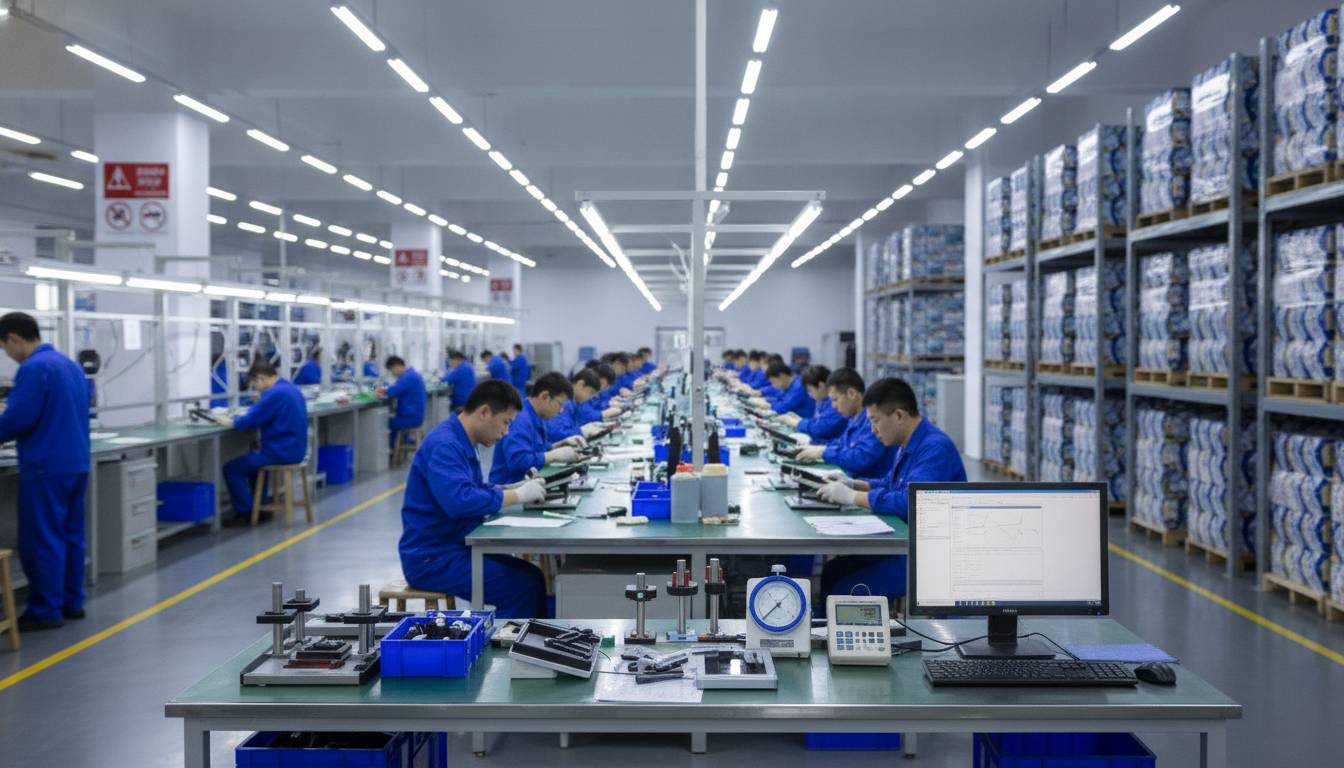
Our 6,500 m² Taizhou facility ships stock-model magnetic window cleaners from 2 units upward, allowing distributors and facility-management buyers to test one unit on single-glazed glass and a second on double-pane windows before scaling to wholesale volumes. Smaller suppliers may require 10 or 20 units as a minimum, which increases upfront cost and storage burden for buyers conducting multi-supplier trials.
Sample Pricing and Shipping
Stock-sample unit prices typically match the lowest published tier on the supplier’s price list, with no bulk discount applied. Courier shipping via DHL, FedEx, or UPS is charged at cost, commonly ranging from $25 to $60 for a 2-kilogram parcel to Europe or North America, depending on the destination postal code and the carrier’s fuel surcharge. Buyers should request a commercial invoice that separates the product cost from the freight charge, simplifying customs clearance and duty calculation.
Lead Time for Stock Samples
Ready-made samples ship within 1 to 3 business days of payment confirmation. Transit time depends on the courier service selected: express air freight reaches most European capitals in 3 to 5 days, while economy air service may take 7 to 10 days. Buyers planning trade-show demonstrations or seasonal product launches should add a 2-day buffer for customs inspection at the destination port.
Private-Label Sampling Requirements
Private-label programs allow distributors to sell magnetic window cleaners under their own brand name, with custom packaging, logo placement, and color schemes. The magnetic window cleaner sampling policy oem factory china for private-label orders differs materially from stock-model terms because tooling, artwork approval, and production setup are involved.
Minimum Order Quantity for Private Label
Our private-label program requires 500 units per SKU as the baseline production run. This MOQ covers the cost of custom carton printing, blister-pack tooling, and label die-cutting. Buyers who need multiple SKUs, for example, a 5-35 mm model and an 8-40 mm model, can split the 500-unit minimum across two thickness ranges, but each SKU must meet a 250-unit sub-minimum to justify the plate-making cost.
Sample Approval and Revision Cycles
Private-label sampling follows a three-stage approval process. First, the factory produces a blank prototype using the buyer’s specified color and material, shipped for structural approval. Second, the buyer submits print-ready artwork in vector format, and the factory prints a packaging proof for color and text verification. Third, the factory assembles a full retail-ready sample with the approved packaging, product insert, and barcode label, which the buyer tests and photographs for e-commerce listings. Each revision cycle adds 5 to 7 days to the overall timeline, so buyers should finalize artwork and Pantone color codes before requesting the first sample.
Tooling Fees and Ownership
Custom packaging requires printing plates, die-cutting molds, and blister-forming tools. Tooling fees range from $150 to $800 depending on the complexity of the carton design and the number of print colors. Buyers should confirm in writing whether the tooling fee is a one-time charge or amortized across the first production order, and whether the buyer or the factory owns the molds after payment. Tooling ownership matters when a buyer switches suppliers or launches a second product line using the same packaging template.
Custom OEM and New-Mold Projects
Buyers with proprietary designs, patented mechanisms, or unique handle shapes enter the custom OEM category. The magnetic window cleaner sampling policy oem factory china for these projects is quoted case by case because mold-making, material sourcing, and engineering validation are project-specific.
Engineering Sample and Prototype Development
Custom projects begin with an engineering sample that validates the mechanical design, magnetic circuit, and assembly sequence. The factory’s R&D team reviews the buyer’s technical drawings, suggests material substitutions to reduce cost or improve durability, and produces a hand-built prototype within 15 to 20 days. This prototype is not production-ready; it serves to confirm that the design is manufacturable at the target cost and meets the buyer’s performance specifications.
Mold-Making Costs and Production MOQ
Injection molds for custom handle shapes, frame components, or locking mechanisms cost between $2,000 and $8,000 per cavity, depending on the part size, tolerance requirements, and expected production volume. A two-cavity mold doubles the tooling cost but halves the per-unit cycle time, making it economical for orders above 5,000 units. Custom-mold projects typically require a 1,000 to 3,000 unit first production run to amortize the tooling investment, and buyers should negotiate mold ownership and storage terms before authorizing mold fabrication.
Material and Component Sourcing
Custom designs may specify materials not stocked by the factory: food-grade silicone for cleaning pads, UV-resistant ABS for outdoor housings, or stainless-steel safety cords for corrosive environments. The factory sources these materials from third-party suppliers, which adds 10 to 15 days to the sampling timeline and increases the unit cost by 8% to 15% compared to standard materials. Buyers should provide material datasheets or reference standards (such as FDA CFR 21 for silicone or ASTM D4329 for UV resistance) to ensure the sourced material meets the intended application.
Sample-Fee Credit and Refund Policy
The most common buyer question about the magnetic window cleaner sampling policy oem factory china is whether the sample fee is refunded or credited. Policies vary by supplier, and buyers should confirm the terms in writing before paying the sample invoice.
Credit Against First Production Order
Our standard policy credits the full sample cost, including the unit price and courier fee, against the buyer’s first production order of 500 units or more, provided the order is placed within 90 days of sample shipment. The credit appears as a line-item deduction on the proforma invoice, reducing the deposit amount due. Buyers who order smaller quantities or place the production order after the 90-day window pay the sample cost outright, with no credit applied.
Non-Refundable Tooling and Artwork Fees
Tooling fees for custom molds, printing plates, and packaging dies are non-refundable once the factory begins fabrication, even if the buyer cancels the project or rejects the sample. Buyers should review and approve all technical drawings, material specifications, and artwork proofs before authorizing tooling payment. If a sample fails to meet the agreed specifications due to factory error, such as incorrect magnetic force, wrong color, or defective assembly, the factory bears the cost of a replacement sample and any tooling rework.
Failed Sample and Revision Terms
When a sample fails the buyer’s quality test, the buyer should document the specific failure mode (weak magnet, poor pad adhesion, safety-cord breakage, or packaging defect) with photographs and measurement data. The factory then determines whether the failure resulted from a design flaw, a material defect, or a misunderstanding of the buyer’s requirements. If the factory is at fault, it produces a revised sample at no charge. If the buyer changes the design specification after the first sample, the buyer pays for the revision and any additional tooling.
Glass Thickness Compatibility Testing
Magnetic window cleaners rely on precise matching between glass thickness and magnetic force. A unit designed for 5 mm single-pane glass will lose its grip on 28 mm double-glazed units, and a unit tuned for 40 mm insulated glass may exert excessive force on thin panes, cracking the glass or damaging the frame seal.
Measuring Glass Thickness Accurately
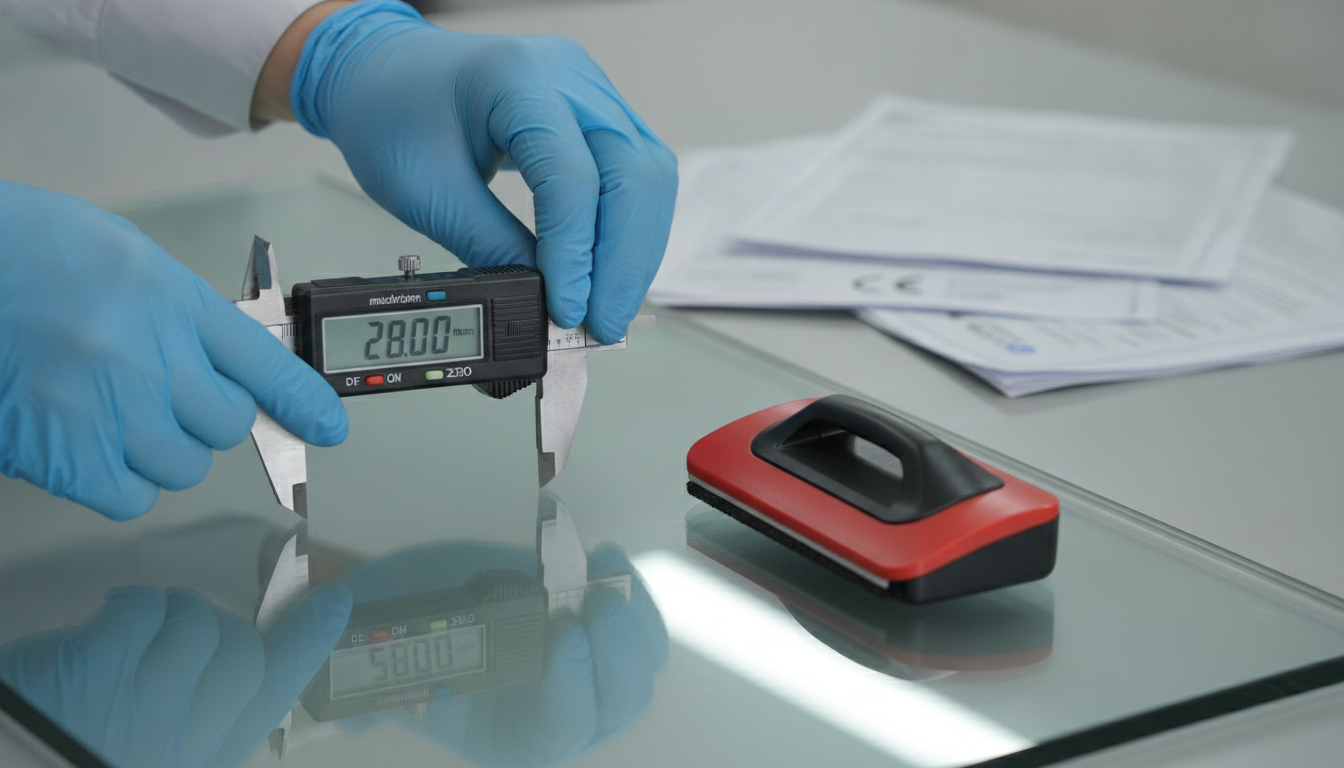
Buyers should measure glass thickness with a digital caliper at three points along the window edge, taking the maximum reading as the design value. Double-glazed units have two panes separated by an air gap or argon-filled spacer; the total thickness includes both panes plus the spacer. Insulated glass units (IGUs) may have a third pane or a low-emissivity coating that affects magnetic permeability, so buyers should request a sample that matches the thickest glazing type in their target market.
Adjustable Magnetic Force Range
Our 6-stage adjustable magnetic force system covers 3-45 mm glass thickness across four SKUs: 3-30 mm, 5-35 mm, 8-40 mm, and 10-45 mm. Each SKU uses NdFeB magnets with a specific pole spacing and flux density, allowing the user to dial the force up or down by rotating the adjustment knob. Buyers serving mixed-glazing markets, such as Europe, where single-pane heritage windows coexist with modern double-glazed units, should sample at least two SKUs to verify compatibility across the full thickness range.
Common Glass-Compatibility Failures
Buyers report that weak magnetic force and outdoor-piece detachment are the most common failure modes when the cleaner is mismatched to the glass. A Belgium reviewer noted that a cleaner marketed for thick glass failed on an 18 mm window and could not remove dirt effectively. Another buyer observed that the outdoor piece fell off during use despite measuring the window correctly, suggesting that the magnetic circuit was under-specified for the glass type. These failures underscore the importance of testing samples on the actual glazing the buyer’s customers will encounter, not just the nominal thickness listed in the product catalog.
In practice: A home user in Germany with 36 mm insulated glass needed an adjustable magnetic window cleaner; 36 mm sits inside the FN-Ultra 10-45 mm SKU with room to spare.
Compliance Documentation and Test Reports
Importing magnetic window cleaners into the European Union, United Kingdom, North America, or Australia requires specific compliance documentation. Buyers should request these documents during the sampling stage to avoid customs holds, retailer rejections, or regulatory fines.
CE Certification and Test Reports
Our magnetic window cleaners carry CE certification issued by Shenzhen Wuxiang Testing (certificate number WUX202105142249ENC), covering the Low Voltage Directive and General Product Safety Directive. The test report documents mechanical strength, electrical safety (for any battery-powered accessories), and chemical compliance for materials in contact with cleaning fluids. Buyers should verify that the certificate lists the exact model number and SKU they intend to import, because a certificate issued for a 5-35 mm SKU does not cover an 8-40 mm variant unless both are tested.
Material Safety and Restricted Substances
European and North American buyers often request material safety data sheets (MSDS) for cleaning pads, handle plastics, and packaging inks. While our factory does not hold a RoHS declaration, buyers can request third-party test reports for heavy metals (lead, cadmium, mercury) and phthalates if their retail customers or regulatory authorities require them. Buyers should specify which substances and test methods apply in their market, such as EN 71-3 for toys or California Proposition 65 for consumer goods, so the factory can source compliant materials and arrange the appropriate tests.
Packaging and Labeling Requirements
EU buyers must ensure that packaging displays the CE mark, importer name and address, and recycling symbols in accordance with the Packaging and Packaging Waste Directive. UK buyers need UKCA marking post-Brexit, and Australian buyers require compliance with the Competition and Consumer Act labeling standards. The factory can print these marks on the retail carton or apply adhesive labels, but buyers must supply the artwork and confirm that the text meets local-language and font-size requirements.
Payment Terms and Order Confirmation
Once the buyer approves the sample, the next step is negotiating payment terms, lead time, and shipping arrangements for the bulk order. The magnetic window cleaner sampling policy oem factory china sets the foundation for these commercial terms, but buyers should clarify every detail in writing before issuing a purchase order.
Deposit and Balance Structure
Payment terms are confirmed at quotation and vary by order size, buyer credit history, and destination country. Buyers should request a proforma invoice that itemizes the unit price, packaging cost, tooling amortization (if applicable), and freight estimate, along with the deposit percentage and balance-due milestone. The proforma invoice serves as the binding commercial agreement, so buyers should review it line by line and request amendments before signing.
Production Lead Time
Lead time depends on whether the order uses stock materials or requires custom sourcing. Stock-model orders of 500 to 2,000 units typically ship within 15 to 25 days of deposit receipt. Private-label orders with custom packaging add 10 to 15 days for artwork approval and plate-making. Custom-mold projects require 30 to 45 days for mold fabrication, plus 20 to 30 days for production and quality inspection. Buyers with fixed launch dates or seasonal deadlines should add a 10-day buffer for unexpected delays such as material shortages, public holidays, or port congestion.
Incoterms and Shipping Arrangements
Our factory ships from Ningbo port, 120 kilometers from the Taizhou production facility. Buyers can choose EXW (factory pickup), FOB Ningbo (factory loads the container and covers inland freight), or CIF destination port (factory arranges ocean freight and insurance). An Australian buyer recently switched the quotation from EXW to FOB and requested delivery costing to four ports across Australia, illustrating how Incoterms selection affects the landed cost and the buyer’s logistics workload. Buyers with their own freight forwarders often prefer EXW or FOB to retain control over the shipping schedule and carrier selection.
Batch Consistency and Ongoing Quality
A single approved sample does not guarantee that every unit in a 5,000-piece production run will meet the same standard. Buyers should specify batch-consistency requirements and inspection protocols in the purchase order to minimize the risk of quality drift.
Pre-Production Sample Approval
Before starting bulk manufacturing, the factory produces a pre-production sample using the same materials, molds, and assembly line that will be used for the full order. The buyer inspects this sample, either in person at the factory or via photographs and measurements, and issues written approval before the factory begins mass production. This step catches any deviations from the original sample, such as a color shift caused by a different plastic-resin batch or a magnetic-force drop due to a substitute magnet supplier.
During-Production and Pre-Shipment Inspection
Buyers can hire a third-party inspection company to visit the factory during production and verify that the assembly process matches the approved specifications. The inspector checks a random sample of finished units for magnetic force, pad adhesion, safety-cord tensile strength, and packaging integrity, then issues a pass/fail report within 24 hours. If the inspection fails, the factory reworks or replaces the defective units before shipping. Pre-shipment inspection is especially valuable for first-time buyers who have not yet established a quality track record with the supplier.
Warranty and After-Sales Support
Warranty terms for magnetic window cleaners typically cover manufacturing defects such as magnet demagnetization, handle cracking, or cord fraying, but exclude damage from misuse, improper storage, or use on glass thicker than the rated range. Buyers should confirm the warranty period (commonly 6 to 12 months from the shipping date), the claim process, and whether the factory provides replacement parts such as spare cleaning pads, safety cords, or adjustment knobs. Clear warranty terms reduce the buyer’s after-sales support burden and protect the buyer’s brand reputation when selling to end users.
Key Decision Criteria
Evaluating a magnetic window cleaner sampling policy oem factory china requires balancing cost, lead time, quality assurance, and commercial flexibility. Buyers should compare multiple suppliers on these dimensions before committing to a sample order.
Buyers should request a written quotation that specifies the MOQ, sample cost, tooling fees, lead time, payment terms, and sample-credit policy before placing a sample order. Verbal agreements and vague email exchanges lead to disputes when the buyer scales to production volumes, so every commercial term should appear in the proforma invoice or a signed sampling agreement.
Frequently Asked Questions
Do Chinese OEM factories refund sample fees after a bulk order?
Most reputable factories credit the sample fee against the first production order rather than issuing a cash refund. The credit appears as a line-item deduction on the proforma invoice, reducing the deposit amount due. Buyers should confirm the credit policy in writing before paying the sample invoice, and verify that the policy specifies a minimum order quantity and a time window within which the production order must be placed. Factories that refuse to credit sample fees or impose unrealistic minimum-order thresholds may lack confidence in their product quality or commercial stability.
How long does it take to receive an OEM sample from China?
Stock-model samples ship within 1 to 3 business days of payment confirmation and reach most European and North American destinations in 3 to 7 days via express courier. Private-label samples require 10 to 15 days for artwork approval and packaging proof, plus 3 to 5 days for courier transit. Custom-mold samples take 15 to 20 days for prototype fabrication, followed by courier shipping. Buyers planning trade shows, seasonal launches, or retailer submission deadlines should add a 2-day buffer for customs inspection and a 5-day buffer for any sample revisions.
What should buyers test before approving a magnetic window cleaner sample?
Buyers should test magnetic force retention across the full glass-thickness range, cleaning-pad adhesion to the inner and outer frames, safety-cord tensile strength under load, and handle ergonomics during extended use. The sample should be tested on the actual glazing type the buyer’s customers will encounter, single-pane, double-glazed, or insulated units, because magnetic permeability varies with glass coatings and air-gap spacing. Buyers should also inspect packaging integrity, label legibility, and instruction-manual clarity, because these elements affect the end-user experience and the retailer’s willingness to stock the product.
Ready to request a sample that matches your glass thickness and compliance requirements? Contact our export team for a detailed quotation covering MOQ, lead time, tooling costs, and sample-credit terms tailored to your market.
Written by the Fonoran Export Team.